

202
S. MENGE et al.
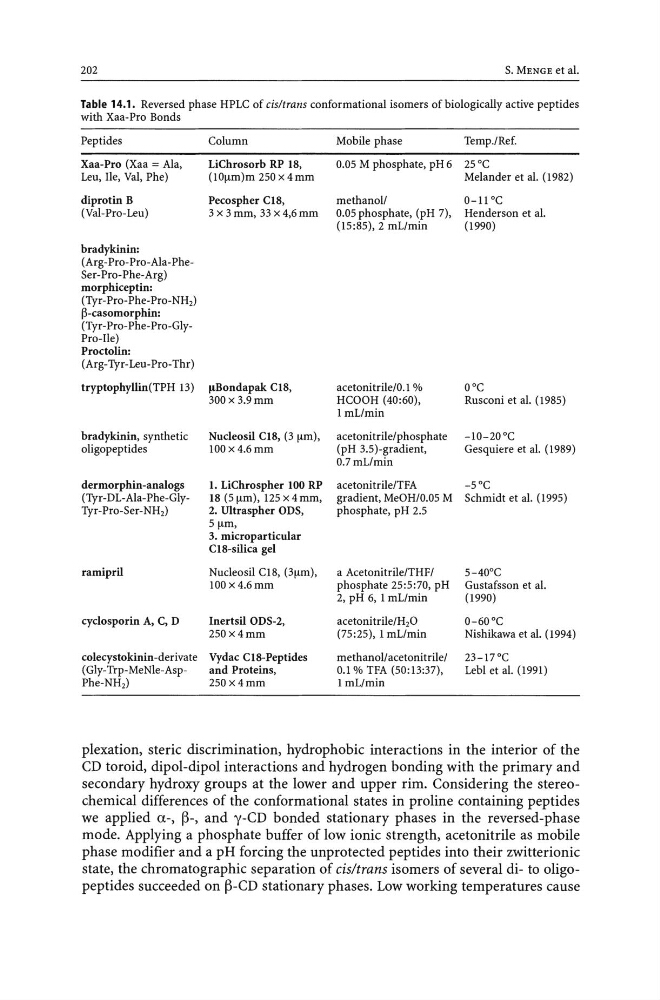
Table 14.1. Reversed phase HPLC of cis/trans conformational isomers of biologically active peptides
with Xaa-Pro Bonds
Peptides
Column
Mobile phase
Temp.lRef.
Xaa-Pro (Xaa = Ala,
LiChrosorb RP IS,
0.05 M phosphate, pH 6 25°C
Leu, lie, Val, Phe)
(10[lm)m 2s0x4mm
Melander et al. (1 9S2)
diprotin B
Pecospher CIS,
methanol!
O-ll °C
(Val-Pro-Leu)
3x3mm,33x4,6mm
0.05 phosphate, (pH 7), Henderson et al.
(1s:Ss), 2 mLlmin
(1990)
bradykinin:
(Arg-Pro-Pro-Ala-PheSer-Pro-Phe-Arg)
morphiceptin:
(Tyr-Pro-Phe-Pro-NH2)
j3-casomorphin:
(Tyr-Pro-Phe-Pro-GlyPro-lie)
Proctolin:
(Arg-Tyr-Leu-Pro-Thr)
tryptophyllin(TPH 13) /lBondapak CIS,
acetonitrile/O.l %
O°C
300x3.9mm
HCOOH (40:60),
Rusconi et al. (1985)
1 mLlmin
bradykinin, synthetic
Nucleosil CIS, (3 [lm), acetonitrile/phosphate -1O-20°C
oligo pep tides
100x4.6mm
(pH 3.s)-gradient,
Gesquiere et al. (1989)
0.7mLlmin
dermorphin-analogs
1. LiChrospher 100 RP acetonitrile/TFA
-5°C
(Tyr-DL-Ala-Phe-Gly18 (5 [lm), 125 x 4 mm, gradient, MeOH/O.Os M Schmidt et al. (1995)
Tyr-Pro-Ser-NH2)
2. Ultraspher ODS,
phosphate, pH 2.5
5 [lm,
3. microparticular
C 18-silica gel
ramipril
Nucleosil C18, (3[lm),
a Acetonitrile/THF/
S-40°C
100x4.6mm
phosphate 25:5:70, pH Gustafsson et al.
2, pH 6, I mLlmin
(1990)
cyclosporin A, C, D
Inertsil ODS-2,
acetonitrile/H2O
0-60°C
2s0x4mm
(75:25), I mLlmin
Nishikawa et al. (1994)
colecystokinin-derivate Vydac CIS-Peptides
methanol/ acetonitrile/
23-17°C
(Gly-Trp-MeNle-Aspand Proteins,
0.1 % TFA (50: 13:37),
Lebl et al. (1991)
Phe-NH2)
2s0x4mm
ImLlmin
plexation, steric discrimination, hydrophobic interactions in the interior of the
CD toroid, dipol-dipol interactions and hydrogen bonding with the primary and
secondary hydroxy groups at the lower and upper rim. Considering the stereochemical differences of the conformational states in proline containing peptides
we applied a-, ~-, and y-CD bonded stationary phases in the reversed-phase
mode. Applying a phosphate buffer of low ionic strength, acetonitrile as mobile
phase modifier and a pH forcing the unprotected peptides into their zwitterionic
state, the chromatographic separation of cis/trans isomers of several di- to oligopeptides succeeded on ~-CD stationary phases. Low working temperatures cause
S. MENGE et al.
Table 14.1. Reversed phase HPLC of cis/trans conformational isomers of biologically active peptides
with Xaa-Pro Bonds
Peptides
Column
Mobile phase
Temp.lRef.
Xaa-Pro (Xaa = Ala,
LiChrosorb RP IS,
0.05 M phosphate, pH 6 25°C
Leu, lie, Val, Phe)
(10[lm)m 2s0x4mm
Melander et al. (1 9S2)
diprotin B
Pecospher CIS,
methanol!
O-ll °C
(Val-Pro-Leu)
3x3mm,33x4,6mm
0.05 phosphate, (pH 7), Henderson et al.
(1s:Ss), 2 mLlmin
(1990)
bradykinin:
(Arg-Pro-Pro-Ala-PheSer-Pro-Phe-Arg)
morphiceptin:
(Tyr-Pro-Phe-Pro-NH2)
j3-casomorphin:
(Tyr-Pro-Phe-Pro-GlyPro-lie)
Proctolin:
(Arg-Tyr-Leu-Pro-Thr)
tryptophyllin(TPH 13) /lBondapak CIS,
acetonitrile/O.l %
O°C
300x3.9mm
HCOOH (40:60),
Rusconi et al. (1985)
1 mLlmin
bradykinin, synthetic
Nucleosil CIS, (3 [lm), acetonitrile/phosphate -1O-20°C
oligo pep tides
100x4.6mm
(pH 3.s)-gradient,
Gesquiere et al. (1989)
0.7mLlmin
dermorphin-analogs
1. LiChrospher 100 RP acetonitrile/TFA
-5°C
(Tyr-DL-Ala-Phe-Gly18 (5 [lm), 125 x 4 mm, gradient, MeOH/O.Os M Schmidt et al. (1995)
Tyr-Pro-Ser-NH2)
2. Ultraspher ODS,
phosphate, pH 2.5
5 [lm,
3. microparticular
C 18-silica gel
ramipril
Nucleosil C18, (3[lm),
a Acetonitrile/THF/
S-40°C
100x4.6mm
phosphate 25:5:70, pH Gustafsson et al.
2, pH 6, I mLlmin
(1990)
cyclosporin A, C, D
Inertsil ODS-2,
acetonitrile/H2O
0-60°C
2s0x4mm
(75:25), I mLlmin
Nishikawa et al. (1994)
colecystokinin-derivate Vydac CIS-Peptides
methanol/ acetonitrile/
23-17°C
(Gly-Trp-MeNle-Aspand Proteins,
0.1 % TFA (50: 13:37),
Lebl et al. (1991)
Phe-NH2)
2s0x4mm
ImLlmin
plexation, steric discrimination, hydrophobic interactions in the interior of the
CD toroid, dipol-dipol interactions and hydrogen bonding with the primary and
secondary hydroxy groups at the lower and upper rim. Considering the stereochemical differences of the conformational states in proline containing peptides
we applied a-, ~-, and y-CD bonded stationary phases in the reversed-phase
mode. Applying a phosphate buffer of low ionic strength, acetonitrile as mobile
phase modifier and a pH forcing the unprotected peptides into their zwitterionic
state, the chromatographic separation of cis/trans isomers of several di- to oligopeptides succeeded on ~-CD stationary phases. Low working temperatures cause