

A New Method for the Isolation of the (-Terminal Peptide of Proteins
179
In 1990, Wetzel et al. reported the best conditions to achieve the highly selective blocking of the amino terminal groups of peptides. The selectivity of this
reaction is based on the difference between the pK of the E amino groups of the
side chain of lysine and the amino terminal groups of the peptides. At pH 6.0,
due to its higher basicity, the E amino groups of lysine residues are predominantly protonated, while the amino terminal groups are not. This is the reason
why the reaction occurs preferably through the amino terminal group of peptides.
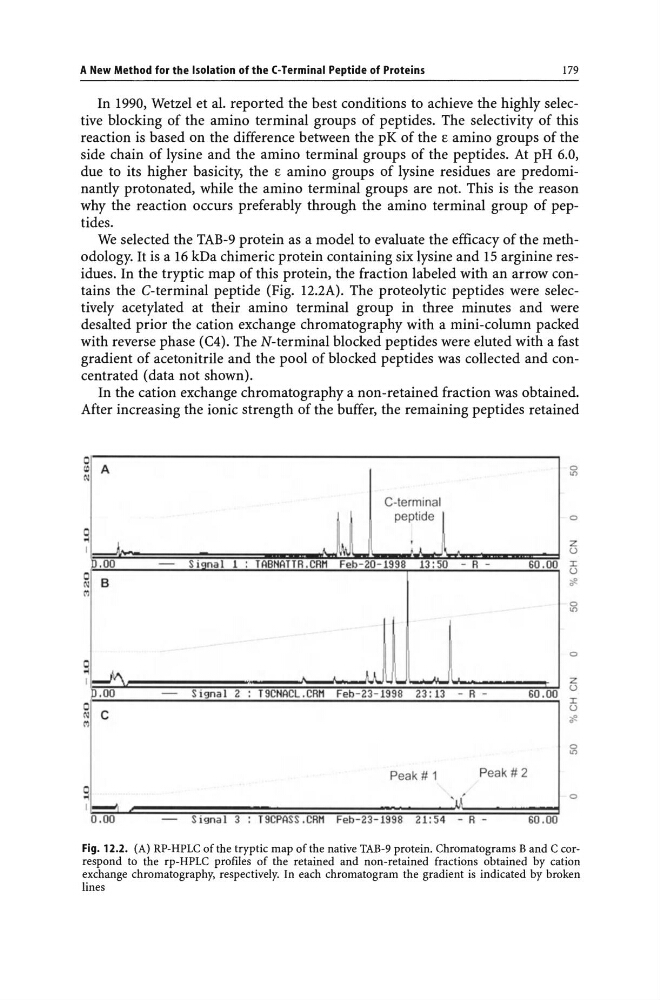
We selected the TAB-9 protein as a model to evaluate the efficacy of the methodology. It is a 16 kDa chimeric protein containing six lysine and 15 arginine residues. In the tryptic map of this protein, the fraction labeled with an arrow contains the C-terminal peptide (Fig. 12.2A). The proteolytic peptides were selectively acetylated at their amino terminal group in three minutes and were
desalted prior the cation exchange chromatography with a mini-column packed
with reverse phase (C4). The N-terminal blocked peptides were eluted with a fast
gradient of acetonitrile and the pool of blocked peptides was collected and concentrated (data not shown).
In the cation exchange chromatography a non-retained fraction was obtained.
After increasing the ionic strength of the buffer, the remaining peptides retained
0
(I)
A
~
S
j,
1
P ,OO
~ B
M
7--"-,,
p,oo
-
~ C
M
~
1 ~
0. 00
C-terminal
peptide
1M.
I
~,
Si gnal 1 : TABNATT R .C RM Feb-20- 1998 13: 50
R
JJ...
Signa l 2 : T 9CNACL. CRM Feb - 23 - 1998 23: 13 - R -
Peak # 1
Peak # 2
'LI
Signal 3 . T9CPASS.CRM Feb 23 1998 21.5 4 - R -
60.00
60,00
60.00
a
z
o
J:
o
*'
a
'"
a
z
o
J:
o
a
'"
a
Fig. 12.2. CAl RP-HPLC of the tryptic map of the native TAB-9 protein. Chromatograms Band C correspond to the rp-HPLC profiles of the retained and non-retained fractions obtained by cation
exchange chromatography, respectively. In each chromatogram the gradient is indicated by broken
lines
179
In 1990, Wetzel et al. reported the best conditions to achieve the highly selective blocking of the amino terminal groups of peptides. The selectivity of this
reaction is based on the difference between the pK of the E amino groups of the
side chain of lysine and the amino terminal groups of the peptides. At pH 6.0,
due to its higher basicity, the E amino groups of lysine residues are predominantly protonated, while the amino terminal groups are not. This is the reason
why the reaction occurs preferably through the amino terminal group of peptides.
We selected the TAB-9 protein as a model to evaluate the efficacy of the methodology. It is a 16 kDa chimeric protein containing six lysine and 15 arginine residues. In the tryptic map of this protein, the fraction labeled with an arrow contains the C-terminal peptide (Fig. 12.2A). The proteolytic peptides were selectively acetylated at their amino terminal group in three minutes and were
desalted prior the cation exchange chromatography with a mini-column packed
with reverse phase (C4). The N-terminal blocked peptides were eluted with a fast
gradient of acetonitrile and the pool of blocked peptides was collected and concentrated (data not shown).
In the cation exchange chromatography a non-retained fraction was obtained.
After increasing the ionic strength of the buffer, the remaining peptides retained
0
(I)
A
~
S
j,
1
P ,OO
~ B
M
7--"-,,
p,oo
-
~ C
M
~
1 ~
0. 00
C-terminal
peptide
1M.
I
~,
Si gnal 1 : TABNATT R .C RM Feb-20- 1998 13: 50
R
JJ...
Signa l 2 : T 9CNACL. CRM Feb - 23 - 1998 23: 13 - R -
Peak # 1
Peak # 2
'LI
Signal 3 . T9CPASS.CRM Feb 23 1998 21.5 4 - R -
60.00
60,00
60.00
a
z
o
J:
o
*'
a
'"
a
z
o
J:
o
a
'"
a
Fig. 12.2. CAl RP-HPLC of the tryptic map of the native TAB-9 protein. Chromatograms Band C correspond to the rp-HPLC profiles of the retained and non-retained fractions obtained by cation
exchange chromatography, respectively. In each chromatogram the gradient is indicated by broken
lines