

178
L. J. GONZALEZ et al.
2.3
Cation Exchange Chromatography
The cation exchange chromatography was performed on a centricon tube with
0.1 [1m pore size (MILLIPORE), containing approximately 50-100 [1L of the
anionic resin EMD-650 (5) 50 3 - (MERCK) or DEAE 5epharose Fast-Flow (Pharmacia). The N-terminal blocked peptides were dissolved in few [1L of the same
equilibrium buffer (H20/TFA 0.05 % containing 0.5 % of octyl glucoside) and
applied onto the resin. A short spin (10 secs.) was done in a small centrifuge
(- 6000 rpm) and the non-retained fraction was collected and analyzed by rpHPLC. The other peptides retained into the resin were eluted after passing a solution of H20/TFA 0.05 % containing NaCI (1 mo1!L).
3
Results and Discussion
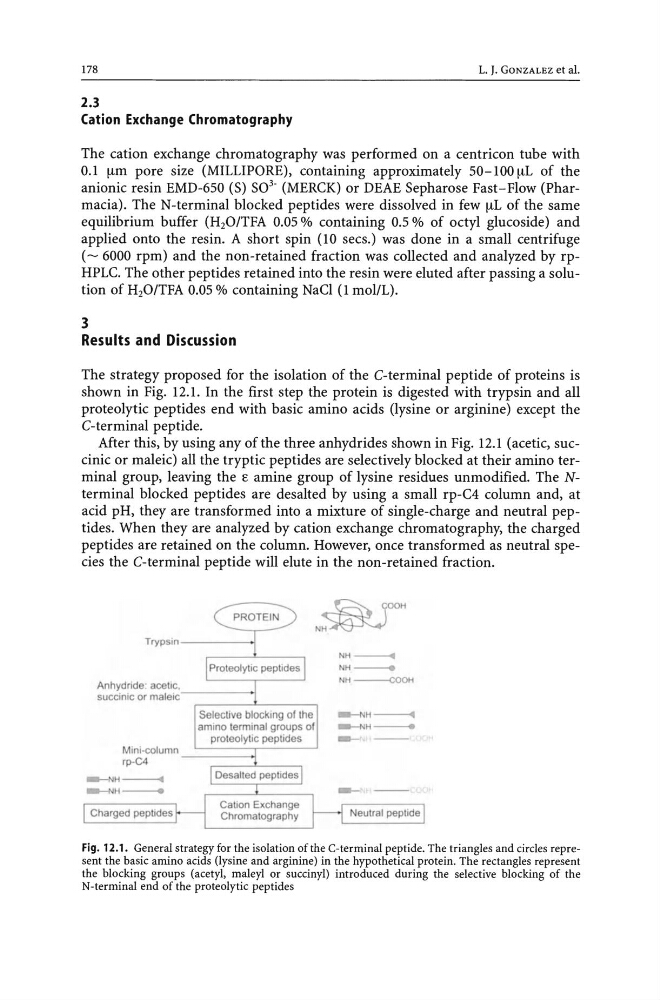
The strategy proposed for the isolation of the C-terminal peptide of proteins is
shown in Fig. 12.1. In the first step the protein is digested with trypsin and all
proteolytic peptides end with basic amino acids (lysine or arginine) except the
C-terminal peptide.
After this, by using any of the three anhydrides shown in Fig. 12.1 (acetic, succinic or maleic) all the tryptic peptides are selectively blocked at their amino terminal group, leaving the £ amine group of lysine residues unmodified. The Nterminal blocked peptides are desalted by using a small rp-C4 column and, at
acid pH, they are transformed into a mixture of single-charge and neutral peptides. When they are analyzed by cation exchange chromatography, the charged
peptides are retained on the column. However, once transformed as neutral species the C-terminal peptide will elute in the non-retained fraction.
~~OOH
N~
T r y p s l n - - - -_
Anhydride: acelic, _ _ _ _ - l
succiniC or maleic
Selective blocking of the
amino terminal groups of
proteolytic peptides
Mini-column ~====l-----'
rp-C4
---.NH _ _ _
- . - N H _
Charged peptldes
Calion Exchange
Chromatography
NH _ _ _
NH _
NH - C O O H
~H
_ _ _
_ _ NH _
-- - -
Fig. 12.1. General strategy for the isolation of the C-terminal peptide. The triangles and circles represent the basic amino acids (lysine and arginine) in the hypothetical protein. The rectangles represent
the blocking groups (acetyl, maleyl or succinyl) introduced during the selective blocking of the
N -terminal end of the proteolytic peptides
L. J. GONZALEZ et al.
2.3
Cation Exchange Chromatography
The cation exchange chromatography was performed on a centricon tube with
0.1 [1m pore size (MILLIPORE), containing approximately 50-100 [1L of the
anionic resin EMD-650 (5) 50 3 - (MERCK) or DEAE 5epharose Fast-Flow (Pharmacia). The N-terminal blocked peptides were dissolved in few [1L of the same
equilibrium buffer (H20/TFA 0.05 % containing 0.5 % of octyl glucoside) and
applied onto the resin. A short spin (10 secs.) was done in a small centrifuge
(- 6000 rpm) and the non-retained fraction was collected and analyzed by rpHPLC. The other peptides retained into the resin were eluted after passing a solution of H20/TFA 0.05 % containing NaCI (1 mo1!L).
3
Results and Discussion
The strategy proposed for the isolation of the C-terminal peptide of proteins is
shown in Fig. 12.1. In the first step the protein is digested with trypsin and all
proteolytic peptides end with basic amino acids (lysine or arginine) except the
C-terminal peptide.
After this, by using any of the three anhydrides shown in Fig. 12.1 (acetic, succinic or maleic) all the tryptic peptides are selectively blocked at their amino terminal group, leaving the £ amine group of lysine residues unmodified. The Nterminal blocked peptides are desalted by using a small rp-C4 column and, at
acid pH, they are transformed into a mixture of single-charge and neutral peptides. When they are analyzed by cation exchange chromatography, the charged
peptides are retained on the column. However, once transformed as neutral species the C-terminal peptide will elute in the non-retained fraction.
~~OOH
N~
T r y p s l n - - - -_
Anhydride: acelic, _ _ _ _ - l
succiniC or maleic
Selective blocking of the
amino terminal groups of
proteolytic peptides
Mini-column ~====l-----'
rp-C4
---.NH _ _ _
- . - N H _
Charged peptldes
Calion Exchange
Chromatography
NH _ _ _
NH _
NH - C O O H
~H
_ _ _
_ _ NH _
-- - -
Fig. 12.1. General strategy for the isolation of the C-terminal peptide. The triangles and circles represent the basic amino acids (lysine and arginine) in the hypothetical protein. The rectangles represent
the blocking groups (acetyl, maleyl or succinyl) introduced during the selective blocking of the
N -terminal end of the proteolytic peptides