

A MALDI-TOF Mass Spectrometry Approach to Investigate the Defense Reactions
165
As we were able to detect already characterized antimicrobial peptides in the
hemolymph of immune-challenged flies (namely the two glycoforms of drosocin,
metchnikowin and drosomycin) we used them as internal calibrants. With this
internal calibration, we assigned more accurate m/z to the unknown DIMs by
measuring them in reflector mode (Fig. 11.3). Although we could not reach
monoisotopic resolution, a better resolution was obtained with reflectron compared to the linear mode, but only for DIMs with a molecular mass below 5 kDa,
as fragmentations occurred for compounds of higher mass, as illustrated for drosomycin (see Fig. 11.3). The average masses were obtained with the following
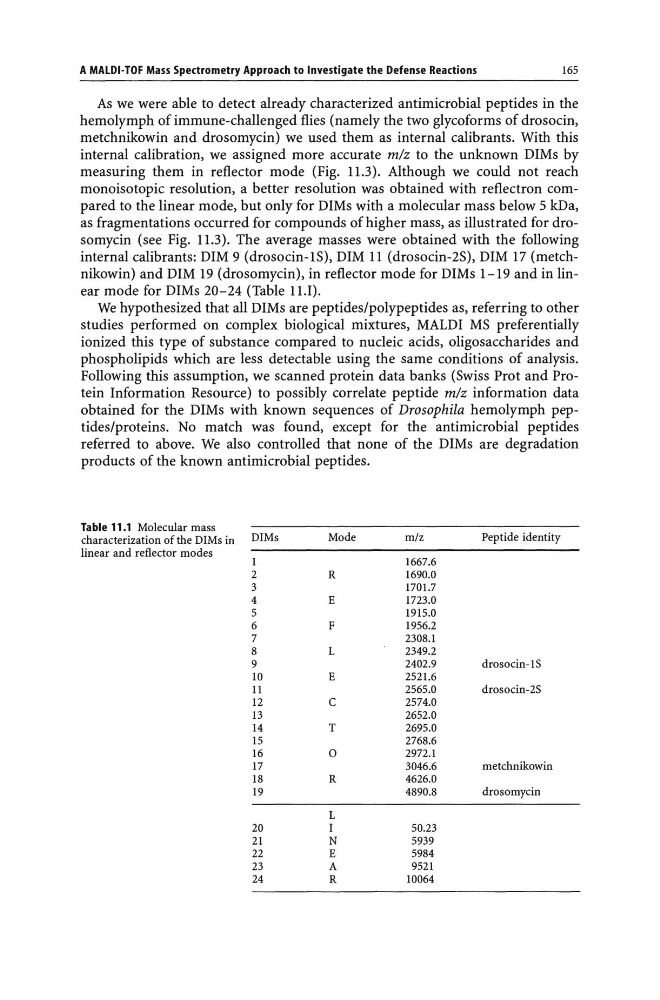
internal calibrants: DIM 9 (drosocin-lS), DIM 11 (drosocin-2S), DIM 17 (metchnikowin) and DIM 19 (drosomycin), in reflector mode for DIMs 1-19 and in linear mode for DIMs 20-24 (Table ILl).
We hypothesized that all DIMs are peptides/polypeptides as, referring to other
studies performed on complex biological mixtures, MALDI MS preferentially
ionized this type of substance compared to nucleic acids, oligo saccharides and
phospholipids which are less detectable using the same conditions of analysis.
Following this assumption, we scanned protein data banks (Swiss Prot and Protein Information Resource) to possibly correlate peptide m/z information data
obtained for the DIMs with known sequences of Drosophila hemolymph peptides/proteins. No match was found, except for the antimicrobial peptides
referred to above. We also controlled that none of the DIMs are degradation
products of the known antimicrobial peptides.
Table 11.1 Molecular mass
characterization of the DIMs in
DIMs
Mode
m/z
Peptide identity
linear and reflector modes
1
1667.6
2
R
1690.0
3
1701.7
4
E
1723.0
5
1915.0
6
F
1956.2
7
2308.1
8
L
2349.2
9
2402.9
drosocin-IS
10
E
2521.6
11
2565.0
drosocin-2S
12
C
2574.0
13
2652.0
14
T
2695.0
15
2768.6
16
0
2972.1
17
3046.6
metchnikowin
18
R
4626.0
19
4890.8
drosomycin
L
20
I
50.23
21
N
5939
22
E
5984
23
A
9521
24
R
10064
165
As we were able to detect already characterized antimicrobial peptides in the
hemolymph of immune-challenged flies (namely the two glycoforms of drosocin,
metchnikowin and drosomycin) we used them as internal calibrants. With this
internal calibration, we assigned more accurate m/z to the unknown DIMs by
measuring them in reflector mode (Fig. 11.3). Although we could not reach
monoisotopic resolution, a better resolution was obtained with reflectron compared to the linear mode, but only for DIMs with a molecular mass below 5 kDa,
as fragmentations occurred for compounds of higher mass, as illustrated for drosomycin (see Fig. 11.3). The average masses were obtained with the following
internal calibrants: DIM 9 (drosocin-lS), DIM 11 (drosocin-2S), DIM 17 (metchnikowin) and DIM 19 (drosomycin), in reflector mode for DIMs 1-19 and in linear mode for DIMs 20-24 (Table ILl).
We hypothesized that all DIMs are peptides/polypeptides as, referring to other
studies performed on complex biological mixtures, MALDI MS preferentially
ionized this type of substance compared to nucleic acids, oligo saccharides and
phospholipids which are less detectable using the same conditions of analysis.
Following this assumption, we scanned protein data banks (Swiss Prot and Protein Information Resource) to possibly correlate peptide m/z information data
obtained for the DIMs with known sequences of Drosophila hemolymph peptides/proteins. No match was found, except for the antimicrobial peptides
referred to above. We also controlled that none of the DIMs are degradation
products of the known antimicrobial peptides.
Table 11.1 Molecular mass
characterization of the DIMs in
DIMs
Mode
m/z
Peptide identity
linear and reflector modes
1
1667.6
2
R
1690.0
3
1701.7
4
E
1723.0
5
1915.0
6
F
1956.2
7
2308.1
8
L
2349.2
9
2402.9
drosocin-IS
10
E
2521.6
11
2565.0
drosocin-2S
12
C
2574.0
13
2652.0
14
T
2695.0
15
2768.6
16
0
2972.1
17
3046.6
metchnikowin
18
R
4626.0
19
4890.8
drosomycin
L
20
I
50.23
21
N
5939
22
E
5984
23
A
9521
24
R
10064