

164
PH. BULET and S. UTTENWEILER-JOSEPH
effects that often occur when mixtures are analyzed (Beavis and Chait 1990, Kratzer et al. 1998). In addition, suppression effects can also affect the detection of
compounds of neighboring molecular masses. The antibacterial peptide cecropin
A (calculated molecular mass of 4156 Da) was not detected in the mass spectrum
presented in Fig. 11.2 although its concentration is around 20 [tM in the hemolymph of immune-challenged flies. We believe that this absence of signal results
from the suppression effects due to the vicinity of the drosomycin peak (DIM 19).
To confirm this hypothesis, we performed the following series of experiments: we
added the equivalent of 20 [tM of cecropin A to the hemolymph of an unchallenged fly (where no drosomycin is present) and observed a clear mass signal at
the expected m/z of 4157. When we further added drosomycin at increasing concentrations, the signal of cecropin A decreased to become undetectable when the
final concentration of drosomycin reached the 100 [tM concentration observed in
vivo in Drosophila hemolymph (data not shown).
The absence of detection of some of the already characterized Drosophila antimicrobial peptides (namely defensin and cecropin A) suggests that suppression
effects can also minimize the exact number of DIMs detected in our experimental
conditions. This has been verified by the experiments performed on different
Drosophila mutants (see below).
'} : urOSOClI1- I S
rcfioc1ur mode
mil
2000
3000
·1000
soon
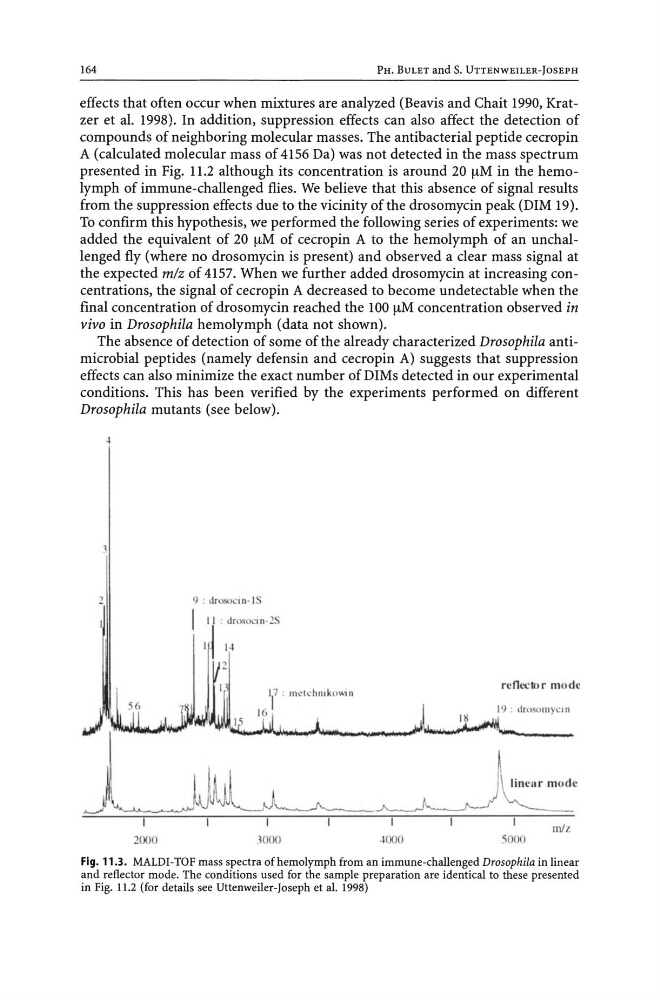
Fig. 11.3. MALDI-TOF mass spectra of hemolymph from an immune-challenged Drosophila in linear
and reflector mode. The conditions used for the sample preparation are identical to these presented
in Fig. 11.2 (for details see Uttenweiler-Joseph et al. 1998)
PH. BULET and S. UTTENWEILER-JOSEPH
effects that often occur when mixtures are analyzed (Beavis and Chait 1990, Kratzer et al. 1998). In addition, suppression effects can also affect the detection of
compounds of neighboring molecular masses. The antibacterial peptide cecropin
A (calculated molecular mass of 4156 Da) was not detected in the mass spectrum
presented in Fig. 11.2 although its concentration is around 20 [tM in the hemolymph of immune-challenged flies. We believe that this absence of signal results
from the suppression effects due to the vicinity of the drosomycin peak (DIM 19).
To confirm this hypothesis, we performed the following series of experiments: we
added the equivalent of 20 [tM of cecropin A to the hemolymph of an unchallenged fly (where no drosomycin is present) and observed a clear mass signal at
the expected m/z of 4157. When we further added drosomycin at increasing concentrations, the signal of cecropin A decreased to become undetectable when the
final concentration of drosomycin reached the 100 [tM concentration observed in
vivo in Drosophila hemolymph (data not shown).
The absence of detection of some of the already characterized Drosophila antimicrobial peptides (namely defensin and cecropin A) suggests that suppression
effects can also minimize the exact number of DIMs detected in our experimental
conditions. This has been verified by the experiments performed on different
Drosophila mutants (see below).
'} : urOSOClI1- I S
rcfioc1ur mode
mil
2000
3000
·1000
soon
Fig. 11.3. MALDI-TOF mass spectra of hemolymph from an immune-challenged Drosophila in linear
and reflector mode. The conditions used for the sample preparation are identical to these presented
in Fig. 11.2 (for details see Uttenweiler-Joseph et al. 1998)