

Elucidation of Functionally Significant Structural Modifications
135
a.i.
20000
PMP ,-Gluc.
laooo
PMP ,-Gluc,
16000
PMP ,-Gluc,
14000
12000
PMP-Gluc
PMP, ·Gluc
10000
PMP
PMP ,-Gluc,
aooo
6000
_
- Gluc-o ~ - PMP _
_
·Gluc-o r- ·Gluc - !+- ·Gluc - 1 _ ·Gluc -o
4000
2000
I
I I I . 11
oJ.. ...
1 ___
100
200
300
400
500
600
700
aoo
900
1000
1100
m/z
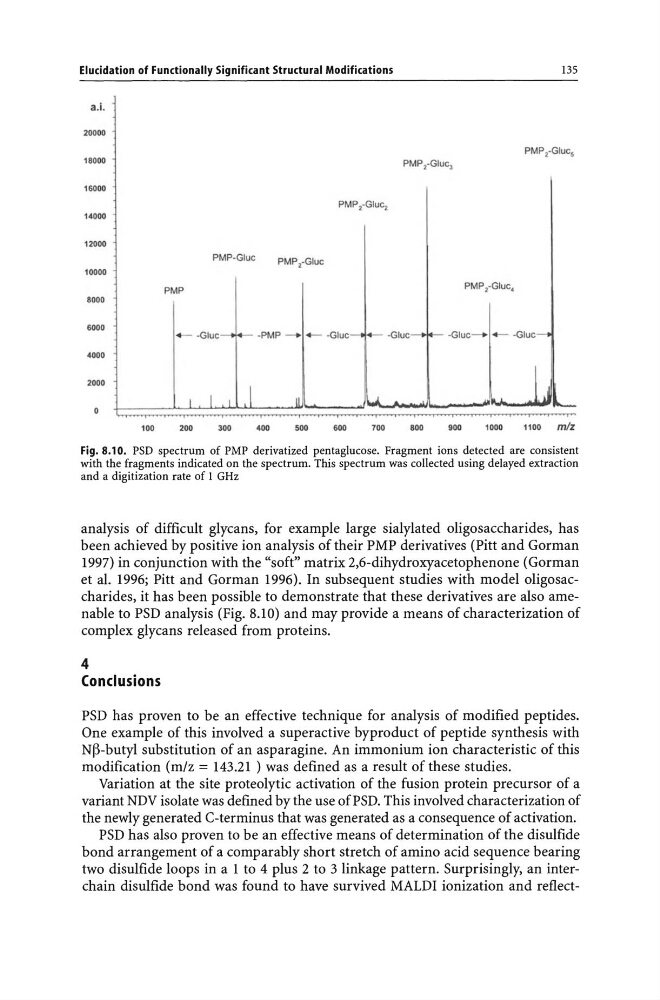
Fig. 8.10. PSD spectrum of PMP derivatized pentaglucose. Fragment ions detected are consistent
with the fragments indicated on the spectrum. This spectrum was collected using delayed extraction
and a digitization rate of 1 GHz
analysis of difficult glycans, for example large sialylated oligosaccharides, has
been achieved by positive ion analysis of their PMP derivatives (Pitt and Gorman
1997) in conjunction with the "soft" matrix 2,6-dihydroxyacetophenone (Gorman
et al. 1996; Pitt and Gorman 1996). In subsequent studies with model oligo saccharides, it has been possible to demonstrate that these derivatives are also amenable to PSD analysis (Fig. 8.10) and may provide a means of characterization of
complex glycans released from proteins.
4
Conclusions
PSD has proven to be an effective technique for analysis of modified peptides.
One example of this involved a superactive byproduct of peptide synthesis with
N~-butyl substitution of an asparagine. An immonium ion characteristic of this
modification (m/z = 143.21 ) was defined as a result of these studies.
Variation at the site proteolytic activation of the fusion protein precursor of a
variant NDV isolate was defined by the use of PSD. This involved characterization of
the newly generated C-terminus that was generated as a consequence of activation.
PSD has also proven to be an effective means of determination of the disulfide
bond arrangement of a comparably short stretch of amino acid sequence bearing
two disulfide loops in a 1 to 4 plus 2 to 3 linkage pattern. Surprisingly, an interchain disulfide bond was found to have survived MALDI ionization and reflect-
135
a.i.
20000
PMP ,-Gluc.
laooo
PMP ,-Gluc,
16000
PMP ,-Gluc,
14000
12000
PMP-Gluc
PMP, ·Gluc
10000
PMP
PMP ,-Gluc,
aooo
6000
_
- Gluc-o ~ - PMP _
_
·Gluc-o r- ·Gluc - !+- ·Gluc - 1 _ ·Gluc -o
4000
2000
I
I I I . 11
oJ.. ...
1 ___
100
200
300
400
500
600
700
aoo
900
1000
1100
m/z
Fig. 8.10. PSD spectrum of PMP derivatized pentaglucose. Fragment ions detected are consistent
with the fragments indicated on the spectrum. This spectrum was collected using delayed extraction
and a digitization rate of 1 GHz
analysis of difficult glycans, for example large sialylated oligosaccharides, has
been achieved by positive ion analysis of their PMP derivatives (Pitt and Gorman
1997) in conjunction with the "soft" matrix 2,6-dihydroxyacetophenone (Gorman
et al. 1996; Pitt and Gorman 1996). In subsequent studies with model oligo saccharides, it has been possible to demonstrate that these derivatives are also amenable to PSD analysis (Fig. 8.10) and may provide a means of characterization of
complex glycans released from proteins.
4
Conclusions
PSD has proven to be an effective technique for analysis of modified peptides.
One example of this involved a superactive byproduct of peptide synthesis with
N~-butyl substitution of an asparagine. An immonium ion characteristic of this
modification (m/z = 143.21 ) was defined as a result of these studies.
Variation at the site proteolytic activation of the fusion protein precursor of a
variant NDV isolate was defined by the use of PSD. This involved characterization of
the newly generated C-terminus that was generated as a consequence of activation.
PSD has also proven to be an effective means of determination of the disulfide
bond arrangement of a comparably short stretch of amino acid sequence bearing
two disulfide loops in a 1 to 4 plus 2 to 3 linkage pattern. Surprisingly, an interchain disulfide bond was found to have survived MALDI ionization and reflect-