

Enantiomeric Ratio E ¼
v B
v A
¼
k cat
K M
h i
A
k cat
K M
h i
B
ΔΔG
6 ¼
¼ ÀRT ln E
The ‘Enantiomeric Ratio’ is not to be confused with the term ‘enantiomer ratio’
(e.r.), which is used to quantify the enantiomeric composition of a mixture of
enantiomers (e.r. ¼ [A]/[B]) [46]. Related alternative methods for the experimental
determination of E-values have been proposed [47–49].
Irreversible Reaction Hydrolytic reactions in aqueous solution can be regarded as
completely irreversible due to the high ‘concentration’ of water present (55.5 mol/L).
Assuming negligible enzyme inhibition, thus both enantiomers of the substrate are
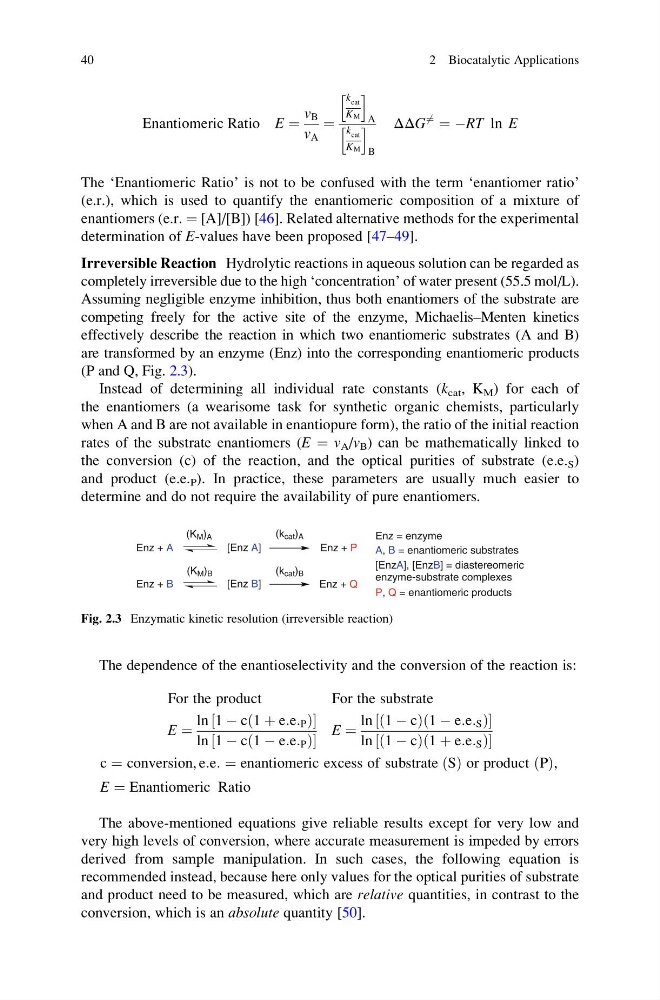
competing freely for the active site of the enzyme, Michaelis–Menten kinetics
effectively describe the reaction in which two enantiomeric substrates (A and B)
are transformed by an enzyme (Enz) into the corresponding enantiomeric products
(P and Q, Fig. 2.3).
Instead of determining all individual rate constants (k cat , K M ) for each of
the enantiomers (a wearisome task for synthetic organic chemists, particularly
when A and B are not available in enantiopure form), the ratio of the initial reaction
rates of the substrate enantiomers (E ¼ v A /v B ) can be mathematically linked to
the conversion (c) of the reaction, and the optical purities of substrate (e.e. S )
and product (e.e. P ). In practice, these parameters are usually much easier to
determine and do not require the availability of pure enantiomers.
The dependence of the enantioselectivity and the conversion of the reaction is:
For the product
For the substrate
E ¼
ln 1 À c 1 þ e:e: P
ð
Þ
½
ln 1 À c 1 À e:e: P
ð
Þ
½
E ¼
ln 1 À c
ð
Þ 1 À e:e: S
ð
Þ
½
ln 1 À c
ð
Þ 1 þ e:e: S
ð
Þ
½
c ¼ conversion, e:e: ¼ enantiomeric excess of substrate S
ð Þ or product P
ð Þ,
E ¼ Enantiomeric Ratio
The above-mentioned equations give reliable results except for very low and
very high levels of conversion, where accurate measurement is impeded by errors
derived from sample manipulation. In such cases, the following equation is
recommended instead, because here only values for the optical purities of substrate
and product need to be measured, which are relative quantities, in contrast to the
conversion, which is an absolute quantity [50].
P, Q = enantiomeric products
A, B = enantiomeric substrates
Enz = enzyme
[EnzA], [EnzB] = diastereomeric
enzyme-substrate complexes
(k cat ) B
(K M ) B
Enz + Q
[Enz B]
Enz + B
(k cat ) A
Enz + P
[Enz A]
Enz + A
(K M ) A
Fig. 2.3 Enzymatic kinetic resolution (irreversible reaction)
40
2 Biocatalytic Applications
v B
v A
¼
k cat
K M
h i
A
k cat
K M
h i
B
ΔΔG
6 ¼
¼ ÀRT ln E
The ‘Enantiomeric Ratio’ is not to be confused with the term ‘enantiomer ratio’
(e.r.), which is used to quantify the enantiomeric composition of a mixture of
enantiomers (e.r. ¼ [A]/[B]) [46]. Related alternative methods for the experimental
determination of E-values have been proposed [47–49].
Irreversible Reaction Hydrolytic reactions in aqueous solution can be regarded as
completely irreversible due to the high ‘concentration’ of water present (55.5 mol/L).
Assuming negligible enzyme inhibition, thus both enantiomers of the substrate are
competing freely for the active site of the enzyme, Michaelis–Menten kinetics
effectively describe the reaction in which two enantiomeric substrates (A and B)
are transformed by an enzyme (Enz) into the corresponding enantiomeric products
(P and Q, Fig. 2.3).
Instead of determining all individual rate constants (k cat , K M ) for each of
the enantiomers (a wearisome task for synthetic organic chemists, particularly
when A and B are not available in enantiopure form), the ratio of the initial reaction
rates of the substrate enantiomers (E ¼ v A /v B ) can be mathematically linked to
the conversion (c) of the reaction, and the optical purities of substrate (e.e. S )
and product (e.e. P ). In practice, these parameters are usually much easier to
determine and do not require the availability of pure enantiomers.
The dependence of the enantioselectivity and the conversion of the reaction is:
For the product
For the substrate
E ¼
ln 1 À c 1 þ e:e: P
ð
Þ
½
ln 1 À c 1 À e:e: P
ð
Þ
½
E ¼
ln 1 À c
ð
Þ 1 À e:e: S
ð
Þ
½
ln 1 À c
ð
Þ 1 þ e:e: S
ð
Þ
½
c ¼ conversion, e:e: ¼ enantiomeric excess of substrate S
ð Þ or product P
ð Þ,
E ¼ Enantiomeric Ratio
The above-mentioned equations give reliable results except for very low and
very high levels of conversion, where accurate measurement is impeded by errors
derived from sample manipulation. In such cases, the following equation is
recommended instead, because here only values for the optical purities of substrate
and product need to be measured, which are relative quantities, in contrast to the
conversion, which is an absolute quantity [50].
P, Q = enantiomeric products
A, B = enantiomeric substrates
Enz = enzyme
[EnzA], [EnzB] = diastereomeric
enzyme-substrate complexes
(k cat ) B
(K M ) B
Enz + Q
[Enz B]
Enz + B
(k cat ) A
Enz + P
[Enz A]
Enz + A
(K M ) A
Fig. 2.3 Enzymatic kinetic resolution (irreversible reaction)
40
2 Biocatalytic Applications