

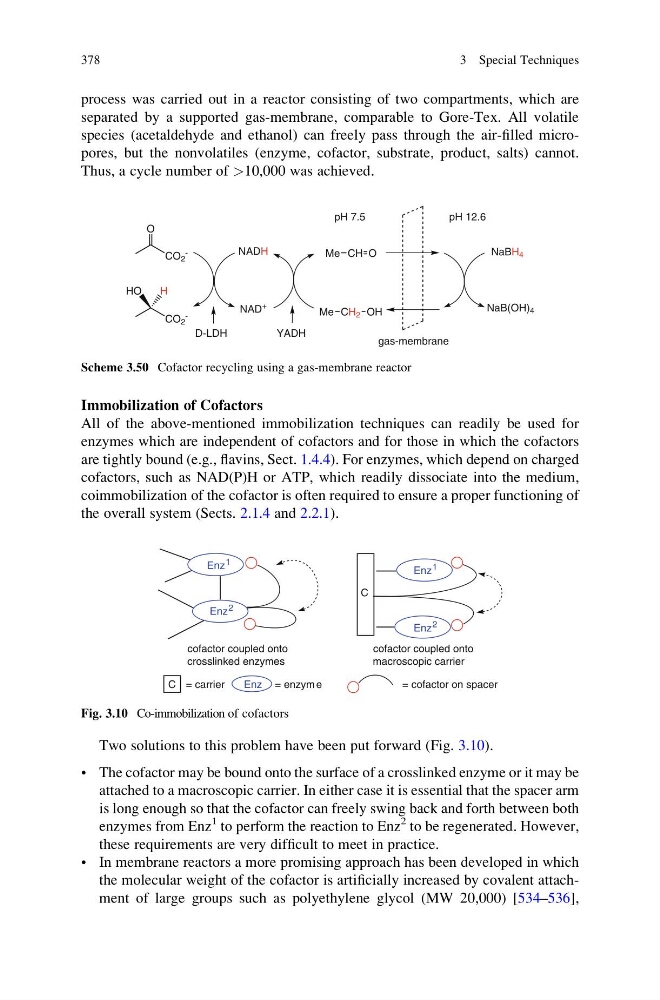
process was carried out in a reactor consisting of two compartments, which are
separated by a supported gas-membrane, comparable to Gore-Tex. All volatile
species (acetaldehyde and ethanol) can freely pass through the air-filled micropores, but the nonvolatiles (enzyme, cofactor, substrate, product, salts) cannot.
Thus, a cycle number of >10,000 was achieved.
Immobilization of Cofactors
All of the above-mentioned immobilization techniques can readily be used for
enzymes which are independent of cofactors and for those in which the cofactors
are tightly bound (e.g., flavins, Sect. 1.4.4). For enzymes, which depend on charged
cofactors, such as NAD(P)H or ATP, which readily dissociate into the medium,
coimmobilization of the cofactor is often required to ensure a proper functioning of
the overall system (Sects. 2.1.4 and 2.2.1).
Two solutions to this problem have been put forward (Fig. 3.10).
• The cofactor may be bound onto the surface of a crosslinked enzyme or it may be
attached to a macroscopic carrier. In either case it is essential that the spacer arm
is long enough so that the cofactor can freely swing back and forth between both
enzymes from Enz
1 to perform the reaction to Enz
2 to be regenerated. However,
these requirements are very difficult to meet in practice.
• In membrane reactors a more promising approach has been developed in which
the molecular weight of the cofactor is artificially increased by covalent attachment of large groups such as polyethylene glycol (MW 20,000) [534–536],
O
CH
Me
CO 2
-
O
CO 2
-
OH
CH 2
Me
gas-membrane
pH 12.6
pH 7.5
D-LDH
NaB(OH) 4
NaBH 4
YADH
NADH
NAD +
HO
H
Scheme 3.50 Cofactor recycling using a gas-membrane reactor
cofactor coupled onto
crosslinked enzymes
cofactor coupled onto
macroscopic carrier
= enzym e
= carrier
Enz
Enz 2
Enz 1
Enz 1
Enz 2
= cofactor on spacer
C
C
Fig. 3.10 Co-immobilization of cofactors
378
3 Special Techniques
separated by a supported gas-membrane, comparable to Gore-Tex. All volatile
species (acetaldehyde and ethanol) can freely pass through the air-filled micropores, but the nonvolatiles (enzyme, cofactor, substrate, product, salts) cannot.
Thus, a cycle number of >10,000 was achieved.
Immobilization of Cofactors
All of the above-mentioned immobilization techniques can readily be used for
enzymes which are independent of cofactors and for those in which the cofactors
are tightly bound (e.g., flavins, Sect. 1.4.4). For enzymes, which depend on charged
cofactors, such as NAD(P)H or ATP, which readily dissociate into the medium,
coimmobilization of the cofactor is often required to ensure a proper functioning of
the overall system (Sects. 2.1.4 and 2.2.1).
Two solutions to this problem have been put forward (Fig. 3.10).
• The cofactor may be bound onto the surface of a crosslinked enzyme or it may be
attached to a macroscopic carrier. In either case it is essential that the spacer arm
is long enough so that the cofactor can freely swing back and forth between both
enzymes from Enz
1 to perform the reaction to Enz
2 to be regenerated. However,
these requirements are very difficult to meet in practice.
• In membrane reactors a more promising approach has been developed in which
the molecular weight of the cofactor is artificially increased by covalent attachment of large groups such as polyethylene glycol (MW 20,000) [534–536],
O
CH
Me
CO 2
-
O
CO 2
-
OH
CH 2
Me
gas-membrane
pH 12.6
pH 7.5
D-LDH
NaB(OH) 4
NaBH 4
YADH
NADH
NAD +
HO
H
Scheme 3.50 Cofactor recycling using a gas-membrane reactor
cofactor coupled onto
crosslinked enzymes
cofactor coupled onto
macroscopic carrier
= enzym e
= carrier
Enz
Enz 2
Enz 1
Enz 1
Enz 2
= cofactor on spacer
C
C
Fig. 3.10 Co-immobilization of cofactors
378
3 Special Techniques