

of enzymes by ultrafiltration, which makes use of the large difference in size
between high-molecular biocatalysts and small substrate/products molecules. Synthetic membranes of defined pore size, covering the range between 500 and
300,000 Da, are commercially available at reasonable cost. The biocatalyst is
detained in the reaction compartment by the membrane, but small substrate/product
molecules can freely diffuse through the pores of the barrier. This principle allows
biocatalytic reactions to be performed in highly desirable continuous processes.
Furthermore, disadvantages caused by heterogeneous catalysis, such as masstransfer limitations and alteration of catalytic properties, are largely avoided
[529]. A variety of synthetic membranes are available in various shapes such as
flat or cylindrical foils or hollow fibers.
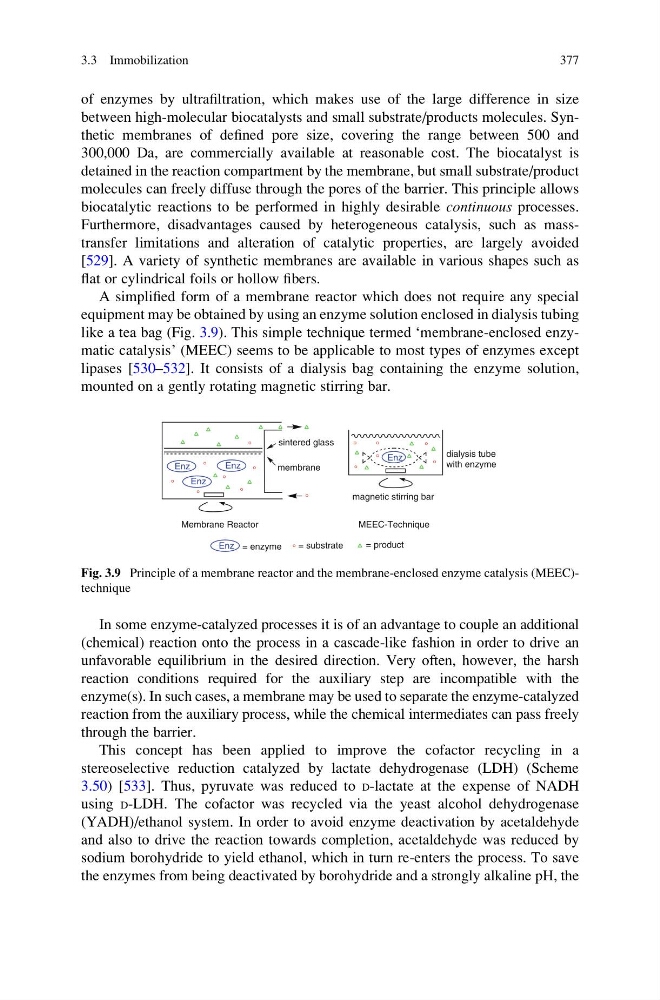
A simplified form of a membrane reactor which does not require any special
equipment may be obtained by using an enzyme solution enclosed in dialysis tubing
like a tea bag (Fig. 3.9). This simple technique termed ‘membrane-enclosed enzymatic catalysis’ (MEEC) seems to be applicable to most types of enzymes except
lipases [530–532]. It consists of a dialysis bag containing the enzyme solution,
mounted on a gently rotating magnetic stirring bar.
In some enzyme-catalyzed processes it is of an advantage to couple an additional
(chemical) reaction onto the process in a cascade-like fashion in order to drive an
unfavorable equilibrium in the desired direction. Very often, however, the harsh
reaction conditions required for the auxiliary step are incompatible with the
enzyme(s). In such cases, a membrane may be used to separate the enzyme-catalyzed
reaction from the auxiliary process, while the chemical intermediates can pass freely
through the barrier.
This concept has been applied to improve the cofactor recycling in a
stereoselective reduction catalyzed by lactate dehydrogenase (LDH) (Scheme
3.50) [533]. Thus, pyruvate was reduced to D-lactate at the expense of NADH
using D-LDH. The cofactor was recycled via the yeast alcohol dehydrogenase
(YADH)/ethanol system. In order to avoid enzyme deactivation by acetaldehyde
and also to drive the reaction towards completion, acetaldehyde was reduced by
sodium borohydride to yield ethanol, which in turn re-enters the process. To save
the enzymes from being deactivated by borohydride and a strongly alkaline pH, the
°
°
°
°
°
°
Enz = enzyme
MEEC-Technique
Membrane Reactor
magnetic stirring bar
dialysis tube
with enzyme
sintered glass
membrane
°
°
°
°
°
°
°
°
Enz
Enz
Enz
° = substrate
= product
Enz
Fig. 3.9 Principle of a membrane reactor and the membrane-enclosed enzyme catalysis (MEEC)technique
3.3 Immobilization
377
between high-molecular biocatalysts and small substrate/products molecules. Synthetic membranes of defined pore size, covering the range between 500 and
300,000 Da, are commercially available at reasonable cost. The biocatalyst is
detained in the reaction compartment by the membrane, but small substrate/product
molecules can freely diffuse through the pores of the barrier. This principle allows
biocatalytic reactions to be performed in highly desirable continuous processes.
Furthermore, disadvantages caused by heterogeneous catalysis, such as masstransfer limitations and alteration of catalytic properties, are largely avoided
[529]. A variety of synthetic membranes are available in various shapes such as
flat or cylindrical foils or hollow fibers.
A simplified form of a membrane reactor which does not require any special
equipment may be obtained by using an enzyme solution enclosed in dialysis tubing
like a tea bag (Fig. 3.9). This simple technique termed ‘membrane-enclosed enzymatic catalysis’ (MEEC) seems to be applicable to most types of enzymes except
lipases [530–532]. It consists of a dialysis bag containing the enzyme solution,
mounted on a gently rotating magnetic stirring bar.
In some enzyme-catalyzed processes it is of an advantage to couple an additional
(chemical) reaction onto the process in a cascade-like fashion in order to drive an
unfavorable equilibrium in the desired direction. Very often, however, the harsh
reaction conditions required for the auxiliary step are incompatible with the
enzyme(s). In such cases, a membrane may be used to separate the enzyme-catalyzed
reaction from the auxiliary process, while the chemical intermediates can pass freely
through the barrier.
This concept has been applied to improve the cofactor recycling in a
stereoselective reduction catalyzed by lactate dehydrogenase (LDH) (Scheme
3.50) [533]. Thus, pyruvate was reduced to D-lactate at the expense of NADH
using D-LDH. The cofactor was recycled via the yeast alcohol dehydrogenase
(YADH)/ethanol system. In order to avoid enzyme deactivation by acetaldehyde
and also to drive the reaction towards completion, acetaldehyde was reduced by
sodium borohydride to yield ethanol, which in turn re-enters the process. To save
the enzymes from being deactivated by borohydride and a strongly alkaline pH, the
°
°
°
°
°
°
Enz = enzyme
MEEC-Technique
Membrane Reactor
magnetic stirring bar
dialysis tube
with enzyme
sintered glass
membrane
°
°
°
°
°
°
°
°
Enz
Enz
Enz
° = substrate
= product
Enz
Fig. 3.9 Principle of a membrane reactor and the membrane-enclosed enzyme catalysis (MEEC)technique
3.3 Immobilization
377