

Redox enzymes are responsible for the replacement of the halogen by a hydrogen atom via reductive dehalogenation [2010, 2011] and oxidative dehalogenation
yields a carbonyl group [2012]. Elimination of hydrogen halide leads to the
formation of an alkene [2013], which is further degraded by oxidation. Since all
of these pathways proceed either with a loss of a functional group or through
removal of a chirality center, they are of little use for the biocatalytic synthesis of
organic compounds. On the other hand, the enzyme-catalyzed hydrolytic replacement of a halide by a hydroxy group and the formation of an epoxide from a
halohydrin take place in a stereocontrolled fashion and are therefore of synthetic
interest.
Dehalogenases
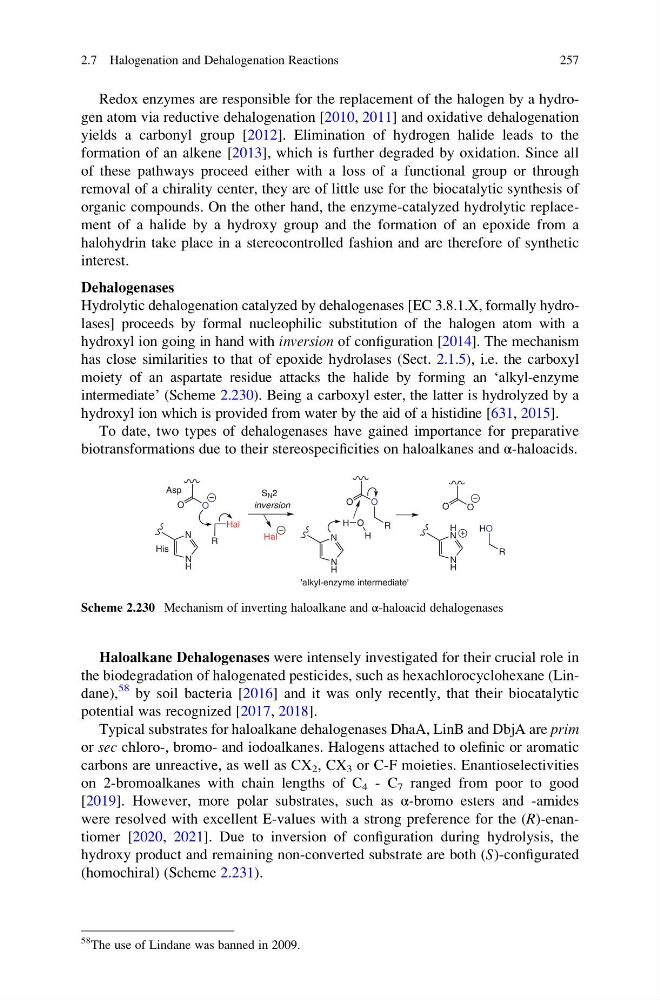
Hydrolytic dehalogenation catalyzed by dehalogenases [EC 3.8.1.X, formally hydrolases] proceeds by formal nucleophilic substitution of the halogen atom with a
hydroxyl ion going in hand with inversion of configuration [2014]. The mechanism
has close similarities to that of epoxide hydrolases (Sect. 2.1.5), i.e. the carboxyl
moiety of an aspartate residue attacks the halide by forming an ‘alkyl-enzyme
intermediate’ (Scheme 2.230). Being a carboxyl ester, the latter is hydrolyzed by a
hydroxyl ion which is provided from water by the aid of a histidine [631, 2015].
To date, two types of dehalogenases have gained importance for preparative
biotransformations due to their stereospecificities on haloalkanes and α-haloacids.
Haloalkane Dehalogenases were intensely investigated for their crucial role in
the biodegradation of halogenated pesticides, such as hexachlorocyclohexane (Lindane),
58 by soil bacteria [2016] and it was only recently, that their biocatalytic
potential was recognized [2017, 2018].
Typical substrates for haloalkane dehalogenases DhaA, LinB and DbjA are prim
or sec chloro-, bromo- and iodoalkanes. Halogens attached to olefinic or aromatic
carbons are unreactive, as well as CX 2 , CX 3 or C-F moieties. Enantioselectivities
on 2-bromoalkanes with chain lengths of C 4 - C 7 ranged from poor to good
[2019]. However, more polar substrates, such as α-bromo esters and -amides
were resolved with excellent E-values with a strong preference for the (R)-enantiomer [2020, 2021]. Due to inversion of configuration during hydrolysis, the
hydroxy product and remaining non-converted substrate are both (S)-configurated
(homochiral) (Scheme 2.231).
R
HO
Hal
R
O
O
N
N
H
O
O
R
O
O
N
N
H
H
H
O
H
N
N
H
inversion
Hal
'alkyl-enzyme intermediate'
S N 2
Asp
His
Scheme 2.230 Mechanism of inverting haloalkane and α-haloacid dehalogenases
58 The use of Lindane was banned in 2009.
2.7 Halogenation and Dehalogenation Reactions
257
yields a carbonyl group [2012]. Elimination of hydrogen halide leads to the
formation of an alkene [2013], which is further degraded by oxidation. Since all
of these pathways proceed either with a loss of a functional group or through
removal of a chirality center, they are of little use for the biocatalytic synthesis of
organic compounds. On the other hand, the enzyme-catalyzed hydrolytic replacement of a halide by a hydroxy group and the formation of an epoxide from a
halohydrin take place in a stereocontrolled fashion and are therefore of synthetic
interest.
Dehalogenases
Hydrolytic dehalogenation catalyzed by dehalogenases [EC 3.8.1.X, formally hydrolases] proceeds by formal nucleophilic substitution of the halogen atom with a
hydroxyl ion going in hand with inversion of configuration [2014]. The mechanism
has close similarities to that of epoxide hydrolases (Sect. 2.1.5), i.e. the carboxyl
moiety of an aspartate residue attacks the halide by forming an ‘alkyl-enzyme
intermediate’ (Scheme 2.230). Being a carboxyl ester, the latter is hydrolyzed by a
hydroxyl ion which is provided from water by the aid of a histidine [631, 2015].
To date, two types of dehalogenases have gained importance for preparative
biotransformations due to their stereospecificities on haloalkanes and α-haloacids.
Haloalkane Dehalogenases were intensely investigated for their crucial role in
the biodegradation of halogenated pesticides, such as hexachlorocyclohexane (Lindane),
58 by soil bacteria [2016] and it was only recently, that their biocatalytic
potential was recognized [2017, 2018].
Typical substrates for haloalkane dehalogenases DhaA, LinB and DbjA are prim
or sec chloro-, bromo- and iodoalkanes. Halogens attached to olefinic or aromatic
carbons are unreactive, as well as CX 2 , CX 3 or C-F moieties. Enantioselectivities
on 2-bromoalkanes with chain lengths of C 4 - C 7 ranged from poor to good
[2019]. However, more polar substrates, such as α-bromo esters and -amides
were resolved with excellent E-values with a strong preference for the (R)-enantiomer [2020, 2021]. Due to inversion of configuration during hydrolysis, the
hydroxy product and remaining non-converted substrate are both (S)-configurated
(homochiral) (Scheme 2.231).
R
HO
Hal
R
O
O
N
N
H
O
O
R
O
O
N
N
H
H
H
O
H
N
N
H
inversion
Hal
'alkyl-enzyme intermediate'
S N 2
Asp
His
Scheme 2.230 Mechanism of inverting haloalkane and α-haloacid dehalogenases
58 The use of Lindane was banned in 2009.
2.7 Halogenation and Dehalogenation Reactions
257