

nonracemic amines from the corresponding ketones. Considering the importance
of amino groups in active pharmaceutical ingredients (APIs)
54 it is not surprising that the asymmetric enzymatic transamination on industrial scale was predominantly developed for pharma-applications, which is illustrated by the
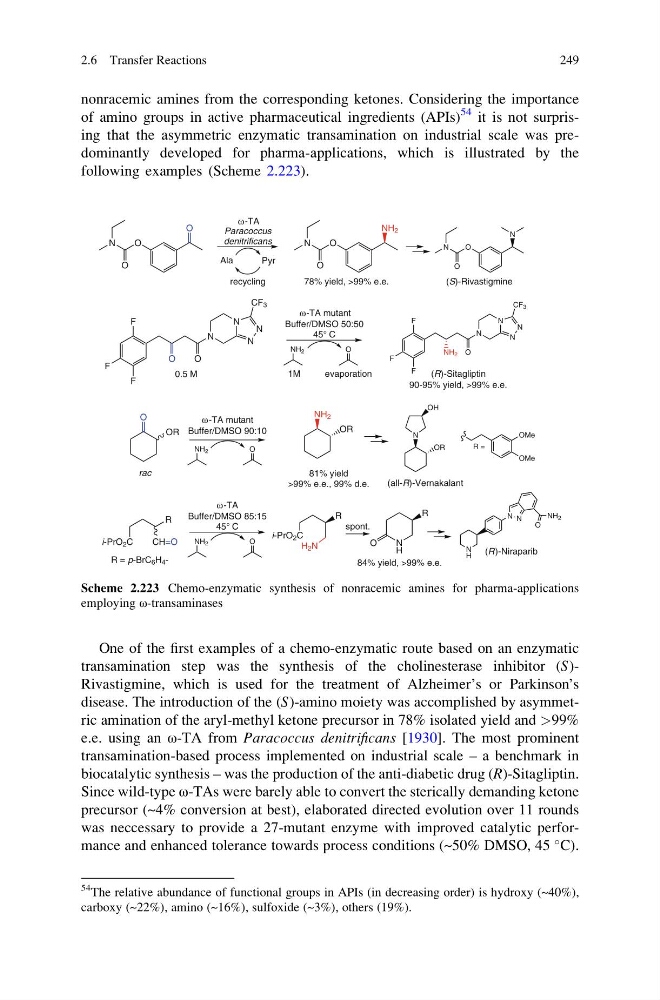
following examples (Scheme 2.223).
One of the first examples of a chemo-enzymatic route based on an enzymatic
transamination step was the synthesis of the cholinesterase inhibitor (S)Rivastigmine, which is used for the treatment of Alzheimer’s or Parkinson’s
disease. The introduction of the (S)-amino moiety was accomplished by asymmetric amination of the aryl-methyl ketone precursor in 78% isolated yield and >99%
e.e. using an ω-TA from Paracoccus denitrificans [1930]. The most prominent
transamination-based process implemented on industrial scale – a benchmark in
biocatalytic synthesis – was the production of the anti-diabetic drug (R)-Sitagliptin.
Since wild-type ω-TAs were barely able to convert the sterically demanding ketone
precursor (~4% conversion at best), elaborated directed evolution over 11 rounds
was neccessary to provide a 27-mutant enzyme with improved catalytic performance and enhanced tolerance towards process conditions (~50% DMSO, 45
C).
N
O
O
O
N
O
NH 2
O
ω-TA
Ala
Pyr
recycling
N
O
N
O
78% yield, >99% e.e.
(S)-Rivastigmine
N
N
N
N
CF 3
O
O
F
F
F
N
N
N
N
CF3
O
NH2
F
F
F
ω-TA mutant
O
NH2
Buffer/DMSO 50:50
45° C
(R)-Sitagliptin
90-95% yield, >99% e.e.
1M
0.5 M
evaporation
Paracoccus
denitrificans
O
OR
rac
NH 2
OR
ω-TA mutant
O
NH2
Buffer/DMSO 90:10
81% yield
>99% e.e., 99% d.e.
OR
N
OH
(all-R)-Vernakalant
OMe
OMe
R =
R
i-PrO 2 C
CH=O
ω-TA
O
NH2
Buffer/DMSO 85:15
45° C
R
i-PrO 2 C
H 2 N
spont.
R
N
H
O
N
H
N N
NH2
O
(R)-Niraparib
84% yield, >99% e.e.
R = p-BrC 6 H 4 -
Scheme 2.223 Chemo-enzymatic synthesis of nonracemic amines for pharma-applications
employing ω-transaminases
54 The relative abundance of functional groups in APIs (in decreasing order) is hydroxy (~40%),
carboxy (~22%), amino (~16%), sulfoxide (~3%), others (19%).
2.6 Transfer Reactions
249
of amino groups in active pharmaceutical ingredients (APIs)
54 it is not surprising that the asymmetric enzymatic transamination on industrial scale was predominantly developed for pharma-applications, which is illustrated by the
following examples (Scheme 2.223).
One of the first examples of a chemo-enzymatic route based on an enzymatic
transamination step was the synthesis of the cholinesterase inhibitor (S)Rivastigmine, which is used for the treatment of Alzheimer’s or Parkinson’s
disease. The introduction of the (S)-amino moiety was accomplished by asymmetric amination of the aryl-methyl ketone precursor in 78% isolated yield and >99%
e.e. using an ω-TA from Paracoccus denitrificans [1930]. The most prominent
transamination-based process implemented on industrial scale – a benchmark in
biocatalytic synthesis – was the production of the anti-diabetic drug (R)-Sitagliptin.
Since wild-type ω-TAs were barely able to convert the sterically demanding ketone
precursor (~4% conversion at best), elaborated directed evolution over 11 rounds
was neccessary to provide a 27-mutant enzyme with improved catalytic performance and enhanced tolerance towards process conditions (~50% DMSO, 45
C).
N
O
O
O
N
O
NH 2
O
ω-TA
Ala
Pyr
recycling
N
O
N
O
78% yield, >99% e.e.
(S)-Rivastigmine
N
N
N
N
CF 3
O
O
F
F
F
N
N
N
N
CF3
O
NH2
F
F
F
ω-TA mutant
O
NH2
Buffer/DMSO 50:50
45° C
(R)-Sitagliptin
90-95% yield, >99% e.e.
1M
0.5 M
evaporation
Paracoccus
denitrificans
O
OR
rac
NH 2
OR
ω-TA mutant
O
NH2
Buffer/DMSO 90:10
81% yield
>99% e.e., 99% d.e.
OR
N
OH
(all-R)-Vernakalant
OMe
OMe
R =
R
i-PrO 2 C
CH=O
ω-TA
O
NH2
Buffer/DMSO 85:15
45° C
R
i-PrO 2 C
H 2 N
spont.
R
N
H
O
N
H
N N
NH2
O
(R)-Niraparib
84% yield, >99% e.e.
R = p-BrC 6 H 4 -
Scheme 2.223 Chemo-enzymatic synthesis of nonracemic amines for pharma-applications
employing ω-transaminases
54 The relative abundance of functional groups in APIs (in decreasing order) is hydroxy (~40%),
carboxy (~22%), amino (~16%), sulfoxide (~3%), others (19%).
2.6 Transfer Reactions
249