

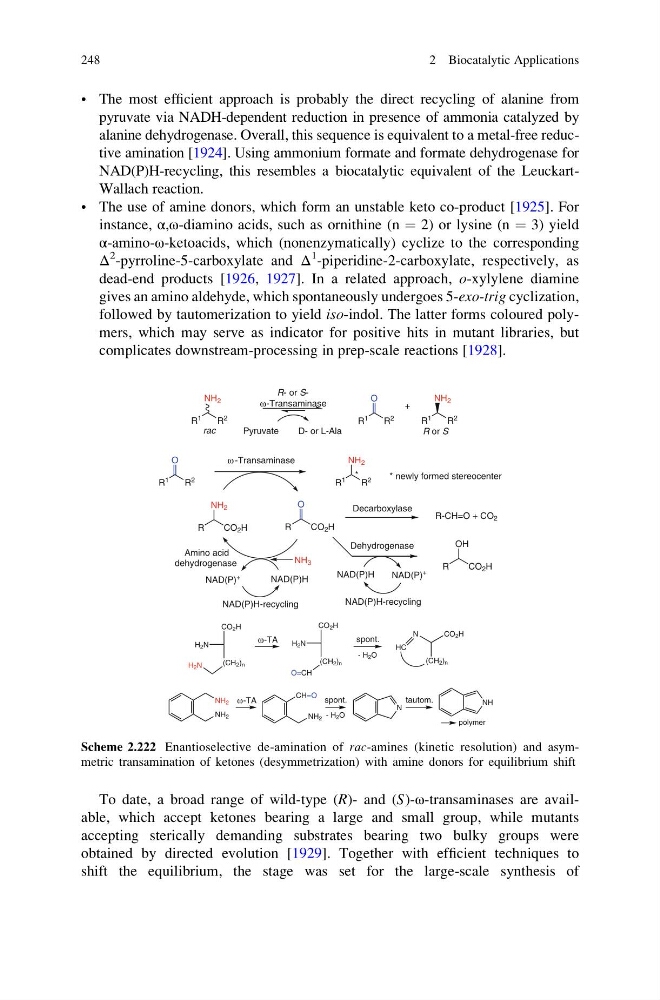
• The most efficient approach is probably the direct recycling of alanine from
pyruvate via NADH-dependent reduction in presence of ammonia catalyzed by
alanine dehydrogenase. Overall, this sequence is equivalent to a metal-free reductive amination [1924]. Using ammonium formate and formate dehydrogenase for
NAD(P)H-recycling, this resembles a biocatalytic equivalent of the LeuckartWallach reaction.
• The use of amine donors, which form an unstable keto co-product [1925]. For
instance, α,ω-diamino acids, such as ornithine (n ¼ 2) or lysine (n ¼ 3) yield
α-amino-ω-ketoacids, which (nonenzymatically) cyclize to the corresponding
Δ
2 -pyrroline-5-carboxylate and Δ
1 -piperidine-2-carboxylate, respectively, as
dead-end products [1926, 1927]. In a related approach, o-xylylene diamine
gives an amino aldehyde, which spontaneously undergoes 5-exo-trig cyclization,
followed by tautomerization to yield iso-indol. The latter forms coloured polymers, which may serve as indicator for positive hits in mutant libraries, but
complicates downstream-processing in prep-scale reactions [1928].
To date, a broad range of wild-type (R)- and (S)-ω-transaminases are available, which accept ketones bearing a large and small group, while mutants
accepting sterically demanding substrates bearing two bulky groups were
obtained by directed evolution [1929]. Together with efficient techniques to
shift the equilibrium, the stage was set for the large-scale synthesis of
O
R 2
R 1
NH 2
CO 2 H
R
O
CO 2 H
R
NH 2
R 2
R 1
OH
CO 2 H
R
* newly formed stereocenter
ω -Transaminase
*
Amino acid
NAD(P)H-recycling
NAD(P)H
NAD(P) +
dehydrogenase
Decarboxylase
R-CH=O + CO 2
NAD(P)H-recycling
NAD(P)
+
NAD(P)H
Dehydrogenase
NH 3
NH 2
R
2
R
1
rac
R- or Sω-Transaminase
NH 2
R
2
R
1
O
R
2
R
1
+
Pyruvate
D- or L-Ala
R or S
CO2H
H2N
(CH2)n
spont.
- H2O
N
CO2H
HC
NH2
NH2
CH=O
NH2
N
NH
ω-TA
spont.
tautom.
ω-TA
- H2O
H2N
CO2H
H2N
(CH2)n
(CH2)n
O=CH
polymer
Scheme 2.222 Enantioselective de-amination of rac-amines (kinetic resolution) and asymmetric transamination of ketones (desymmetrization) with amine donors for equilibrium shift
248
2 Biocatalytic Applications
pyruvate via NADH-dependent reduction in presence of ammonia catalyzed by
alanine dehydrogenase. Overall, this sequence is equivalent to a metal-free reductive amination [1924]. Using ammonium formate and formate dehydrogenase for
NAD(P)H-recycling, this resembles a biocatalytic equivalent of the LeuckartWallach reaction.
• The use of amine donors, which form an unstable keto co-product [1925]. For
instance, α,ω-diamino acids, such as ornithine (n ¼ 2) or lysine (n ¼ 3) yield
α-amino-ω-ketoacids, which (nonenzymatically) cyclize to the corresponding
Δ
2 -pyrroline-5-carboxylate and Δ
1 -piperidine-2-carboxylate, respectively, as
dead-end products [1926, 1927]. In a related approach, o-xylylene diamine
gives an amino aldehyde, which spontaneously undergoes 5-exo-trig cyclization,
followed by tautomerization to yield iso-indol. The latter forms coloured polymers, which may serve as indicator for positive hits in mutant libraries, but
complicates downstream-processing in prep-scale reactions [1928].
To date, a broad range of wild-type (R)- and (S)-ω-transaminases are available, which accept ketones bearing a large and small group, while mutants
accepting sterically demanding substrates bearing two bulky groups were
obtained by directed evolution [1929]. Together with efficient techniques to
shift the equilibrium, the stage was set for the large-scale synthesis of
O
R 2
R 1
NH 2
CO 2 H
R
O
CO 2 H
R
NH 2
R 2
R 1
OH
CO 2 H
R
* newly formed stereocenter
ω -Transaminase
*
Amino acid
NAD(P)H-recycling
NAD(P)H
NAD(P) +
dehydrogenase
Decarboxylase
R-CH=O + CO 2
NAD(P)H-recycling
NAD(P)
+
NAD(P)H
Dehydrogenase
NH 3
NH 2
R
2
R
1
rac
R- or Sω-Transaminase
NH 2
R
2
R
1
O
R
2
R
1
+
Pyruvate
D- or L-Ala
R or S
CO2H
H2N
(CH2)n
spont.
- H2O
N
CO2H
HC
NH2
NH2
CH=O
NH2
N
NH
ω-TA
spont.
tautom.
ω-TA
- H2O
H2N
CO2H
H2N
(CH2)n
(CH2)n
O=CH
polymer
Scheme 2.222 Enantioselective de-amination of rac-amines (kinetic resolution) and asymmetric transamination of ketones (desymmetrization) with amine donors for equilibrium shift
248
2 Biocatalytic Applications