

On the other hand, (S)-hydroxynitrile lyases [1729–1732] were found in Sorghum bicolor [1733] (millet), Hevea brasiliensis [1734, 1735] (rubber tree),
Ximenia americana [1736] (sandalwood), Sambucus niger [1737] (elder), Manihot
esculenta [1731, 1738] (cassava), flax, and clover. They do not contain FAD and
they exhibit a more narrow substrate tolerance, as aliphatic aldehydes are not
always accepted. Furthermore, the reaction rates and optical purities are sometimes
lower than those which are obtained when the (R)-enzyme is used. Based on X-ray
structures [1739, 1740], the mechanism of enzymatic cyanohydrin formation has
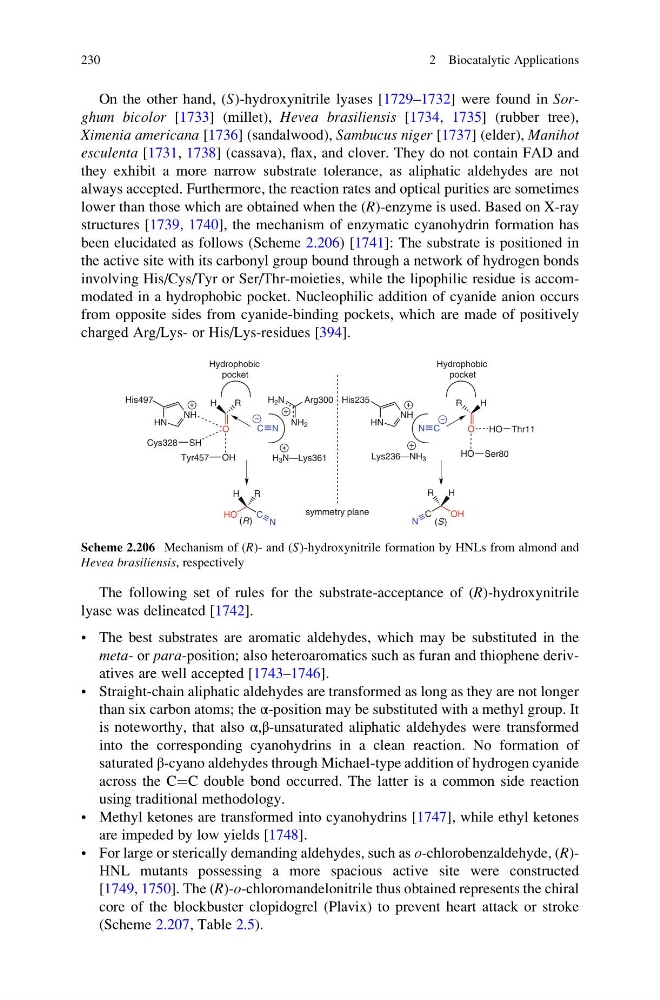
been elucidated as follows (Scheme 2.206) [1741]: The substrate is positioned in
the active site with its carbonyl group bound through a network of hydrogen bonds
involving His/Cys/Tyr or Ser/Thr-moieties, while the lipophilic residue is accommodated in a hydrophobic pocket. Nucleophilic addition of cyanide anion occurs
from opposite sides from cyanide-binding pockets, which are made of positively
charged Arg/Lys- or His/Lys-residues [394].
The following set of rules for the substrate-acceptance of (R)-hydroxynitrile
lyase was delineated [1742].
• The best substrates are aromatic aldehydes, which may be substituted in the
meta- or para-position; also heteroaromatics such as furan and thiophene derivatives are well accepted [1743–1746].
• Straight-chain aliphatic aldehydes are transformed as long as they are not longer
than six carbon atoms; the α-position may be substituted with a methyl group. It
is noteworthy, that also α,β-unsaturated aliphatic aldehydes were transformed
into the corresponding cyanohydrins in a clean reaction. No formation of
saturated β-cyano aldehydes through Michael-type addition of hydrogen cyanide
across the C¼C double bond occurred. The latter is a common side reaction
using traditional methodology.
• Methyl ketones are transformed into cyanohydrins [1747], while ethyl ketones
are impeded by low yields [1748].
• For large or sterically demanding aldehydes, such as o-chlorobenzaldehyde, (R)HNL mutants possessing a more spacious active site were constructed
[1749, 1750]. The (R)-o-chloromandelonitrile thus obtained represents the chiral
core of the blockbuster clopidogrel (Plavix) to prevent heart attack or stroke
(Scheme 2.207, Table 2.5).
HN
NH
His235
Thr11
Ser80
HO
HO
O
N C
Tyr457
Cys328
OH
SH
R
H
O
N
C
Arg300
NH 2
H 2 N
R
H
N
C
HO
R
H
R
H
N
C
OH
Lys236—NH 3
pocket
Hydrophobic
pocket
Hydrophobic
H 3 N—Lys361
(R)
(S)
HN
NH
His497
symmetry plane
Scheme 2.206 Mechanism of (R)- and (S)-hydroxynitrile formation by HNLs from almond and
Hevea brasiliensis, respectively
230
2 Biocatalytic Applications
Ximenia americana [1736] (sandalwood), Sambucus niger [1737] (elder), Manihot
esculenta [1731, 1738] (cassava), flax, and clover. They do not contain FAD and
they exhibit a more narrow substrate tolerance, as aliphatic aldehydes are not
always accepted. Furthermore, the reaction rates and optical purities are sometimes
lower than those which are obtained when the (R)-enzyme is used. Based on X-ray
structures [1739, 1740], the mechanism of enzymatic cyanohydrin formation has
been elucidated as follows (Scheme 2.206) [1741]: The substrate is positioned in
the active site with its carbonyl group bound through a network of hydrogen bonds
involving His/Cys/Tyr or Ser/Thr-moieties, while the lipophilic residue is accommodated in a hydrophobic pocket. Nucleophilic addition of cyanide anion occurs
from opposite sides from cyanide-binding pockets, which are made of positively
charged Arg/Lys- or His/Lys-residues [394].
The following set of rules for the substrate-acceptance of (R)-hydroxynitrile
lyase was delineated [1742].
• The best substrates are aromatic aldehydes, which may be substituted in the
meta- or para-position; also heteroaromatics such as furan and thiophene derivatives are well accepted [1743–1746].
• Straight-chain aliphatic aldehydes are transformed as long as they are not longer
than six carbon atoms; the α-position may be substituted with a methyl group. It
is noteworthy, that also α,β-unsaturated aliphatic aldehydes were transformed
into the corresponding cyanohydrins in a clean reaction. No formation of
saturated β-cyano aldehydes through Michael-type addition of hydrogen cyanide
across the C¼C double bond occurred. The latter is a common side reaction
using traditional methodology.
• Methyl ketones are transformed into cyanohydrins [1747], while ethyl ketones
are impeded by low yields [1748].
• For large or sterically demanding aldehydes, such as o-chlorobenzaldehyde, (R)HNL mutants possessing a more spacious active site were constructed
[1749, 1750]. The (R)-o-chloromandelonitrile thus obtained represents the chiral
core of the blockbuster clopidogrel (Plavix) to prevent heart attack or stroke
(Scheme 2.207, Table 2.5).
HN
NH
His235
Thr11
Ser80
HO
HO
O
N C
Tyr457
Cys328
OH
SH
R
H
O
N
C
Arg300
NH 2
H 2 N
R
H
N
C
HO
R
H
R
H
N
C
OH
Lys236—NH 3
Hydrophobic
Hydrophobic
H 3 N—Lys361
(R)
(S)
HN
NH
His497
symmetry plane
Scheme 2.206 Mechanism of (R)- and (S)-hydroxynitrile formation by HNLs from almond and
Hevea brasiliensis, respectively
230
2 Biocatalytic Applications