

1.4 Enzyme Properties and Nomenclature
1.4.1 Structural Biology in a Nutshell
The polyamide chain of an enzyme is kept in a three-dimensional structure – the one
with the lowest ΔG [107] – which is predominantly determined by its primary
sequence.
13 For an organic chemist, an enzyme may be compared with a ball of
yarn: Due to the natural aqueous environment, the hydrophilic polar groups (such as –
COO
À , –OH, –NH 3
+
, –SH, and –CONH 2 ) are mainly located on the outer surface of
the enzyme in order to become hydrated, with the lipophilic substituents (the aryl and
alkyl chains lacking affinity to water) being buried inside. As a consequence, the
surface of an enzyme is covered by a tightly bound layer of water, which cannot be
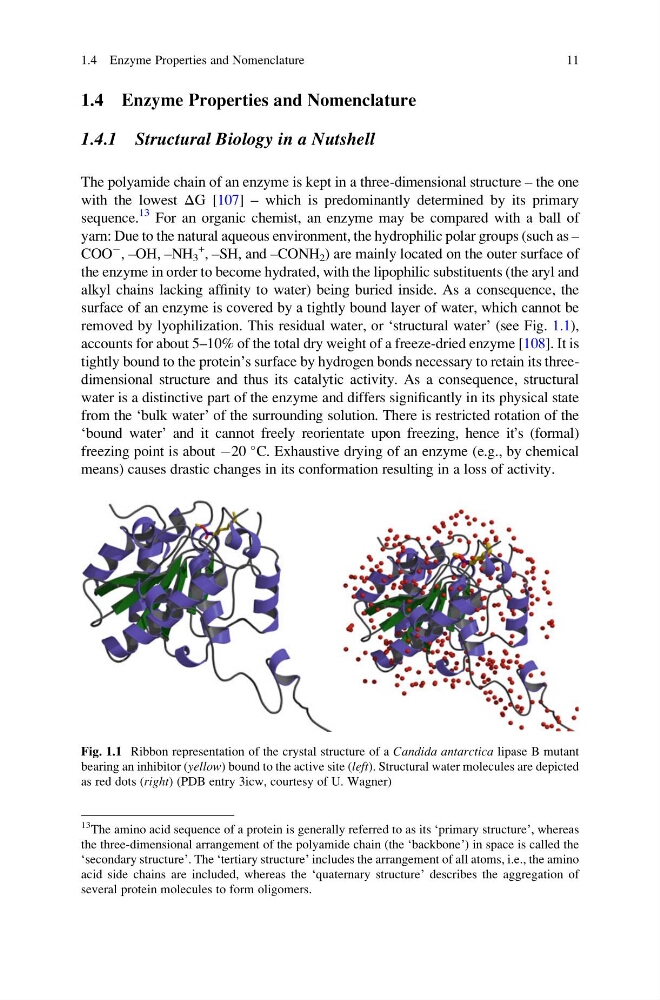
removed by lyophilization. This residual water, or ‘structural water’ (see Fig. 1.1),
accounts for about 5–10% of the total dry weight of a freeze-dried enzyme [108]. It is
tightly bound to the protein’s surface by hydrogen bonds necessary to retain its threedimensional structure and thus its catalytic activity. As a consequence, structural
water is a distinctive part of the enzyme and differs significantly in its physical state
from the ‘bulk water’ of the surrounding solution. There is restricted rotation of the
‘bound water’ and it cannot freely reorientate upon freezing, hence it’s (formal)
freezing point is about À20
C. Exhaustive drying of an enzyme (e.g., by chemical
means) causes drastic changes in its conformation resulting in a loss of activity.
Fig. 1.1 Ribbon representation of the crystal structure of a Candida antarctica lipase B mutant
bearing an inhibitor (yellow) bound to the active site (left). Structural water molecules are depicted
as red dots (right) (PDB entry 3icw, courtesy of U. Wagner)
13 The amino acid sequence of a protein is generally referred to as its ‘primary structure’, whereas
the three-dimensional arrangement of the polyamide chain (the ‘backbone’) in space is called the
‘secondary structure’. The ‘tertiary structure’ includes the arrangement of all atoms, i.e., the amino
acid side chains are included, whereas the ‘quaternary structure’ describes the aggregation of
several protein molecules to form oligomers.
1.4 Enzyme Properties and Nomenclature
11
1.4.1 Structural Biology in a Nutshell
The polyamide chain of an enzyme is kept in a three-dimensional structure – the one
with the lowest ΔG [107] – which is predominantly determined by its primary
sequence.
13 For an organic chemist, an enzyme may be compared with a ball of
yarn: Due to the natural aqueous environment, the hydrophilic polar groups (such as –
COO
À , –OH, –NH 3
+
, –SH, and –CONH 2 ) are mainly located on the outer surface of
the enzyme in order to become hydrated, with the lipophilic substituents (the aryl and
alkyl chains lacking affinity to water) being buried inside. As a consequence, the
surface of an enzyme is covered by a tightly bound layer of water, which cannot be
removed by lyophilization. This residual water, or ‘structural water’ (see Fig. 1.1),
accounts for about 5–10% of the total dry weight of a freeze-dried enzyme [108]. It is
tightly bound to the protein’s surface by hydrogen bonds necessary to retain its threedimensional structure and thus its catalytic activity. As a consequence, structural
water is a distinctive part of the enzyme and differs significantly in its physical state
from the ‘bulk water’ of the surrounding solution. There is restricted rotation of the
‘bound water’ and it cannot freely reorientate upon freezing, hence it’s (formal)
freezing point is about À20
C. Exhaustive drying of an enzyme (e.g., by chemical
means) causes drastic changes in its conformation resulting in a loss of activity.
Fig. 1.1 Ribbon representation of the crystal structure of a Candida antarctica lipase B mutant
bearing an inhibitor (yellow) bound to the active site (left). Structural water molecules are depicted
as red dots (right) (PDB entry 3icw, courtesy of U. Wagner)
13 The amino acid sequence of a protein is generally referred to as its ‘primary structure’, whereas
the three-dimensional arrangement of the polyamide chain (the ‘backbone’) in space is called the
‘secondary structure’. The ‘tertiary structure’ includes the arrangement of all atoms, i.e., the amino
acid side chains are included, whereas the ‘quaternary structure’ describes the aggregation of
several protein molecules to form oligomers.
1.4 Enzyme Properties and Nomenclature
11