

formation of lipid peroxides is considered to be involved in some serious
diseases and malfunctions including arteriosclerosis and cancer [1392].
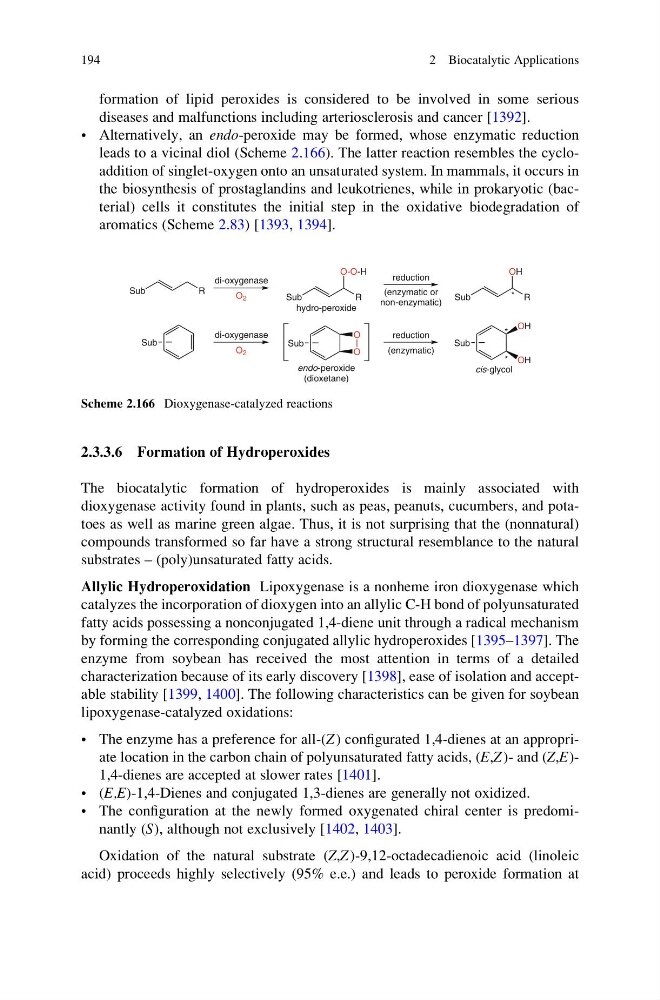
• Alternatively, an endo-peroxide may be formed, whose enzymatic reduction
leads to a vicinal diol (Scheme 2.166). The latter reaction resembles the cycloaddition of singlet-oxygen onto an unsaturated system. In mammals, it occurs in
the biosynthesis of prostaglandins and leukotrienes, while in prokaryotic (bacterial) cells it constitutes the initial step in the oxidative biodegradation of
aromatics (Scheme 2.83) [1393, 1394].
2.3.3.6 Formation of Hydroperoxides
The biocatalytic formation of hydroperoxides is mainly associated with
dioxygenase activity found in plants, such as peas, peanuts, cucumbers, and potatoes as well as marine green algae. Thus, it is not surprising that the (nonnatural)
compounds transformed so far have a strong structural resemblance to the natural
substrates – (poly)unsaturated fatty acids.
Allylic Hydroperoxidation Lipoxygenase is a nonheme iron dioxygenase which
catalyzes the incorporation of dioxygen into an allylic C-H bond of polyunsaturated
fatty acids possessing a nonconjugated 1,4-diene unit through a radical mechanism
by forming the corresponding conjugated allylic hydroperoxides [1395–1397]. The
enzyme from soybean has received the most attention in terms of a detailed
characterization because of its early discovery [1398], ease of isolation and acceptable stability [1399, 1400]. The following characteristics can be given for soybean
lipoxygenase-catalyzed oxidations:
• The enzyme has a preference for all-(Z) configurated 1,4-dienes at an appropriate location in the carbon chain of polyunsaturated fatty acids, (E,Z)- and (Z,E)1,4-dienes are accepted at slower rates [1401].
• (E,E)-1,4-Dienes and conjugated 1,3-dienes are generally not oxidized.
• The configuration at the newly formed oxygenated chiral center is predominantly (S), although not exclusively [1402, 1403].
Oxidation of the natural substrate (Z,Z )-9,12-octadecadienoic acid (linoleic
acid) proceeds highly selectively (95% e.e.) and leads to peroxide formation at
di-oxygenase
reduction
(enzymatic or
non-enzymatic)
reduction
cis-glycol
endo-peroxide
(dioxetane)
hydro-peroxide
di-oxygenase
Sub
R
(enzymatic)
Sub
Sub
R
O-O-H
O 2
Sub
R
OH
O 2
Sub
O
O
Sub
OH
OH
*
*
*
Scheme 2.166 Dioxygenase-catalyzed reactions
194
2 Biocatalytic Applications
diseases and malfunctions including arteriosclerosis and cancer [1392].
• Alternatively, an endo-peroxide may be formed, whose enzymatic reduction
leads to a vicinal diol (Scheme 2.166). The latter reaction resembles the cycloaddition of singlet-oxygen onto an unsaturated system. In mammals, it occurs in
the biosynthesis of prostaglandins and leukotrienes, while in prokaryotic (bacterial) cells it constitutes the initial step in the oxidative biodegradation of
aromatics (Scheme 2.83) [1393, 1394].
2.3.3.6 Formation of Hydroperoxides
The biocatalytic formation of hydroperoxides is mainly associated with
dioxygenase activity found in plants, such as peas, peanuts, cucumbers, and potatoes as well as marine green algae. Thus, it is not surprising that the (nonnatural)
compounds transformed so far have a strong structural resemblance to the natural
substrates – (poly)unsaturated fatty acids.
Allylic Hydroperoxidation Lipoxygenase is a nonheme iron dioxygenase which
catalyzes the incorporation of dioxygen into an allylic C-H bond of polyunsaturated
fatty acids possessing a nonconjugated 1,4-diene unit through a radical mechanism
by forming the corresponding conjugated allylic hydroperoxides [1395–1397]. The
enzyme from soybean has received the most attention in terms of a detailed
characterization because of its early discovery [1398], ease of isolation and acceptable stability [1399, 1400]. The following characteristics can be given for soybean
lipoxygenase-catalyzed oxidations:
• The enzyme has a preference for all-(Z) configurated 1,4-dienes at an appropriate location in the carbon chain of polyunsaturated fatty acids, (E,Z)- and (Z,E)1,4-dienes are accepted at slower rates [1401].
• (E,E)-1,4-Dienes and conjugated 1,3-dienes are generally not oxidized.
• The configuration at the newly formed oxygenated chiral center is predominantly (S), although not exclusively [1402, 1403].
Oxidation of the natural substrate (Z,Z )-9,12-octadecadienoic acid (linoleic
acid) proceeds highly selectively (95% e.e.) and leads to peroxide formation at
di-oxygenase
reduction
(enzymatic or
non-enzymatic)
reduction
cis-glycol
endo-peroxide
(dioxetane)
hydro-peroxide
di-oxygenase
Sub
R
(enzymatic)
Sub
Sub
R
O-O-H
O 2
Sub
R
OH
O 2
Sub
O
O
Sub
OH
OH
*
*
*
Scheme 2.166 Dioxygenase-catalyzed reactions
194
2 Biocatalytic Applications