

monooxygenase generates the lactone by consuming the reduced cofactor. Therefore, the NAD(P)H is concurrently recycled in a closed loop via ‘hydrogen-borrowing’ (Scheme 3.42).
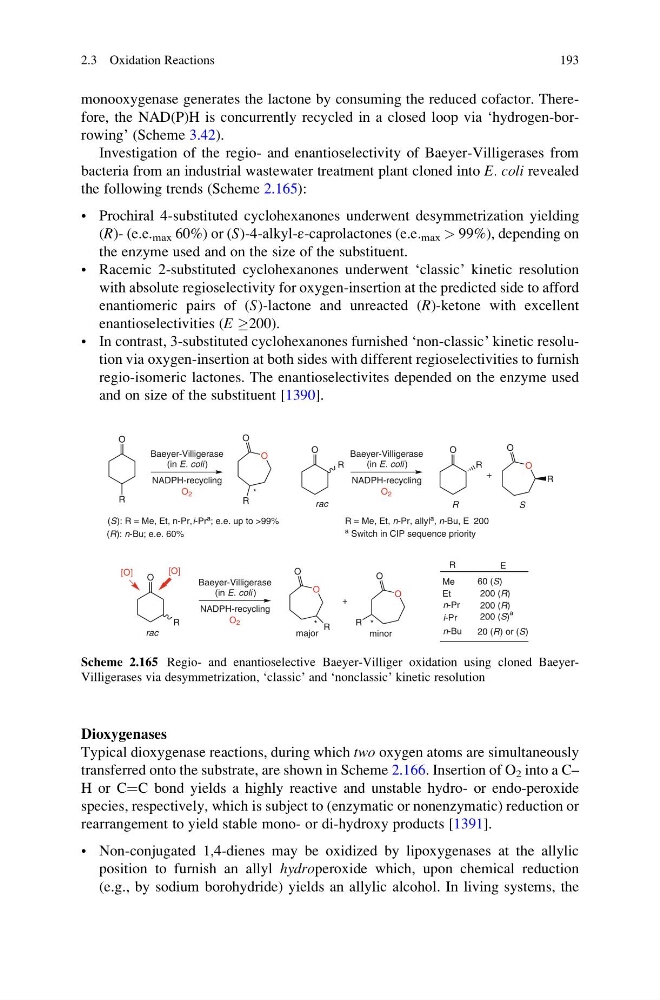
Investigation of the regio- and enantioselectivity of Baeyer-Villigerases from
bacteria from an industrial wastewater treatment plant cloned into E. coli revealed
the following trends (Scheme 2.165):
• Prochiral 4-substituted cyclohexanones underwent desymmetrization yielding
(R)- (e.e. max 60%) or (S)-4-alkyl-ε-caprolactones (e.e. max > 99%), depending on
the enzyme used and on the size of the substituent.
• Racemic 2-substituted cyclohexanones underwent ‘classic’ kinetic resolution
with absolute regioselectivity for oxygen-insertion at the predicted side to afford
enantiomeric pairs of (S)-lactone and unreacted (R)-ketone with excellent
enantioselectivities (E !200).
• In contrast, 3-substituted cyclohexanones furnished ‘non-classic’ kinetic resolution via oxygen-insertion at both sides with different regioselectivities to furnish
regio-isomeric lactones. The enantioselectivites depended on the enzyme used
and on size of the substituent [1390].
Dioxygenases
Typical dioxygenase reactions, during which two oxygen atoms are simultaneously
transferred onto the substrate, are shown in Scheme 2.166. Insertion of O 2 into a C–
H or C¼C bond yields a highly reactive and unstable hydro- or endo-peroxide
species, respectively, which is subject to (enzymatic or nonenzymatic) reduction or
rearrangement to yield stable mono- or di-hydroxy products [1391].
• Non-conjugated 1,4-dienes may be oxidized by lipoxygenases at the allylic
position to furnish an allyl hydroperoxide which, upon chemical reduction
(e.g., by sodium borohydride) yields an allylic alcohol. In living systems, the
R
O
R
O
O
R
O
R
O
O
R
O
R
O
R
O
O
R
O
O
Baeyer-Villigerase
(in E. coli)
NADPH-recycling
*
(S): R = Me, Et, n-Pr, i-Pr
a ; e.e. up to >99%
(R): n-Bu; e.e. 60%
rac
+
R = Me, Et, n-Pr, allyl a , n-Bu, E 200
rac
*
major
minor
+
*
E
60 (S)
200 (R)
200 (R)
200 (S)
a
20 (R) or (S)
a Switch in CIP sequence priority
O 2
R
S
[O]
[O]
R
Me
Et
n-Pr
i-Pr
n-Bu
Baeyer-Villigerase
(in E. coli )
NADPH-recycling
O 2
Baeyer-Villigerase
(in E. coli )
NADPH-recycling
O 2
Scheme 2.165 Regio- and enantioselective Baeyer-Villiger oxidation using cloned BaeyerVilligerases via desymmetrization, ‘classic’ and ‘nonclassic’ kinetic resolution
2.3 Oxidation Reactions
193
Investigation of the regio- and enantioselectivity of Baeyer-Villigerases from
bacteria from an industrial wastewater treatment plant cloned into E. coli revealed
the following trends (Scheme 2.165):
• Prochiral 4-substituted cyclohexanones underwent desymmetrization yielding
(R)- (e.e. max 60%) or (S)-4-alkyl-ε-caprolactones (e.e. max > 99%), depending on
the enzyme used and on the size of the substituent.
• Racemic 2-substituted cyclohexanones underwent ‘classic’ kinetic resolution
with absolute regioselectivity for oxygen-insertion at the predicted side to afford
enantiomeric pairs of (S)-lactone and unreacted (R)-ketone with excellent
enantioselectivities (E !200).
• In contrast, 3-substituted cyclohexanones furnished ‘non-classic’ kinetic resolution via oxygen-insertion at both sides with different regioselectivities to furnish
regio-isomeric lactones. The enantioselectivites depended on the enzyme used
and on size of the substituent [1390].
Dioxygenases
Typical dioxygenase reactions, during which two oxygen atoms are simultaneously
transferred onto the substrate, are shown in Scheme 2.166. Insertion of O 2 into a C–
H or C¼C bond yields a highly reactive and unstable hydro- or endo-peroxide
species, respectively, which is subject to (enzymatic or nonenzymatic) reduction or
rearrangement to yield stable mono- or di-hydroxy products [1391].
• Non-conjugated 1,4-dienes may be oxidized by lipoxygenases at the allylic
position to furnish an allyl hydroperoxide which, upon chemical reduction
(e.g., by sodium borohydride) yields an allylic alcohol. In living systems, the
R
O
R
O
O
R
O
R
O
O
R
O
R
O
R
O
O
R
O
O
Baeyer-Villigerase
(in E. coli)
NADPH-recycling
*
(S): R = Me, Et, n-Pr, i-Pr
a ; e.e. up to >99%
(R): n-Bu; e.e. 60%
rac
+
R = Me, Et, n-Pr, allyl a , n-Bu, E 200
rac
*
major
minor
+
*
E
60 (S)
200 (R)
200 (R)
200 (S)
a
20 (R) or (S)
a Switch in CIP sequence priority
O 2
R
S
[O]
[O]
R
Me
Et
n-Pr
i-Pr
n-Bu
Baeyer-Villigerase
(in E. coli )
NADPH-recycling
O 2
Baeyer-Villigerase
(in E. coli )
NADPH-recycling
O 2
Scheme 2.165 Regio- and enantioselective Baeyer-Villiger oxidation using cloned BaeyerVilligerases via desymmetrization, ‘classic’ and ‘nonclassic’ kinetic resolution
2.3 Oxidation Reactions
193