

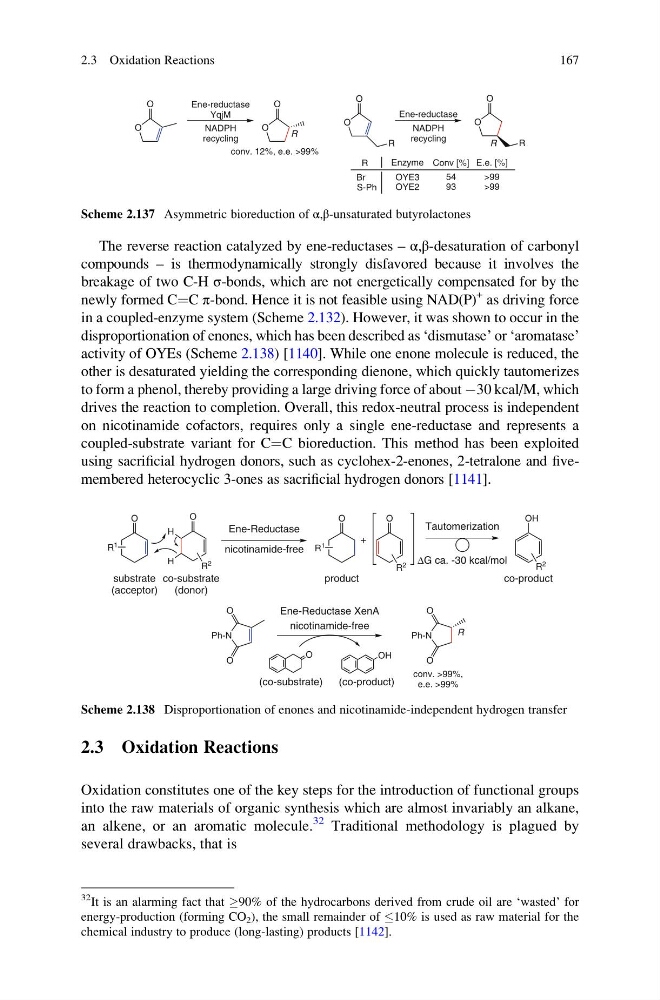
The reverse reaction catalyzed by ene-reductases – α,β-desaturation of carbonyl
compounds – is thermodynamically strongly disfavored because it involves the
breakage of two C-H σ-bonds, which are not energetically compensated for by the
newly formed C¼C π-bond. Hence it is not feasible using NAD(P)
+ as driving force
in a coupled-enzyme system (Scheme 2.132). However, it was shown to occur in the
disproportionation of enones, which has been described as ‘dismutase’ or ‘aromatase’
activity of OYEs (Scheme 2.138) [1140]. While one enone molecule is reduced, the
other is desaturated yielding the corresponding dienone, which quickly tautomerizes
to form a phenol, thereby providing a large driving force of about À30 kcal/M, which
drives the reaction to completion. Overall, this redox-neutral process is independent
on nicotinamide cofactors, requires only a single ene-reductase and represents a
coupled-substrate variant for C¼C bioreduction. This method has been exploited
using sacrificial hydrogen donors, such as cyclohex-2-enones, 2-tetralone and fivemembered heterocyclic 3-ones as sacrificial hydrogen donors [1141].
2.3 Oxidation Reactions
Oxidation constitutes one of the key steps for the introduction of functional groups
into the raw materials of organic synthesis which are almost invariably an alkane,
an alkene, or an aromatic molecule.
32 Traditional methodology is plagued by
several drawbacks, that is
Ene-reductase
YqjM
NADPH
recycling
O
O
O
O
R
conv. 12%, e.e. >99%
Ene-reductase
NADPH
recycling
O
O
R
R
O
O
R
R
Enzyme Conv [%] E.e. [%]
Br
S-Ph
OYE3
OYE2
54
93
>99
>99
Scheme 2.137 Asymmetric bioreduction of α,β-unsaturated butyrolactones
O
O
OH
Ene-Reductase
+
O
O
H
H
substrate
(acceptor)
co-substrate
(donor)
nicotinamide-free
Tautomerization
ΔG ca. -30 kcal/mol
product
co-product
R
1
R
2
R 1
R
2
R
2
(co-substrate)
(co-product)
Ene-Reductase XenA
nicotinamide-free
O
OH
Ph-N
O
O
Ph-N
O
O
R
conv. >99%,
e.e. >99%
Scheme 2.138 Disproportionation of enones and nicotinamide-independent hydrogen transfer
32 It is an alarming fact that !90% of the hydrocarbons derived from crude oil are ‘wasted’ for
energy-production (forming CO 2 ), the small remainder of 10% is used as raw material for the
chemical industry to produce (long-lasting) products [1142].
2.3 Oxidation Reactions
167
compounds – is thermodynamically strongly disfavored because it involves the
breakage of two C-H σ-bonds, which are not energetically compensated for by the
newly formed C¼C π-bond. Hence it is not feasible using NAD(P)
+ as driving force
in a coupled-enzyme system (Scheme 2.132). However, it was shown to occur in the
disproportionation of enones, which has been described as ‘dismutase’ or ‘aromatase’
activity of OYEs (Scheme 2.138) [1140]. While one enone molecule is reduced, the
other is desaturated yielding the corresponding dienone, which quickly tautomerizes
to form a phenol, thereby providing a large driving force of about À30 kcal/M, which
drives the reaction to completion. Overall, this redox-neutral process is independent
on nicotinamide cofactors, requires only a single ene-reductase and represents a
coupled-substrate variant for C¼C bioreduction. This method has been exploited
using sacrificial hydrogen donors, such as cyclohex-2-enones, 2-tetralone and fivemembered heterocyclic 3-ones as sacrificial hydrogen donors [1141].
2.3 Oxidation Reactions
Oxidation constitutes one of the key steps for the introduction of functional groups
into the raw materials of organic synthesis which are almost invariably an alkane,
an alkene, or an aromatic molecule.
32 Traditional methodology is plagued by
several drawbacks, that is
Ene-reductase
YqjM
NADPH
recycling
O
O
O
O
R
conv. 12%, e.e. >99%
Ene-reductase
NADPH
recycling
O
O
R
R
O
O
R
R
Enzyme Conv [%] E.e. [%]
Br
S-Ph
OYE3
OYE2
54
93
>99
>99
Scheme 2.137 Asymmetric bioreduction of α,β-unsaturated butyrolactones
O
O
OH
Ene-Reductase
+
O
O
H
H
substrate
(acceptor)
co-substrate
(donor)
nicotinamide-free
Tautomerization
ΔG ca. -30 kcal/mol
product
co-product
R
1
R
2
R 1
R
2
R
2
(co-substrate)
(co-product)
Ene-Reductase XenA
nicotinamide-free
O
OH
Ph-N
O
O
Ph-N
O
O
R
conv. >99%,
e.e. >99%
Scheme 2.138 Disproportionation of enones and nicotinamide-independent hydrogen transfer
32 It is an alarming fact that !90% of the hydrocarbons derived from crude oil are ‘wasted’ for
energy-production (forming CO 2 ), the small remainder of 10% is used as raw material for the
chemical industry to produce (long-lasting) products [1142].
2.3 Oxidation Reactions
167