

of a (Z )-maleate [1132]. This bioreduction was upscaled to 70g batch size with
subsequent in situ ester hydrolysis [1133].
The suitability of β-substituted α-haloacrylate esters as substrates for
ene-reductases was first proven using baker’s yeast and the absolute configuration
of the product was shown to depend on the (E/Z)-configuration of the substrate
[1134]. While the chiral recognition of the (Z)-alkenes was perfect, the (E)-isomers
gave products with lower e.e. and it was shown that the microbial reduction took
place on the carboxylic acid stage, which were formed enzymatically by hydrolysis
of the starting esters prior to the reduction step [1135].
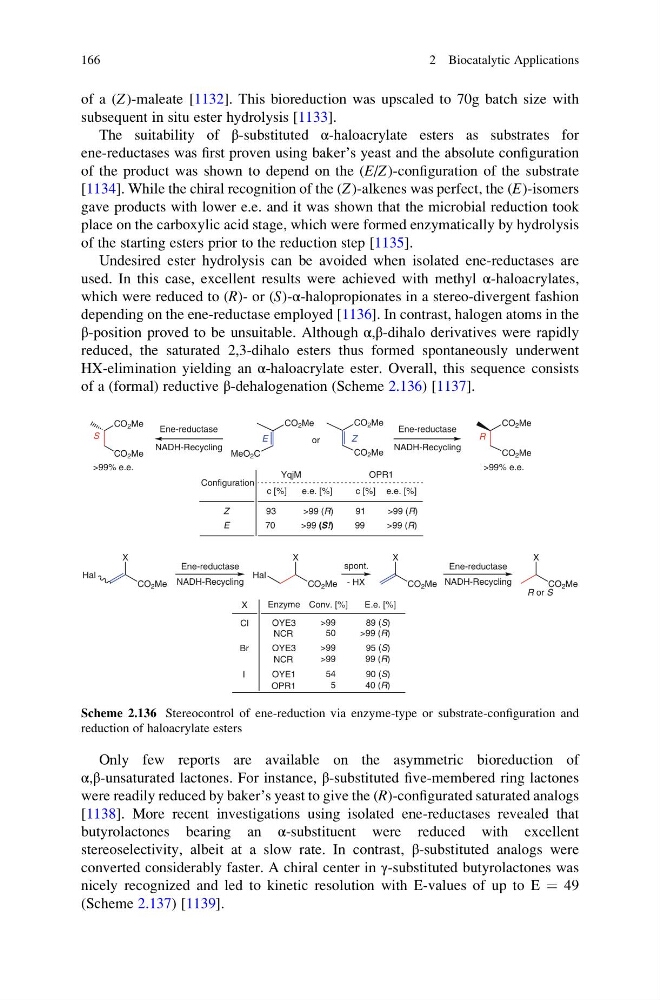
Undesired ester hydrolysis can be avoided when isolated ene-reductases are
used. In this case, excellent results were achieved with methyl α-haloacrylates,
which were reduced to (R)- or (S)-α-halopropionates in a stereo-divergent fashion
depending on the ene-reductase employed [1136]. In contrast, halogen atoms in the
β-position proved to be unsuitable. Although α,β-dihalo derivatives were rapidly
reduced, the saturated 2,3-dihalo esters thus formed spontaneously underwent
HX-elimination yielding an α-haloacrylate ester. Overall, this sequence consists
of a (formal) reductive β-dehalogenation (Scheme 2.136) [1137].
Only few reports are available on the asymmetric bioreduction of
α,β-unsaturated lactones. For instance, β-substituted five-membered ring lactones
were readily reduced by baker’s yeast to give the (R)-configurated saturated analogs
[1138]. More recent investigations using isolated ene-reductases revealed that
butyrolactones bearing an α-substituent were reduced with excellent
stereoselectivity, albeit at a slow rate. In contrast, β-substituted analogs were
converted considerably faster. A chiral center in γ-substituted butyrolactones was
nicely recognized and led to kinetic resolution with E-values of up to E ¼ 49
(Scheme 2.137) [1139].
CO 2 Me
CO 2 Me
CO 2 Me
CO 2 Me
CO 2 Me
CO 2 Me
MeO 2 C
CO 2 Me
Configuration
E
>99 (R)
70
99
>99 (S!)
Z
>99 (R)
93
91
>99 (R)
e.e. [%]
c [%]
e.e. [%]
c [%]
YqjM
NADH-Recycling
Ene-reductase
NADH-Recycling
or
E
Z
OPR1
R
S
Ene-reductase
>99% e.e.
>99% e.e.
CO 2 Me
X
CO 2 Me
X
R or S
CO 2 Me
X
Hal
spont.
- HX
CO 2 Me
X
Hal
NADH-Recycling
Ene-reductase
NADH-Recycling
Ene-reductase
X
Enzyme Conv. [%]
E.e. [%]
Cl
Br
I
OYE3
NCR
>99
50
89 (S)
>99 (R)
OYE3
NCR
>99
>99
95 (S)
99 (R)
OYE1
OPR1
54
5
90 (S)
40 (R)
Scheme 2.136 Stereocontrol of ene-reduction via enzyme-type or substrate-configuration and
reduction of haloacrylate esters
166
2 Biocatalytic Applications
subsequent in situ ester hydrolysis [1133].
The suitability of β-substituted α-haloacrylate esters as substrates for
ene-reductases was first proven using baker’s yeast and the absolute configuration
of the product was shown to depend on the (E/Z)-configuration of the substrate
[1134]. While the chiral recognition of the (Z)-alkenes was perfect, the (E)-isomers
gave products with lower e.e. and it was shown that the microbial reduction took
place on the carboxylic acid stage, which were formed enzymatically by hydrolysis
of the starting esters prior to the reduction step [1135].
Undesired ester hydrolysis can be avoided when isolated ene-reductases are
used. In this case, excellent results were achieved with methyl α-haloacrylates,
which were reduced to (R)- or (S)-α-halopropionates in a stereo-divergent fashion
depending on the ene-reductase employed [1136]. In contrast, halogen atoms in the
β-position proved to be unsuitable. Although α,β-dihalo derivatives were rapidly
reduced, the saturated 2,3-dihalo esters thus formed spontaneously underwent
HX-elimination yielding an α-haloacrylate ester. Overall, this sequence consists
of a (formal) reductive β-dehalogenation (Scheme 2.136) [1137].
Only few reports are available on the asymmetric bioreduction of
α,β-unsaturated lactones. For instance, β-substituted five-membered ring lactones
were readily reduced by baker’s yeast to give the (R)-configurated saturated analogs
[1138]. More recent investigations using isolated ene-reductases revealed that
butyrolactones bearing an α-substituent were reduced with excellent
stereoselectivity, albeit at a slow rate. In contrast, β-substituted analogs were
converted considerably faster. A chiral center in γ-substituted butyrolactones was
nicely recognized and led to kinetic resolution with E-values of up to E ¼ 49
(Scheme 2.137) [1139].
CO 2 Me
CO 2 Me
CO 2 Me
CO 2 Me
CO 2 Me
CO 2 Me
MeO 2 C
CO 2 Me
Configuration
E
>99 (R)
70
99
>99 (S!)
Z
>99 (R)
93
91
>99 (R)
e.e. [%]
c [%]
e.e. [%]
c [%]
YqjM
NADH-Recycling
Ene-reductase
NADH-Recycling
or
E
Z
OPR1
R
S
Ene-reductase
>99% e.e.
>99% e.e.
CO 2 Me
X
CO 2 Me
X
R or S
CO 2 Me
X
Hal
spont.
- HX
CO 2 Me
X
Hal
NADH-Recycling
Ene-reductase
NADH-Recycling
Ene-reductase
X
Enzyme Conv. [%]
E.e. [%]
Cl
Br
I
OYE3
NCR
>99
50
89 (S)
>99 (R)
OYE3
NCR
>99
>99
95 (S)
99 (R)
OYE1
OPR1
54
5
90 (S)
40 (R)
Scheme 2.136 Stereocontrol of ene-reduction via enzyme-type or substrate-configuration and
reduction of haloacrylate esters
166
2 Biocatalytic Applications