

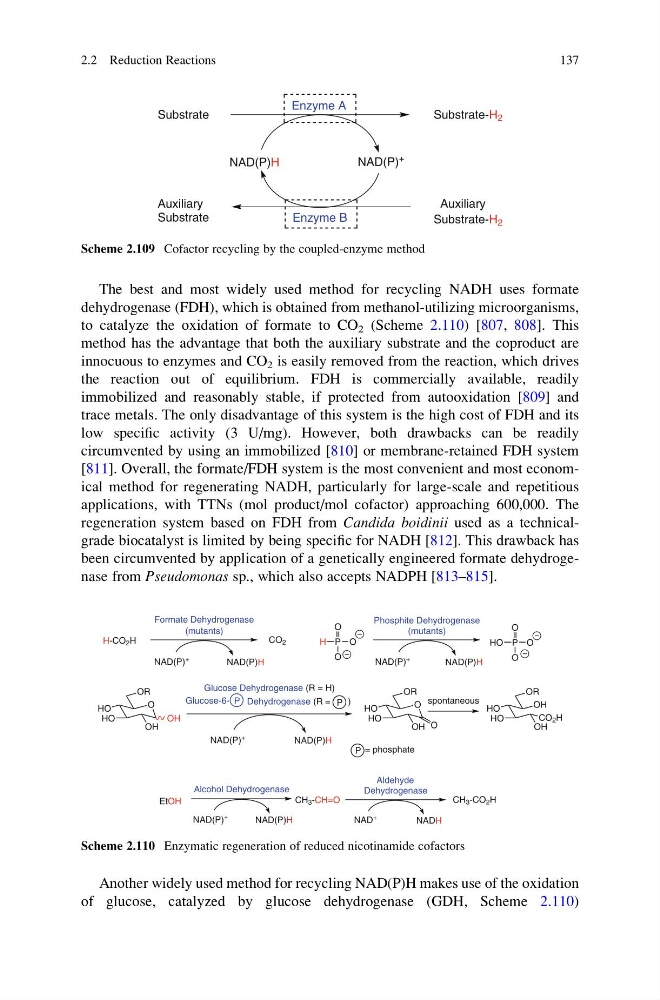
The best and most widely used method for recycling NADH uses formate
dehydrogenase (FDH), which is obtained from methanol-utilizing microorganisms,
to catalyze the oxidation of formate to CO 2 (Scheme 2.110) [807, 808]. This
method has the advantage that both the auxiliary substrate and the coproduct are
innocuous to enzymes and CO 2 is easily removed from the reaction, which drives
the reaction out of equilibrium. FDH is commercially available, readily
immobilized and reasonably stable, if protected from autooxidation [809] and
trace metals. The only disadvantage of this system is the high cost of FDH and its
low specific activity (3 U/mg). However, both drawbacks can be readily
circumvented by using an immobilized [810] or membrane-retained FDH system
[811]. Overall, the formate/FDH system is the most convenient and most economical method for regenerating NADH, particularly for large-scale and repetitious
applications, with TTNs (mol product/mol cofactor) approaching 600,000. The
regeneration system based on FDH from Candida boidinii used as a technicalgrade biocatalyst is limited by being specific for NADH [812]. This drawback has
been circumvented by application of a genetically engineered formate dehydrogenase from Pseudomonas sp., which also accepts NADPH [813–815].
Another widely used method for recycling NAD(P)H makes use of the oxidation
of glucose, catalyzed by glucose dehydrogenase (GDH, Scheme 2.110)
Enzyme B
Enzyme A
NAD(P)
+
NAD(P)H
Auxiliary
Substrate-H 2
Auxiliary
Substrate
Substrate-H 2
Substrate
Scheme 2.109 Cofactor recycling by the coupled-enzyme method
O
O
HO
O
P
O
O
H
O
P
OH
OR
HO
HO
OH
O
O
OR
HO
HO
OH
O
OR
HO
HO
OH
CO 2 H
OH
Dehydrogenase (R =
)
(mutants)
(mutants)
NAD(P)H
NAD(P)
+
Phosphite Dehydrogenase
NAD(P)H
NAD(P)
+
Glucose-6Formate Dehydrogenase
Glucose Dehydrogenase (R = H)
NAD(P)H
NAD(P)
+
spontaneous
NAD(P)
+
NAD(P)H
Alcohol Dehydrogenase
Aldehyde
Dehydrogenase
= phosphate
P
P
P
H-CO 2 H
CO 2
EtOH
CH 3 -CO 2 H
CH 3 -CH=O
NADH
NAD
+
Scheme 2.110 Enzymatic regeneration of reduced nicotinamide cofactors
2.2 Reduction Reactions
137
dehydrogenase (FDH), which is obtained from methanol-utilizing microorganisms,
to catalyze the oxidation of formate to CO 2 (Scheme 2.110) [807, 808]. This
method has the advantage that both the auxiliary substrate and the coproduct are
innocuous to enzymes and CO 2 is easily removed from the reaction, which drives
the reaction out of equilibrium. FDH is commercially available, readily
immobilized and reasonably stable, if protected from autooxidation [809] and
trace metals. The only disadvantage of this system is the high cost of FDH and its
low specific activity (3 U/mg). However, both drawbacks can be readily
circumvented by using an immobilized [810] or membrane-retained FDH system
[811]. Overall, the formate/FDH system is the most convenient and most economical method for regenerating NADH, particularly for large-scale and repetitious
applications, with TTNs (mol product/mol cofactor) approaching 600,000. The
regeneration system based on FDH from Candida boidinii used as a technicalgrade biocatalyst is limited by being specific for NADH [812]. This drawback has
been circumvented by application of a genetically engineered formate dehydrogenase from Pseudomonas sp., which also accepts NADPH [813–815].
Another widely used method for recycling NAD(P)H makes use of the oxidation
of glucose, catalyzed by glucose dehydrogenase (GDH, Scheme 2.110)
Enzyme B
Enzyme A
NAD(P)
+
NAD(P)H
Auxiliary
Substrate-H 2
Auxiliary
Substrate
Substrate-H 2
Substrate
Scheme 2.109 Cofactor recycling by the coupled-enzyme method
O
O
HO
O
P
O
O
H
O
P
OH
OR
HO
HO
OH
O
O
OR
HO
HO
OH
O
OR
HO
HO
OH
CO 2 H
OH
Dehydrogenase (R =
)
(mutants)
(mutants)
NAD(P)H
NAD(P)
+
Phosphite Dehydrogenase
NAD(P)H
NAD(P)
+
Glucose-6Formate Dehydrogenase
Glucose Dehydrogenase (R = H)
NAD(P)H
NAD(P)
+
spontaneous
NAD(P)
+
NAD(P)H
Alcohol Dehydrogenase
Aldehyde
Dehydrogenase
= phosphate
P
P
P
H-CO 2 H
CO 2
EtOH
CH 3 -CO 2 H
CH 3 -CH=O
NADH
NAD
+
Scheme 2.110 Enzymatic regeneration of reduced nicotinamide cofactors
2.2 Reduction Reactions
137