

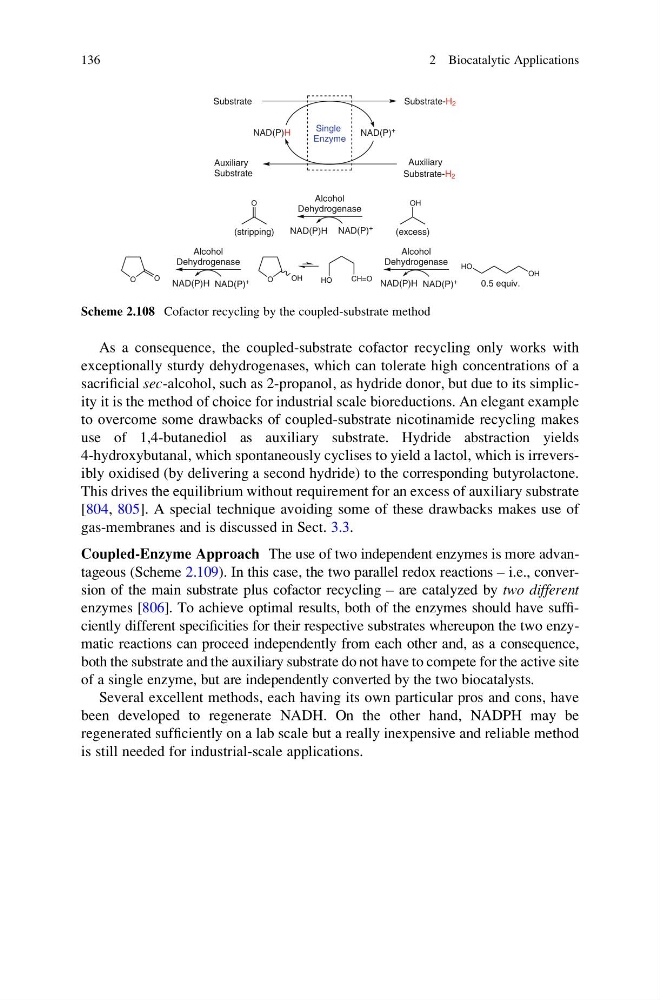
As a consequence, the coupled-substrate cofactor recycling only works with
exceptionally sturdy dehydrogenases, which can tolerate high concentrations of a
sacrificial sec-alcohol, such as 2-propanol, as hydride donor, but due to its simplicity it is the method of choice for industrial scale bioreductions. An elegant example
to overcome some drawbacks of coupled-substrate nicotinamide recycling makes
use of 1,4-butanediol as auxiliary substrate. Hydride abstraction yields
4-hydroxybutanal, which spontaneously cyclises to yield a lactol, which is irreversibly oxidised (by delivering a second hydride) to the corresponding butyrolactone.
This drives the equilibrium without requirement for an excess of auxiliary substrate
[804, 805]. A special technique avoiding some of these drawbacks makes use of
gas-membranes and is discussed in Sect. 3.3.
Coupled-Enzyme Approach The use of two independent enzymes is more advantageous (Scheme 2.109). In this case, the two parallel redox reactions – i.e., conversion of the main substrate plus cofactor recycling – are catalyzed by two different
enzymes [806]. To achieve optimal results, both of the enzymes should have sufficiently different specificities for their respective substrates whereupon the two enzymatic reactions can proceed independently from each other and, as a consequence,
both the substrate and the auxiliary substrate do not have to compete for the active site
of a single enzyme, but are independently converted by the two biocatalysts.
Several excellent methods, each having its own particular pros and cons, have
been developed to regenerate NADH. On the other hand, NADPH may be
regenerated sufficiently on a lab scale but a really inexpensive and reliable method
is still needed for industrial-scale applications.
NAD(P) +
NAD(P)H
Single
Enzyme
Auxiliary
Substrate-H 2
Auxiliary
Substrate
Substrate-H 2
Substrate
NAD(P) +
NAD(P)H
Alcohol
Dehydrogenase
NAD(P) +
NAD(P)H
Alcohol
Dehydrogenase
OH
O
(stripping)
(excess)
HO
OH
O
OH
O
O
0.5 equiv.
CH=O
HO
NAD(P)
+
NAD(P)H
Alcohol
Dehydrogenase
Scheme 2.108 Cofactor recycling by the coupled-substrate method
136
2 Biocatalytic Applications
exceptionally sturdy dehydrogenases, which can tolerate high concentrations of a
sacrificial sec-alcohol, such as 2-propanol, as hydride donor, but due to its simplicity it is the method of choice for industrial scale bioreductions. An elegant example
to overcome some drawbacks of coupled-substrate nicotinamide recycling makes
use of 1,4-butanediol as auxiliary substrate. Hydride abstraction yields
4-hydroxybutanal, which spontaneously cyclises to yield a lactol, which is irreversibly oxidised (by delivering a second hydride) to the corresponding butyrolactone.
This drives the equilibrium without requirement for an excess of auxiliary substrate
[804, 805]. A special technique avoiding some of these drawbacks makes use of
gas-membranes and is discussed in Sect. 3.3.
Coupled-Enzyme Approach The use of two independent enzymes is more advantageous (Scheme 2.109). In this case, the two parallel redox reactions – i.e., conversion of the main substrate plus cofactor recycling – are catalyzed by two different
enzymes [806]. To achieve optimal results, both of the enzymes should have sufficiently different specificities for their respective substrates whereupon the two enzymatic reactions can proceed independently from each other and, as a consequence,
both the substrate and the auxiliary substrate do not have to compete for the active site
of a single enzyme, but are independently converted by the two biocatalysts.
Several excellent methods, each having its own particular pros and cons, have
been developed to regenerate NADH. On the other hand, NADPH may be
regenerated sufficiently on a lab scale but a really inexpensive and reliable method
is still needed for industrial-scale applications.
NAD(P) +
NAD(P)H
Single
Enzyme
Auxiliary
Substrate-H 2
Auxiliary
Substrate
Substrate-H 2
Substrate
NAD(P) +
NAD(P)H
Alcohol
Dehydrogenase
NAD(P) +
NAD(P)H
Alcohol
Dehydrogenase
OH
O
(stripping)
(excess)
HO
OH
O
OH
O
O
0.5 equiv.
CH=O
HO
NAD(P)
+
NAD(P)H
Alcohol
Dehydrogenase
Scheme 2.108 Cofactor recycling by the coupled-substrate method
136
2 Biocatalytic Applications