

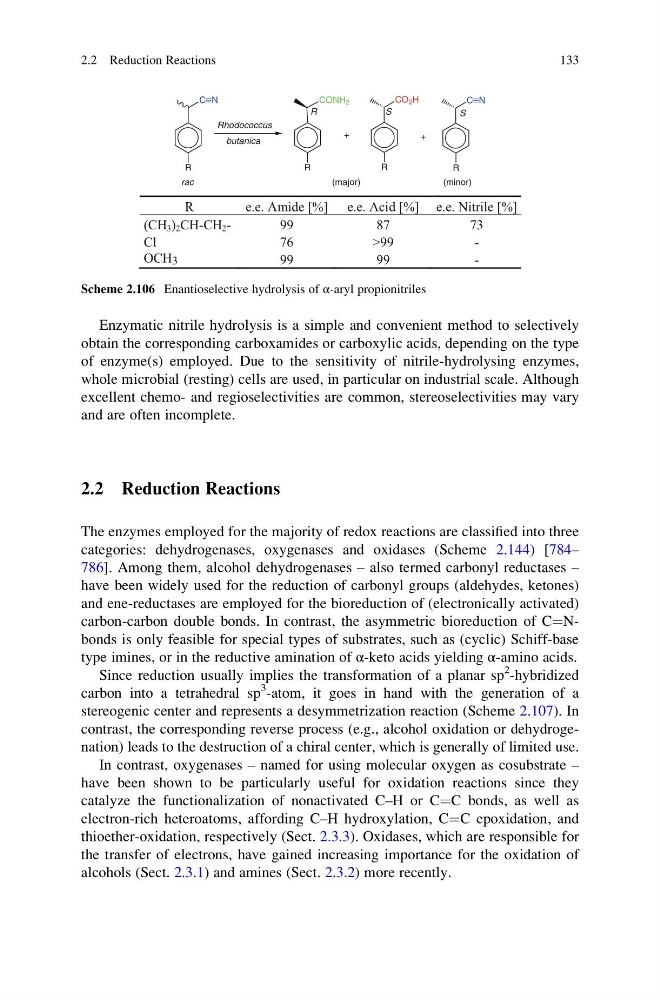
Enzymatic nitrile hydrolysis is a simple and convenient method to selectively
obtain the corresponding carboxamides or carboxylic acids, depending on the type
of enzyme(s) employed. Due to the sensitivity of nitrile-hydrolysing enzymes,
whole microbial (resting) cells are used, in particular on industrial scale. Although
excellent chemo- and regioselectivities are common, stereoselectivities may vary
and are often incomplete.
2.2 Reduction Reactions
The enzymes employed for the majority of redox reactions are classified into three
categories: dehydrogenases, oxygenases and oxidases (Scheme 2.144) [784–
786]. Among them, alcohol dehydrogenases – also termed carbonyl reductases –
have been widely used for the reduction of carbonyl groups (aldehydes, ketones)
and ene-reductases are employed for the bioreduction of (electronically activated)
carbon-carbon double bonds. In contrast, the asymmetric bioreduction of C¼Nbonds is only feasible for special types of substrates, such as (cyclic) Schiff-base
type imines, or in the reductive amination of α-keto acids yielding α-amino acids.
Since reduction usually implies the transformation of a planar sp
2 -hybridized
carbon into a tetrahedral sp
3 -atom, it goes in hand with the generation of a
stereogenic center and represents a desymmetrization reaction (Scheme 2.107). In
contrast, the corresponding reverse process (e.g., alcohol oxidation or dehydrogenation) leads to the destruction of a chiral center, which is generally of limited use.
In contrast, oxygenases – named for using molecular oxygen as cosubstrate –
have been shown to be particularly useful for oxidation reactions since they
catalyze the functionalization of nonactivated C–H or C¼C bonds, as well as
electron-rich heteroatoms, affording C–H hydroxylation, C¼C epoxidation, and
thioether-oxidation, respectively (Sect. 2.3.3). Oxidases, which are responsible for
the transfer of electrons, have gained increasing importance for the oxidation of
alcohols (Sect. 2.3.1) and amines (Sect. 2.3.2) more recently.
CONH 2
R
CO 2 H
R
C≡N
R
C≡N
R
(major)
(minor)
Rhodococcus
butanica
+
+
rac
R
S
S
R
e.e. Amide [%] e.e. Acid [%] e.e. Nitrile [%]
(CH 3 ) 2 CH-CH 2 -
9 9
8 7
7 3
Cl
76
>99
-
OCH 3
99
99
-
Scheme 2.106 Enantioselective hydrolysis of α-aryl propionitriles
2.2 Reduction Reactions
133
obtain the corresponding carboxamides or carboxylic acids, depending on the type
of enzyme(s) employed. Due to the sensitivity of nitrile-hydrolysing enzymes,
whole microbial (resting) cells are used, in particular on industrial scale. Although
excellent chemo- and regioselectivities are common, stereoselectivities may vary
and are often incomplete.
2.2 Reduction Reactions
The enzymes employed for the majority of redox reactions are classified into three
categories: dehydrogenases, oxygenases and oxidases (Scheme 2.144) [784–
786]. Among them, alcohol dehydrogenases – also termed carbonyl reductases –
have been widely used for the reduction of carbonyl groups (aldehydes, ketones)
and ene-reductases are employed for the bioreduction of (electronically activated)
carbon-carbon double bonds. In contrast, the asymmetric bioreduction of C¼Nbonds is only feasible for special types of substrates, such as (cyclic) Schiff-base
type imines, or in the reductive amination of α-keto acids yielding α-amino acids.
Since reduction usually implies the transformation of a planar sp
2 -hybridized
carbon into a tetrahedral sp
3 -atom, it goes in hand with the generation of a
stereogenic center and represents a desymmetrization reaction (Scheme 2.107). In
contrast, the corresponding reverse process (e.g., alcohol oxidation or dehydrogenation) leads to the destruction of a chiral center, which is generally of limited use.
In contrast, oxygenases – named for using molecular oxygen as cosubstrate –
have been shown to be particularly useful for oxidation reactions since they
catalyze the functionalization of nonactivated C–H or C¼C bonds, as well as
electron-rich heteroatoms, affording C–H hydroxylation, C¼C epoxidation, and
thioether-oxidation, respectively (Sect. 2.3.3). Oxidases, which are responsible for
the transfer of electrons, have gained increasing importance for the oxidation of
alcohols (Sect. 2.3.1) and amines (Sect. 2.3.2) more recently.
CONH 2
R
CO 2 H
R
C≡N
R
C≡N
R
(major)
(minor)
Rhodococcus
butanica
+
+
rac
R
S
S
R
e.e. Amide [%] e.e. Acid [%] e.e. Nitrile [%]
(CH 3 ) 2 CH-CH 2 -
9 9
8 7
7 3
Cl
76
>99
-
OCH 3
99
99
-
Scheme 2.106 Enantioselective hydrolysis of α-aryl propionitriles
2.2 Reduction Reactions
133