

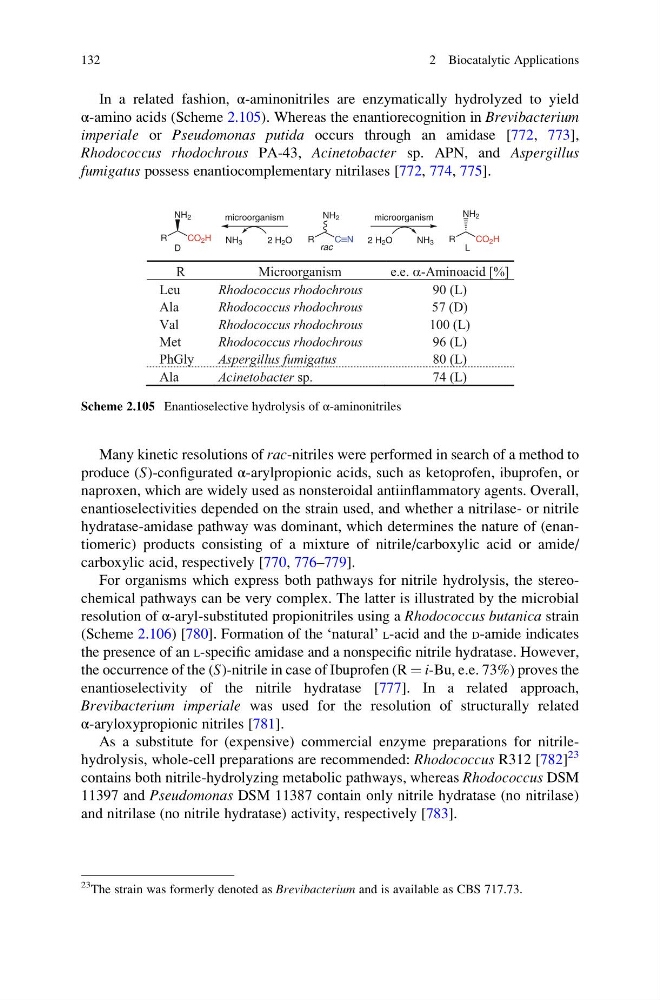
In a related fashion, α-aminonitriles are enzymatically hydrolyzed to yield
α-amino acids (Scheme 2.105). Whereas the enantiorecognition in Brevibacterium
imperiale or Pseudomonas putida occurs through an amidase [772, 773],
Rhodococcus rhodochrous PA-43, Acinetobacter sp. APN, and Aspergillus
fumigatus possess enantiocomplementary nitrilases [772, 774, 775].
Many kinetic resolutions of rac-nitriles were performed in search of a method to
produce (S)-configurated α-arylpropionic acids, such as ketoprofen, ibuprofen, or
naproxen, which are widely used as nonsteroidal antiinflammatory agents. Overall,
enantioselectivities depended on the strain used, and whether a nitrilase- or nitrile
hydratase-amidase pathway was dominant, which determines the nature of (enantiomeric) products consisting of a mixture of nitrile/carboxylic acid or amide/
carboxylic acid, respectively [770, 776–779].
For organisms which express both pathways for nitrile hydrolysis, the stereochemical pathways can be very complex. The latter is illustrated by the microbial
resolution of α-aryl-substituted propionitriles using a Rhodococcus butanica strain
(Scheme 2.106) [780]. Formation of the ‘natural’ L-acid and the D-amide indicates
the presence of an L-specific amidase and a nonspecific nitrile hydratase. However,
the occurrence of the (S)-nitrile in case of Ibuprofen (R ¼ i-Bu, e.e. 73%) proves the
enantioselectivity of the nitrile hydratase [777]. In a related approach,
Brevibacterium imperiale was used for the resolution of structurally related
α-aryloxypropionic nitriles [781].
As a substitute for (expensive) commercial enzyme preparations for nitrilehydrolysis, whole-cell preparations are recommended: Rhodococcus R312 [782]
23
contains both nitrile-hydrolyzing metabolic pathways, whereas Rhodococcus DSM
11397 and Pseudomonas DSM 11387 contain only nitrile hydratase (no nitrilase)
and nitrilase (no nitrile hydratase) activity, respectively [783].
23 The strain was formerly denoted as Brevibacterium and is available as CBS 717.73.
C≡N
NH 2
R
NH 2
CO 2 H
R
NH 2
CO 2 H
R
rac
L
microorganism
D
microorganism
2 H 2 O
NH 3
2 H 2 O
NH 3
R
Microorganism
e.e. α-Aminoacid [%]
Leu
Rhodococcus rhodochrous
90 (L)
Ala
Rhodococcus rhodochrous
57 (D)
Val
Rhodococcus rhodochrous
100 (L)
Met
Rhodococcus rhodochrous
96 (L)
PhGly
Aspergillus fumigatus
80 (L)
Ala
Acinetobacter sp.
74 (L)
Scheme 2.105 Enantioselective hydrolysis of α-aminonitriles
132
2 Biocatalytic Applications
α-amino acids (Scheme 2.105). Whereas the enantiorecognition in Brevibacterium
imperiale or Pseudomonas putida occurs through an amidase [772, 773],
Rhodococcus rhodochrous PA-43, Acinetobacter sp. APN, and Aspergillus
fumigatus possess enantiocomplementary nitrilases [772, 774, 775].
Many kinetic resolutions of rac-nitriles were performed in search of a method to
produce (S)-configurated α-arylpropionic acids, such as ketoprofen, ibuprofen, or
naproxen, which are widely used as nonsteroidal antiinflammatory agents. Overall,
enantioselectivities depended on the strain used, and whether a nitrilase- or nitrile
hydratase-amidase pathway was dominant, which determines the nature of (enantiomeric) products consisting of a mixture of nitrile/carboxylic acid or amide/
carboxylic acid, respectively [770, 776–779].
For organisms which express both pathways for nitrile hydrolysis, the stereochemical pathways can be very complex. The latter is illustrated by the microbial
resolution of α-aryl-substituted propionitriles using a Rhodococcus butanica strain
(Scheme 2.106) [780]. Formation of the ‘natural’ L-acid and the D-amide indicates
the presence of an L-specific amidase and a nonspecific nitrile hydratase. However,
the occurrence of the (S)-nitrile in case of Ibuprofen (R ¼ i-Bu, e.e. 73%) proves the
enantioselectivity of the nitrile hydratase [777]. In a related approach,
Brevibacterium imperiale was used for the resolution of structurally related
α-aryloxypropionic nitriles [781].
As a substitute for (expensive) commercial enzyme preparations for nitrilehydrolysis, whole-cell preparations are recommended: Rhodococcus R312 [782]
23
contains both nitrile-hydrolyzing metabolic pathways, whereas Rhodococcus DSM
11397 and Pseudomonas DSM 11387 contain only nitrile hydratase (no nitrilase)
and nitrilase (no nitrile hydratase) activity, respectively [783].
23 The strain was formerly denoted as Brevibacterium and is available as CBS 717.73.
C≡N
NH 2
R
NH 2
CO 2 H
R
NH 2
CO 2 H
R
rac
L
microorganism
D
microorganism
2 H 2 O
NH 3
2 H 2 O
NH 3
R
Microorganism
e.e. α-Aminoacid [%]
Leu
Rhodococcus rhodochrous
90 (L)
Ala
Rhodococcus rhodochrous
57 (D)
Val
Rhodococcus rhodochrous
100 (L)
Met
Rhodococcus rhodochrous
96 (L)
PhGly
Aspergillus fumigatus
80 (L)
Ala
Acinetobacter sp.
74 (L)
Scheme 2.105 Enantioselective hydrolysis of α-aminonitriles
132
2 Biocatalytic Applications