

substrates and the relative reactivity of the enzyme-phosphate intermediate with
water or the alcohol substrate. In order to boost trans-phosphorylation over hydrolysis, the following strategies have been developed:
• In presence if a high-energy phosphate donor and elevated concentrations
of the substrate alcohol, trans-phosphorylation is usually a fast process, which
gives acceptable yields of the desired phosphate ester, which has to be
recovered to prevent hydrolysis upon extended reaction times (kinetic control)
[598–600].
• Kinetic control is facilitated by using a flow-system, where the phosphate donor
and the substrate are continuously pumped through a column containing the
immobilized phosphatase. By adjusting the flow rate, the residence (contact)
time between enzyme and reactants can be tuned such that the maximum
conversion is reached when the product leaves the column. Since the
immobilized enzyme stays behind, no undesired hydrolysis can occur [601].
• Phosphatase mutants have been designed which show a greatly diminished
hydrolysis rates but maintain good trans-phosphorylation activities [602].
• Reversal of hydrolysis is possible for selected substrates (e.g. glycerol), which
are tolerated at very high concentrations (~70–95% v/v) at reduced water
activities (thermodynamic control), where inorganic phosphate serves as phosphate donor [603, 604]. In practice, however, workup is problematic due to
highly viscous reaction systems. A schematic representation of the time course
of kinetic versus thermodynamic control is given in Fig. 2.19.
O
Substrate
OH
Substrate
phosphatase
= phosphate
P
P
P
P
P
n
n
n = 1, 2, poly
N NH
His158
Trans-phosphorylation
Hydrolysis
P
H 2 O
fast
slow
N
NH
His197
PP i
P i
R-O-P
R-OH
activation
HN
N
His197
P
O
O
OH
O H
H
O H
R
P i
R O- P
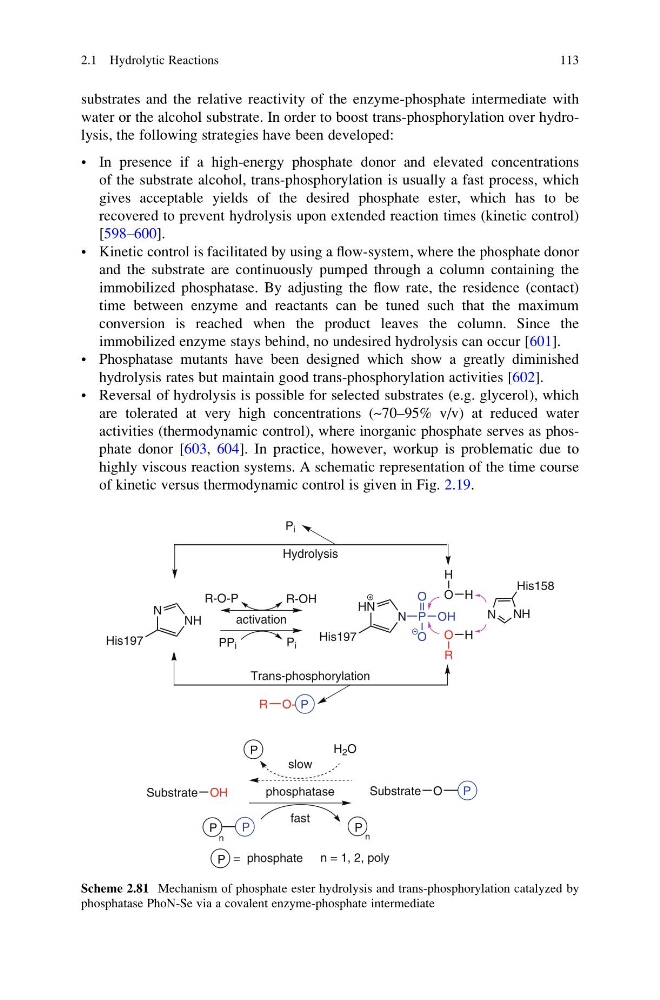
Scheme 2.81 Mechanism of phosphate ester hydrolysis and trans-phosphorylation catalyzed by
phosphatase PhoN-Se via a covalent enzyme-phosphate intermediate
2.1 Hydrolytic Reactions
113
water or the alcohol substrate. In order to boost trans-phosphorylation over hydrolysis, the following strategies have been developed:
• In presence if a high-energy phosphate donor and elevated concentrations
of the substrate alcohol, trans-phosphorylation is usually a fast process, which
gives acceptable yields of the desired phosphate ester, which has to be
recovered to prevent hydrolysis upon extended reaction times (kinetic control)
[598–600].
• Kinetic control is facilitated by using a flow-system, where the phosphate donor
and the substrate are continuously pumped through a column containing the
immobilized phosphatase. By adjusting the flow rate, the residence (contact)
time between enzyme and reactants can be tuned such that the maximum
conversion is reached when the product leaves the column. Since the
immobilized enzyme stays behind, no undesired hydrolysis can occur [601].
• Phosphatase mutants have been designed which show a greatly diminished
hydrolysis rates but maintain good trans-phosphorylation activities [602].
• Reversal of hydrolysis is possible for selected substrates (e.g. glycerol), which
are tolerated at very high concentrations (~70–95% v/v) at reduced water
activities (thermodynamic control), where inorganic phosphate serves as phosphate donor [603, 604]. In practice, however, workup is problematic due to
highly viscous reaction systems. A schematic representation of the time course
of kinetic versus thermodynamic control is given in Fig. 2.19.
O
Substrate
OH
Substrate
phosphatase
= phosphate
P
P
P
P
P
n
n
n = 1, 2, poly
N NH
His158
Trans-phosphorylation
Hydrolysis
P
H 2 O
fast
slow
N
NH
His197
PP i
P i
R-O-P
R-OH
activation
HN
N
His197
P
O
O
OH
O H
H
O H
R
P i
R O- P
Scheme 2.81 Mechanism of phosphate ester hydrolysis and trans-phosphorylation catalyzed by
phosphatase PhoN-Se via a covalent enzyme-phosphate intermediate
2.1 Hydrolytic Reactions
113