

remaining substrate alcohols were obtained with moderate to good optical purities
(88 to >94%). Interestingly, the phosphorylation of the aminoalcohol shown in the
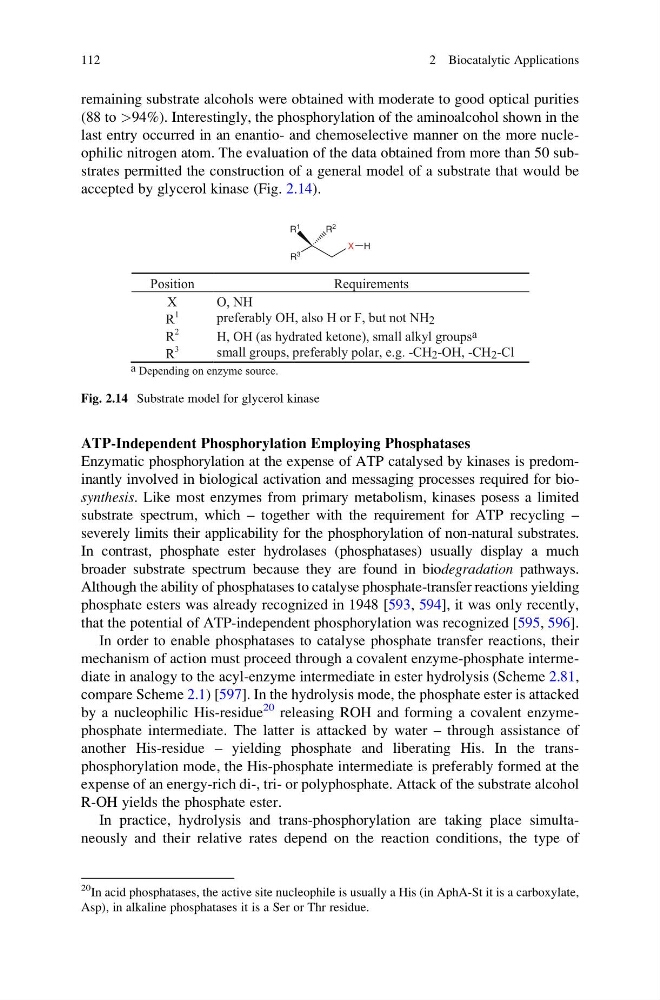
last entry occurred in an enantio- and chemoselective manner on the more nucleophilic nitrogen atom. The evaluation of the data obtained from more than 50 substrates permitted the construction of a general model of a substrate that would be
accepted by glycerol kinase (Fig. 2.14).
ATP-Independent Phosphorylation Employing Phosphatases
Enzymatic phosphorylation at the expense of ATP catalysed by kinases is predominantly involved in biological activation and messaging processes required for biosynthesis. Like most enzymes from primary metabolism, kinases posess a limited
substrate spectrum, which – together with the requirement for ATP recycling –
severely limits their applicability for the phosphorylation of non-natural substrates.
In contrast, phosphate ester hydrolases (phosphatases) usually display a much
broader substrate spectrum because they are found in biodegradation pathways.
Although the ability of phosphatases to catalyse phosphate-transfer reactions yielding
phosphate esters was already recognized in 1948 [593, 594], it was only recently,
that the potential of ATP-independent phosphorylation was recognized [595, 596].
In order to enable phosphatases to catalyse phosphate transfer reactions, their
mechanism of action must proceed through a covalent enzyme-phosphate intermediate in analogy to the acyl-enzyme intermediate in ester hydrolysis (Scheme 2.81,
compare Scheme 2.1) [597]. In the hydrolysis mode, the phosphate ester is attacked
by a nucleophilic His-residue
20 releasing ROH and forming a covalent enzymephosphate intermediate. The latter is attacked by water – through assistance of
another His-residue – yielding phosphate and liberating His. In the transphosphorylation mode, the His-phosphate intermediate is preferably formed at the
expense of an energy-rich di-, tri- or polyphosphate. Attack of the substrate alcohol
R-OH yields the phosphate ester.
In practice, hydrolysis and trans-phosphorylation are taking place simultaneously and their relative rates depend on the reaction conditions, the type of
R 2
R 1
H
X
R 3
Position
Requirements
X
O , N H
R
1
preferably OH, also H or F, but not NH 2
R
2
H, OH (as hydrated ketone), small alkyl groups a
R
3
small groups, preferably polar, e.g. -CH 2 -OH, -CH 2 -Cl
a Depending on enzyme source.
Fig. 2.14 Substrate model for glycerol kinase
20 In acid phosphatases, the active site nucleophile is usually a His (in AphA-St it is a carboxylate,
Asp), in alkaline phosphatases it is a Ser or Thr residue.
112
2 Biocatalytic Applications
(88 to >94%). Interestingly, the phosphorylation of the aminoalcohol shown in the
last entry occurred in an enantio- and chemoselective manner on the more nucleophilic nitrogen atom. The evaluation of the data obtained from more than 50 substrates permitted the construction of a general model of a substrate that would be
accepted by glycerol kinase (Fig. 2.14).
ATP-Independent Phosphorylation Employing Phosphatases
Enzymatic phosphorylation at the expense of ATP catalysed by kinases is predominantly involved in biological activation and messaging processes required for biosynthesis. Like most enzymes from primary metabolism, kinases posess a limited
substrate spectrum, which – together with the requirement for ATP recycling –
severely limits their applicability for the phosphorylation of non-natural substrates.
In contrast, phosphate ester hydrolases (phosphatases) usually display a much
broader substrate spectrum because they are found in biodegradation pathways.
Although the ability of phosphatases to catalyse phosphate-transfer reactions yielding
phosphate esters was already recognized in 1948 [593, 594], it was only recently,
that the potential of ATP-independent phosphorylation was recognized [595, 596].
In order to enable phosphatases to catalyse phosphate transfer reactions, their
mechanism of action must proceed through a covalent enzyme-phosphate intermediate in analogy to the acyl-enzyme intermediate in ester hydrolysis (Scheme 2.81,
compare Scheme 2.1) [597]. In the hydrolysis mode, the phosphate ester is attacked
by a nucleophilic His-residue
20 releasing ROH and forming a covalent enzymephosphate intermediate. The latter is attacked by water – through assistance of
another His-residue – yielding phosphate and liberating His. In the transphosphorylation mode, the His-phosphate intermediate is preferably formed at the
expense of an energy-rich di-, tri- or polyphosphate. Attack of the substrate alcohol
R-OH yields the phosphate ester.
In practice, hydrolysis and trans-phosphorylation are taking place simultaneously and their relative rates depend on the reaction conditions, the type of
R 2
R 1
H
X
R 3
Position
Requirements
X
O , N H
R
1
preferably OH, also H or F, but not NH 2
R
2
H, OH (as hydrated ketone), small alkyl groups a
R
3
small groups, preferably polar, e.g. -CH 2 -OH, -CH 2 -Cl
a Depending on enzyme source.
Fig. 2.14 Substrate model for glycerol kinase
20 In acid phosphatases, the active site nucleophile is usually a His (in AphA-St it is a carboxylate,
Asp), in alkaline phosphatases it is a Ser or Thr residue.
112
2 Biocatalytic Applications