

[457], which makes it an intermediate between an esterase and a lipase. Its
selectivity could be predicted through computer modeling to a fair extent [458],
and for the majority of substrates the Kazlauskas’ rule (Scheme 2.45) can be
applied. In line with these properties of CALB, selectivity-enhancement by addition
of water-miscible organic cosolvents such as t-butanol or acetone is possible – a
technique which is rather common for esterases. All of these properties make
CALB the most widely used lipase both in the hydrolysis [459–464] and synthesis
of esters (Sect. 3.1.1).
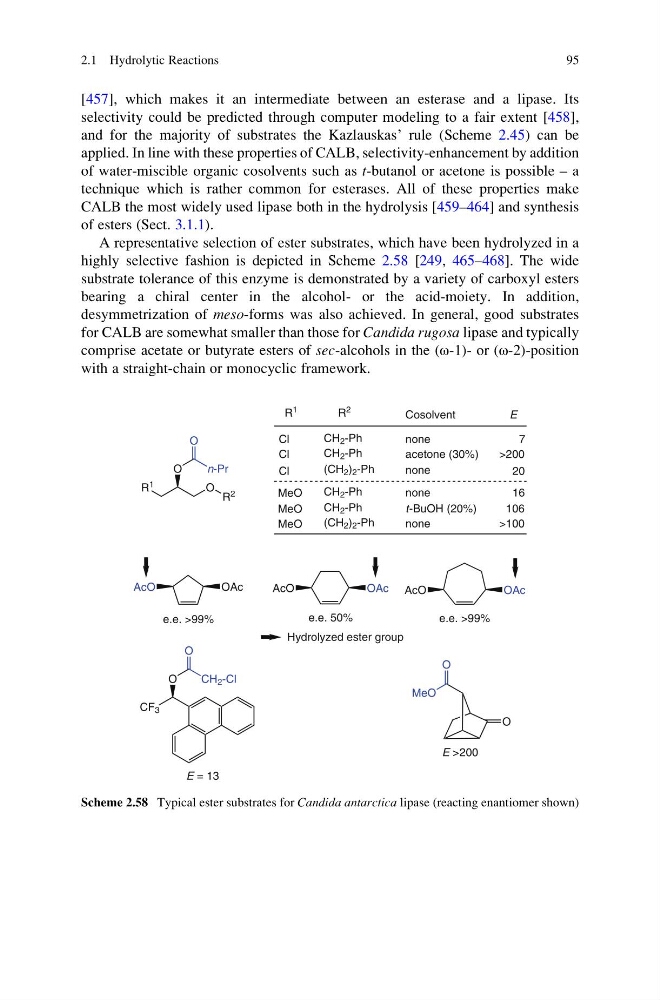
A representative selection of ester substrates, which have been hydrolyzed in a
highly selective fashion is depicted in Scheme 2.58 [249, 465–468]. The wide
substrate tolerance of this enzyme is demonstrated by a variety of carboxyl esters
bearing a chiral center in the alcohol- or the acid-moiety. In addition,
desymmetrization of meso-forms was also achieved. In general, good substrates
for CALB are somewhat smaller than those for Candida rugosa lipase and typically
comprise acetate or butyrate esters of sec-alcohols in the (ω-1)- or (ω-2)-position
with a straight-chain or monocyclic framework.
OAc
AcO
AcO
OAc
AcO
OAc
O
MeO
O
n-Pr
O
O
R
2
O
R 1
CF 3
CH 2 -Cl
O
O
E >200
e.e. >99%
e.e. 50%
e.e. >99%
Hydrolyzed ester group
Cosolvent
E
none
none
none
none
acetone (30%)
t-BuOH (20%)
106
16
7
>200
20
>100
(CH 2 ) 2 -Ph
(CH 2 ) 2 -Ph
E = 13
Cl
Cl
Cl
CH 2 -Ph
CH 2 -Ph
CH 2 -Ph
CH 2 -Ph
R 1
R
2
MeO
MeO
MeO
Scheme 2.58 Typical ester substrates for Candida antarctica lipase (reacting enantiomer shown)
2.1 Hydrolytic Reactions
95
selectivity could be predicted through computer modeling to a fair extent [458],
and for the majority of substrates the Kazlauskas’ rule (Scheme 2.45) can be
applied. In line with these properties of CALB, selectivity-enhancement by addition
of water-miscible organic cosolvents such as t-butanol or acetone is possible – a
technique which is rather common for esterases. All of these properties make
CALB the most widely used lipase both in the hydrolysis [459–464] and synthesis
of esters (Sect. 3.1.1).
A representative selection of ester substrates, which have been hydrolyzed in a
highly selective fashion is depicted in Scheme 2.58 [249, 465–468]. The wide
substrate tolerance of this enzyme is demonstrated by a variety of carboxyl esters
bearing a chiral center in the alcohol- or the acid-moiety. In addition,
desymmetrization of meso-forms was also achieved. In general, good substrates
for CALB are somewhat smaller than those for Candida rugosa lipase and typically
comprise acetate or butyrate esters of sec-alcohols in the (ω-1)- or (ω-2)-position
with a straight-chain or monocyclic framework.
OAc
AcO
AcO
OAc
AcO
OAc
O
MeO
O
n-Pr
O
O
R
2
O
R 1
CF 3
CH 2 -Cl
O
O
E >200
e.e. >99%
e.e. 50%
e.e. >99%
Hydrolyzed ester group
Cosolvent
E
none
none
none
none
acetone (30%)
t-BuOH (20%)
106
16
7
>200
20
>100
(CH 2 ) 2 -Ph
(CH 2 ) 2 -Ph
E = 13
Cl
Cl
Cl
CH 2 -Ph
CH 2 -Ph
CH 2 -Ph
CH 2 -Ph
R 1
R
2
MeO
MeO
MeO
Scheme 2.58 Typical ester substrates for Candida antarctica lipase (reacting enantiomer shown)
2.1 Hydrolytic Reactions
95