

The most versatile ‘champion’ lipase for preparative biotransformations is obtained
from the basidomycetous yeast Candida antarctica (CAL) [452]. As indicated by its
name, this yeast was isolated in Antarctica with the aim of finding enzymes with
extreme properties to be used in detergent formulations. Like others, the organism
produces two isoenzymes A and B, which differ to a significant extent [453]: whereas
lipase A (CALA) is Ca
2+
-dependent and more thermostable, the B-component is less
thermotolerant and metal-independent. More important for preparative applications,
the substrate-specificity varies a great deal, as the A-lipase is highly active in a
nonspecific manner on triglycerides, showing a preference for the sn-2 ester group
[454] and is not very useful for simple nonnatural esters. On the contrary, the
B-component (CALB) is very active on a broad range of nonnatural esters. Both
isoenzymes have been made available in pure form through cloning and
overexpression in Aspergillus oryzae as the host organism [455] and various preparations of this enzyme are produced by Novozymes (DK) in bulk quantities [456]. For the
preparative applications discussed below, the B-component has been used more often.
CALB is an exceptionally robust protein which is deactivated only at
50–60
C,
15 and thus also shows increased resistance towards organic solvents. In
contrast to many other lipases, the enzyme shows only weak interfacial activation
OAc
R
1
PhS
R
2
PhS
O
O-CO-n-Pr
R
N
R
2
R
2
R
1 -CO-O
CH 2
-CH
-C≡CH
R
O-CO-n-Pr
OAc
E >100
R
1 = H, Me; R
2 = i-Pr, Aryl, n-Pent
E = 61-64
R = i-Pr, Ph
>50
27
E
E = 8-24
R = Hal, Et, OMe, SMe, C≡N
E >100
H
Cl
R 2
R
1
Me
n-Pr
Me
=
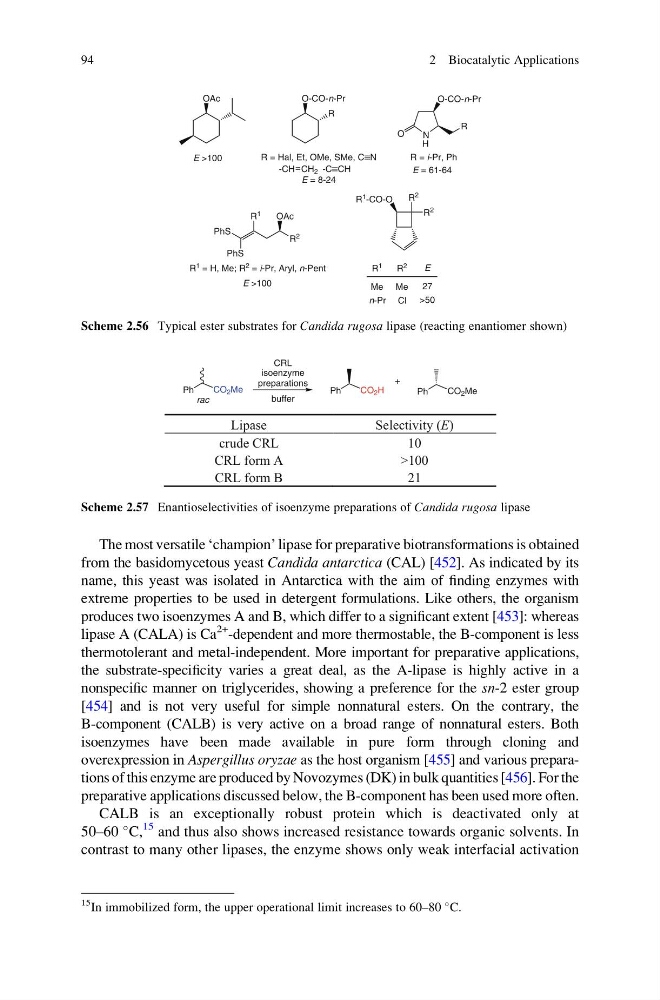
Scheme 2.56 Typical ester substrates for Candida rugosa lipase (reacting enantiomer shown)
CO 2 Me
Ph
CO 2 H
Ph
CO 2 Me
Ph
buffer
CRL
+
rac
isoenzyme
preparations
Lipase
Selectivity (E)
crude CRL
10
CRL form A
>100
CRL form B
21
Scheme 2.57 Enantioselectivities of isoenzyme preparations of Candida rugosa lipase
15 In immobilized form, the upper operational limit increases to 60–80
C.
94
2 Biocatalytic Applications
from the basidomycetous yeast Candida antarctica (CAL) [452]. As indicated by its
name, this yeast was isolated in Antarctica with the aim of finding enzymes with
extreme properties to be used in detergent formulations. Like others, the organism
produces two isoenzymes A and B, which differ to a significant extent [453]: whereas
lipase A (CALA) is Ca
2+
-dependent and more thermostable, the B-component is less
thermotolerant and metal-independent. More important for preparative applications,
the substrate-specificity varies a great deal, as the A-lipase is highly active in a
nonspecific manner on triglycerides, showing a preference for the sn-2 ester group
[454] and is not very useful for simple nonnatural esters. On the contrary, the
B-component (CALB) is very active on a broad range of nonnatural esters. Both
isoenzymes have been made available in pure form through cloning and
overexpression in Aspergillus oryzae as the host organism [455] and various preparations of this enzyme are produced by Novozymes (DK) in bulk quantities [456]. For the
preparative applications discussed below, the B-component has been used more often.
CALB is an exceptionally robust protein which is deactivated only at
50–60
C,
15 and thus also shows increased resistance towards organic solvents. In
contrast to many other lipases, the enzyme shows only weak interfacial activation
OAc
R
1
PhS
R
2
PhS
O
O-CO-n-Pr
R
N
R
2
R
2
R
1 -CO-O
CH 2
-CH
-C≡CH
R
O-CO-n-Pr
OAc
E >100
R
1 = H, Me; R
2 = i-Pr, Aryl, n-Pent
E = 61-64
R = i-Pr, Ph
>50
27
E
E = 8-24
R = Hal, Et, OMe, SMe, C≡N
E >100
H
Cl
R 2
R
1
Me
n-Pr
Me
=
Scheme 2.56 Typical ester substrates for Candida rugosa lipase (reacting enantiomer shown)
CO 2 Me
Ph
CO 2 H
Ph
CO 2 Me
Ph
buffer
CRL
+
rac
isoenzyme
preparations
Lipase
Selectivity (E)
crude CRL
10
CRL form A
>100
CRL form B
21
Scheme 2.57 Enantioselectivities of isoenzyme preparations of Candida rugosa lipase
15 In immobilized form, the upper operational limit increases to 60–80
C.
94
2 Biocatalytic Applications