

36
M. SUGITA
gD = 1 during S period. k2 = k 20 during G 1 and S, and k2 = k 20 + k21
during G 2 and M. If we assume that k21?> k 20 , then Y (predator) decays
strongly in G 2 and x (prey) increases, i.e. mitosis is prepared in the period
G 2 • In the same way k4 = k 40 during G 2 and M and k4 = k 40 + k41 during
G 1 and S. The possibility of DNA replication may be prepared during G 1
period.
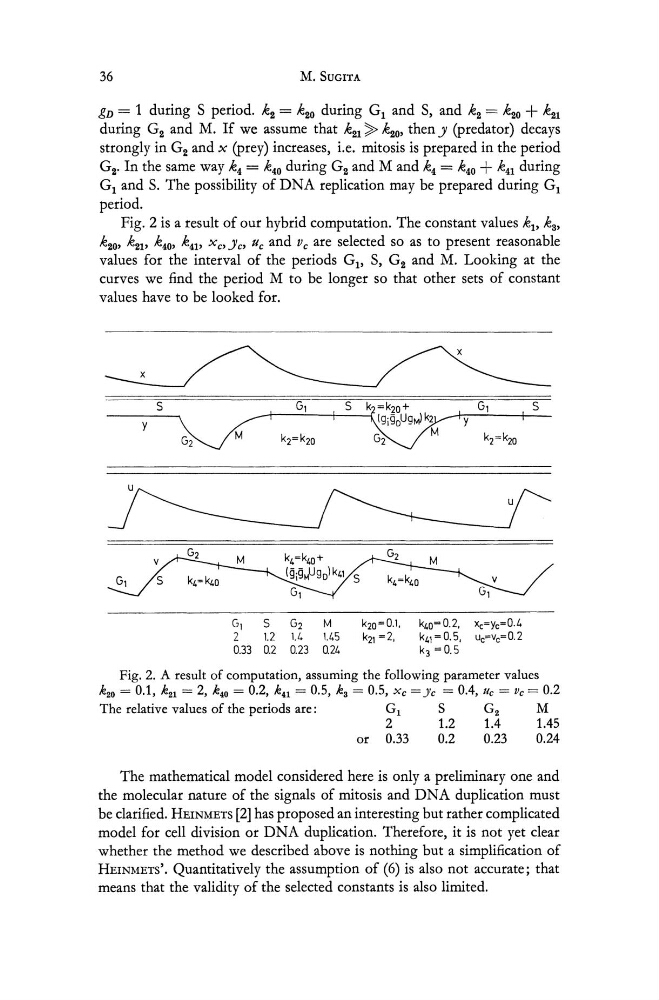
Fig. 2 is a result of our hybrid computation. The constant values kl' k 3 ,
k 20 , k21' k 40 , k 41 , Xe,Ye, He and Ve are selected so as to present reasonable
values for the interval of the periods G 1 , S, G 2 and M. Looking at the
curves we find the period M to be longer so that other sets of constant
values have to be looked for.
x
5
G,
y
M
G,
G1
5
G2
M
2
1.2 1.L.
1.1.5
0..33 0.2 0..23 o..2L.
5
u
k20=o.·l.
k40=O.2. xc=Yc=O.L.
k2' =2.
k4,=o..5, uc=vc=O.2
k3=o.·5
Fig. 2. A result of computation, assuming the following parameter values
k20 = 0.1, k21 = 2, k40 = 0.2, k41 = 0.5, ka = 0.5, Xc = J'e = 0.4, He = Ve = 0.2
The relative values of the periods are:
G1
S
G2
M
2
1.2
1.4
1.45
or 0.33
0.2
0.23
0.24
The mathematical model considered here is only a preliminary one and
the molecular nature of the signals of mitosis and DNA duplication must
be clarified. HEINMETS [2] has proposed an interesting but rather complicated
model for cell division or DNA duplication. Therefore, it is not yet clear
whether the method we described above is nothing but a simplification of
HEINMETS'. Quantitatively the assumption of (6) is also not accurate; that
means that the validity of the selected constants is also limited.
M. SUGITA
gD = 1 during S period. k2 = k 20 during G 1 and S, and k2 = k 20 + k21
during G 2 and M. If we assume that k21?> k 20 , then Y (predator) decays
strongly in G 2 and x (prey) increases, i.e. mitosis is prepared in the period
G 2 • In the same way k4 = k 40 during G 2 and M and k4 = k 40 + k41 during
G 1 and S. The possibility of DNA replication may be prepared during G 1
period.
Fig. 2 is a result of our hybrid computation. The constant values kl' k 3 ,
k 20 , k21' k 40 , k 41 , Xe,Ye, He and Ve are selected so as to present reasonable
values for the interval of the periods G 1 , S, G 2 and M. Looking at the
curves we find the period M to be longer so that other sets of constant
values have to be looked for.
x
5
G,
y
M
G,
G1
5
G2
M
2
1.2 1.L.
1.1.5
0..33 0.2 0..23 o..2L.
5
u
k20=o.·l.
k40=O.2. xc=Yc=O.L.
k2' =2.
k4,=o..5, uc=vc=O.2
k3=o.·5
Fig. 2. A result of computation, assuming the following parameter values
k20 = 0.1, k21 = 2, k40 = 0.2, k41 = 0.5, ka = 0.5, Xc = J'e = 0.4, He = Ve = 0.2
The relative values of the periods are:
G1
S
G2
M
2
1.2
1.4
1.45
or 0.33
0.2
0.23
0.24
The mathematical model considered here is only a preliminary one and
the molecular nature of the signals of mitosis and DNA duplication must
be clarified. HEINMETS [2] has proposed an interesting but rather complicated
model for cell division or DNA duplication. Therefore, it is not yet clear
whether the method we described above is nothing but a simplification of
HEINMETS'. Quantitatively the assumption of (6) is also not accurate; that
means that the validity of the selected constants is also limited.