

Interaction of a Digital System with a Continuous One in the Cell
35
we are considering the correlation between mitotic system and the system
of DNA only qualitatively; therefore, we will simply assume that
IX (x,y,u,v) = fJ (x,y,u,v) = y (x,y,u,v) = a (x,y,u,v) = 1
(6)
kl and k3 are assumed to be constant (decay constant). For k2 and k4 let
us assume the following step functions
where
k2 = k20 + (.gi n gD U gM) k21
k4 = k40 + (iii n gM U gD) k41
(7)
(8)
and gi or gM is the negation of the respective quantities; nand U are the
notations for logical product and sum. YeAS, SUGITA and BENSAM [7] have
suggested the state of inactive DNA, which is one half of the DNA just
replicated and inactivated during G 2 period. gi may correspond to such an
inactive state.
The step function of (7) suggests "isozymes", i.e. enzymes catalyzing
a certain metabolic pathway i --+ j, however, being of several molecular
origin and, thus, regulated by different genetic loci. The rate constant kij
can be represented by
kij = ~ (kij)r gr
(9)
r
where gr =-~ 1 shows that the locus r is an open or readable state and (ki)r
is the rate constant catalyzed by the enzyme corresponding to r.
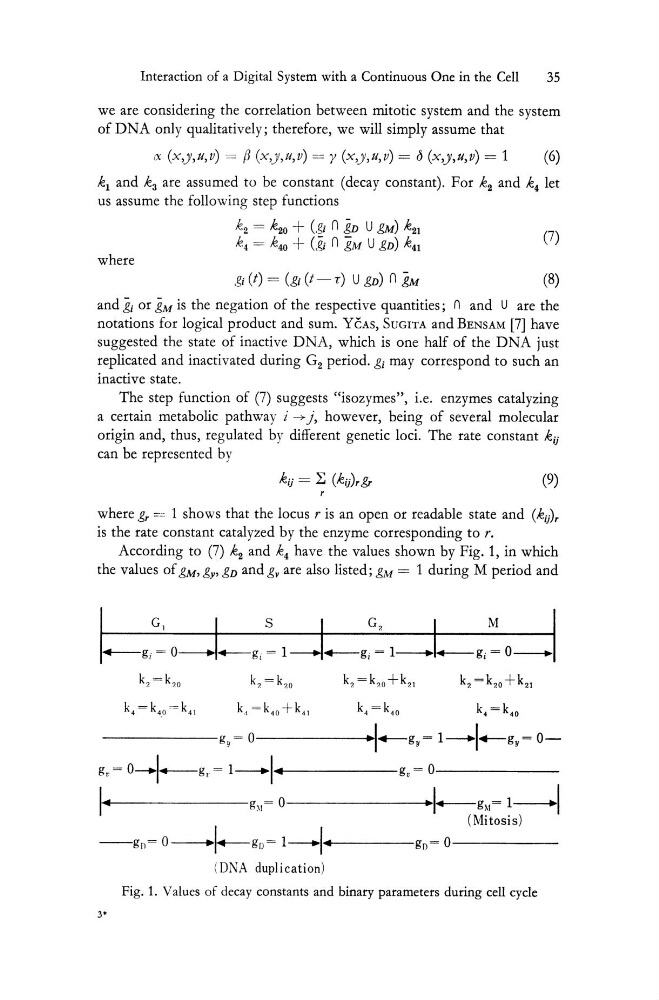
According to (7) k2 and k4 have the values shown by Fig. 1, in which
the values of gM, gy, gD and gv are also listed; gM = 1 during M period and
k, = k,o
k. = k.o
k. = k.o
- - - - - - - g y = o-------~.I4---gy = l-I..--gy = 0g,=o_l_g,=I_I"
g,=O-------I..
g~l= 0
·1-gM= 1----+1
(Mi tosis)
--gn= o--l.---gD= 1_1..
gll= 0 - - - - - - -
(DNA duplication)
Fig. 1. Values of decay constants and binary parameters during cell cycle
3*
35
we are considering the correlation between mitotic system and the system
of DNA only qualitatively; therefore, we will simply assume that
IX (x,y,u,v) = fJ (x,y,u,v) = y (x,y,u,v) = a (x,y,u,v) = 1
(6)
kl and k3 are assumed to be constant (decay constant). For k2 and k4 let
us assume the following step functions
where
k2 = k20 + (.gi n gD U gM) k21
k4 = k40 + (iii n gM U gD) k41
(7)
(8)
and gi or gM is the negation of the respective quantities; nand U are the
notations for logical product and sum. YeAS, SUGITA and BENSAM [7] have
suggested the state of inactive DNA, which is one half of the DNA just
replicated and inactivated during G 2 period. gi may correspond to such an
inactive state.
The step function of (7) suggests "isozymes", i.e. enzymes catalyzing
a certain metabolic pathway i --+ j, however, being of several molecular
origin and, thus, regulated by different genetic loci. The rate constant kij
can be represented by
kij = ~ (kij)r gr
(9)
r
where gr =-~ 1 shows that the locus r is an open or readable state and (ki)r
is the rate constant catalyzed by the enzyme corresponding to r.
According to (7) k2 and k4 have the values shown by Fig. 1, in which
the values of gM, gy, gD and gv are also listed; gM = 1 during M period and
k, = k,o
k. = k.o
k. = k.o
- - - - - - - g y = o-------~.I4---gy = l-I..--gy = 0g,=o_l_g,=I_I"
g,=O-------I..
g~l= 0
·1-gM= 1----+1
(Mi tosis)
--gn= o--l.---gD= 1_1..
gll= 0 - - - - - - -
(DNA duplication)
Fig. 1. Values of decay constants and binary parameters during cell cycle
3*