

C:ausality, C:omplexity and Computers
13
to obtain the system's behaviour a synthesis in quantitative terms is required
of the separatelv established properties of its parts. We must therefore
substitute for the question "What cause?" the question "How much?"
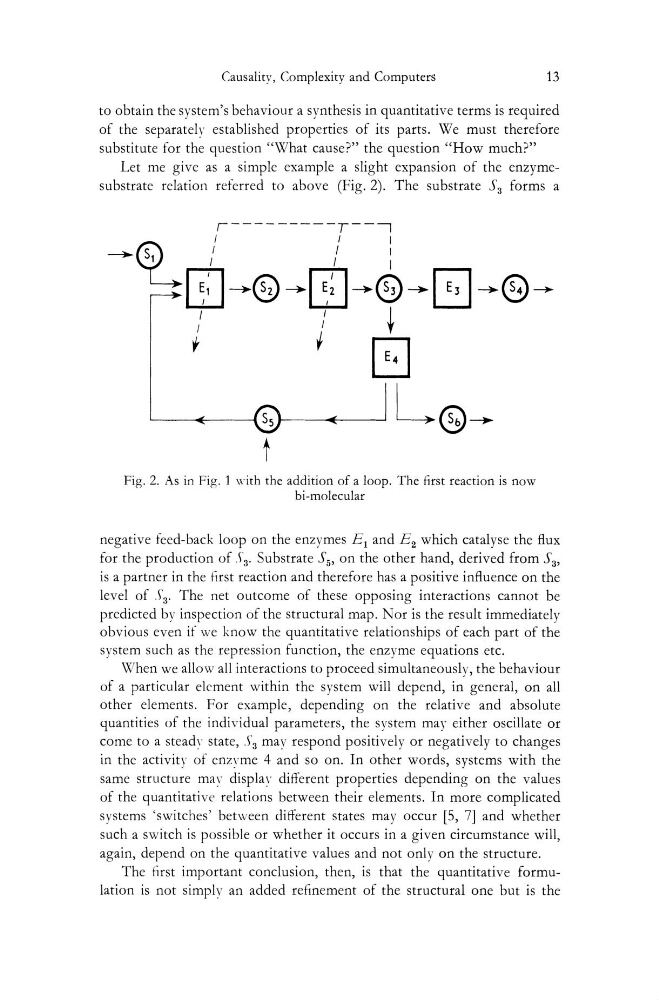
Let me give as a simple example a slight expansion of the enzymesubstrate relation referred to above (Fig. 2). The substrate 53 forms a
t
Fig. 2. As in Fig. 1 with the addition of a loop. The first reaction is now
bi-molecular
negative feed-back loop on the enzymes E1 and E2 which catalyse the flux
for the production of .1'3' Substrate 55' on the other hand, derived from 53'
is a partner in the tirst reaction and therefore has a positive influence on the
level of .1'3' The net outcome of these opposing interactions cannot be
predicted by inspection of the structural map. Nor is the result immediately
obvious even if we know the quantitative relationships of each part of the
system such as the repression function, the enzyme equations etc.
When we allow all interactions to proceed simultaneously, the behaviour
of a particular element within the system will depend, in general, on all
other clements. For example, depending on the relative and absolute
quantities of the individual parameters, the system may either oscillate or
come to a stead," state, .1'3 may respond positively or negatively to changes
in the activity of en7."me 4 and so on. In other words, systems with the
same structure rna\' displa \ different properties depending on the values
of the quantitative relations hetween their elements. In more complicated
systems 'switches' between different states may occur [5, 7J and whether
such a switch is possible or whether it occurs in a given circumstance will,
again, depend on the quantitative values and not only on the structure.
The tirst important conclusion, then, is that the quantitative formulation is not simplv an added refinement of the structural one but is the
13
to obtain the system's behaviour a synthesis in quantitative terms is required
of the separatelv established properties of its parts. We must therefore
substitute for the question "What cause?" the question "How much?"
Let me give as a simple example a slight expansion of the enzymesubstrate relation referred to above (Fig. 2). The substrate 53 forms a
t
Fig. 2. As in Fig. 1 with the addition of a loop. The first reaction is now
bi-molecular
negative feed-back loop on the enzymes E1 and E2 which catalyse the flux
for the production of .1'3' Substrate 55' on the other hand, derived from 53'
is a partner in the tirst reaction and therefore has a positive influence on the
level of .1'3' The net outcome of these opposing interactions cannot be
predicted by inspection of the structural map. Nor is the result immediately
obvious even if we know the quantitative relationships of each part of the
system such as the repression function, the enzyme equations etc.
When we allow all interactions to proceed simultaneously, the behaviour
of a particular element within the system will depend, in general, on all
other clements. For example, depending on the relative and absolute
quantities of the individual parameters, the system may either oscillate or
come to a stead," state, .1'3 may respond positively or negatively to changes
in the activity of en7."me 4 and so on. In other words, systems with the
same structure rna\' displa \ different properties depending on the values
of the quantitative relations hetween their elements. In more complicated
systems 'switches' between different states may occur [5, 7J and whether
such a switch is possible or whether it occurs in a given circumstance will,
again, depend on the quantitative values and not only on the structure.
The tirst important conclusion, then, is that the quantitative formulation is not simplv an added refinement of the structural one but is the