

12
H. KAesER, and]. A. BURNS
nature of this relationship is, constitutes a large part of everyday scientific
pursuit. We thus establish biochemical pathways, nerve and muscle connections, circulatory and transport systems, cell and tissue organisation and
so on. When, as is usual, a large number of elements are involved, the
method of choice is to take these two at a time. This method of isolation
is sometimes achieved by studying the elements actually isolated from the
system. When this is not possible or inconvenient, the rest of the system is
immobilised, held constant or uncoupled and the relations are studied.
The elements may be in the system but not of it.
By a series of such isolation procedures under different conditions it is,
in principle, possible to establish the relationship between all the elements
even if each element stands in some relation to many others.
The net result of such investigations is the establishment of the structure
of the system. We usually represent this diagrammatically as a map, such as
anatomical, biochemical or neurological maps, and this is helpful in some
simple cases to understand and predict the behaviour of the system. In
particular, a linear sequence of interactions is easily grasped. Elaborate
hierarchies of causes can thus be established.
Difficulties, however, begin to appear when it is found that an 'effect'
is connected by a feed-back to a 'prior cause'. Which is 'prior' will depend
on where you started to investigate the system. This is a very general
problem but we would like to demonstrate it by reference to systems with
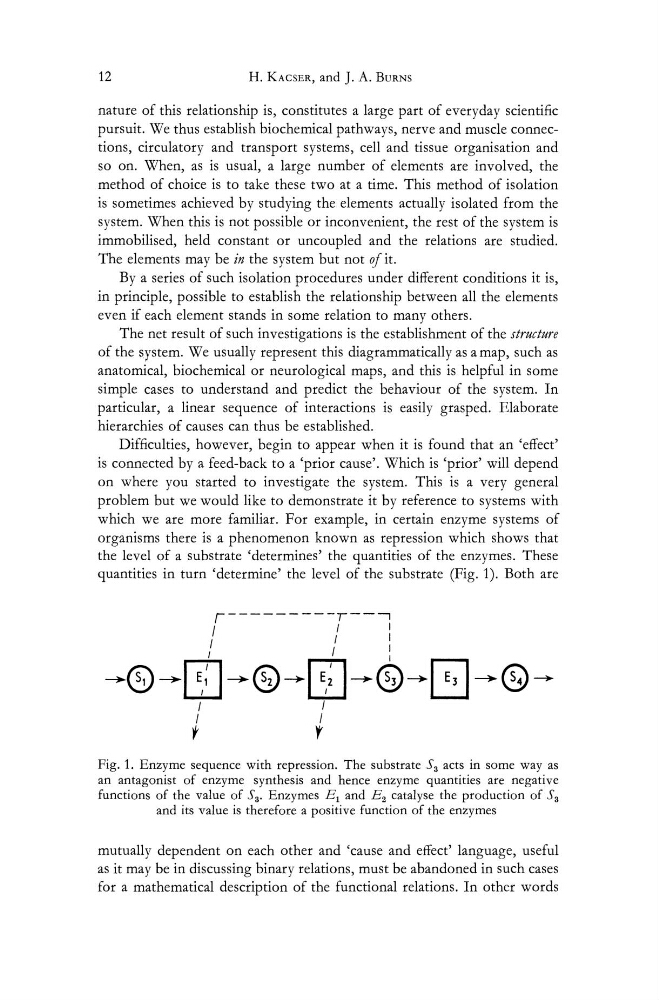
which we are more familiar. For example, in certain enzyme systems of
organisms there is a phenomenon known as repression which shows that
the level of a substrate 'determines' the quantities of the enzymes. These
quantities in turn 'determine' the level of the substrate (Fig. 1). Both are
Fig. 1. Enzyme sequence with repression. The substrate 53 acts in some way as
an antagonist of enzyme synthesis and hence enzyme quantities are negative
functions of the value of 53. Enzymes E1 and E2 catalyse the production of 53
and its value is therefore a positive function of the enzymes
mutually dependent on each other and 'cause and effect' language, useful
as it may be in discussing binary relations, must be abandoned in such cases
for a mathematical description of the functional relations. In other words
H. KAesER, and]. A. BURNS
nature of this relationship is, constitutes a large part of everyday scientific
pursuit. We thus establish biochemical pathways, nerve and muscle connections, circulatory and transport systems, cell and tissue organisation and
so on. When, as is usual, a large number of elements are involved, the
method of choice is to take these two at a time. This method of isolation
is sometimes achieved by studying the elements actually isolated from the
system. When this is not possible or inconvenient, the rest of the system is
immobilised, held constant or uncoupled and the relations are studied.
The elements may be in the system but not of it.
By a series of such isolation procedures under different conditions it is,
in principle, possible to establish the relationship between all the elements
even if each element stands in some relation to many others.
The net result of such investigations is the establishment of the structure
of the system. We usually represent this diagrammatically as a map, such as
anatomical, biochemical or neurological maps, and this is helpful in some
simple cases to understand and predict the behaviour of the system. In
particular, a linear sequence of interactions is easily grasped. Elaborate
hierarchies of causes can thus be established.
Difficulties, however, begin to appear when it is found that an 'effect'
is connected by a feed-back to a 'prior cause'. Which is 'prior' will depend
on where you started to investigate the system. This is a very general
problem but we would like to demonstrate it by reference to systems with
which we are more familiar. For example, in certain enzyme systems of
organisms there is a phenomenon known as repression which shows that
the level of a substrate 'determines' the quantities of the enzymes. These
quantities in turn 'determine' the level of the substrate (Fig. 1). Both are
Fig. 1. Enzyme sequence with repression. The substrate 53 acts in some way as
an antagonist of enzyme synthesis and hence enzyme quantities are negative
functions of the value of 53. Enzymes E1 and E2 catalyse the production of 53
and its value is therefore a positive function of the enzymes
mutually dependent on each other and 'cause and effect' language, useful
as it may be in discussing binary relations, must be abandoned in such cases
for a mathematical description of the functional relations. In other words