

260
K. P. RAo
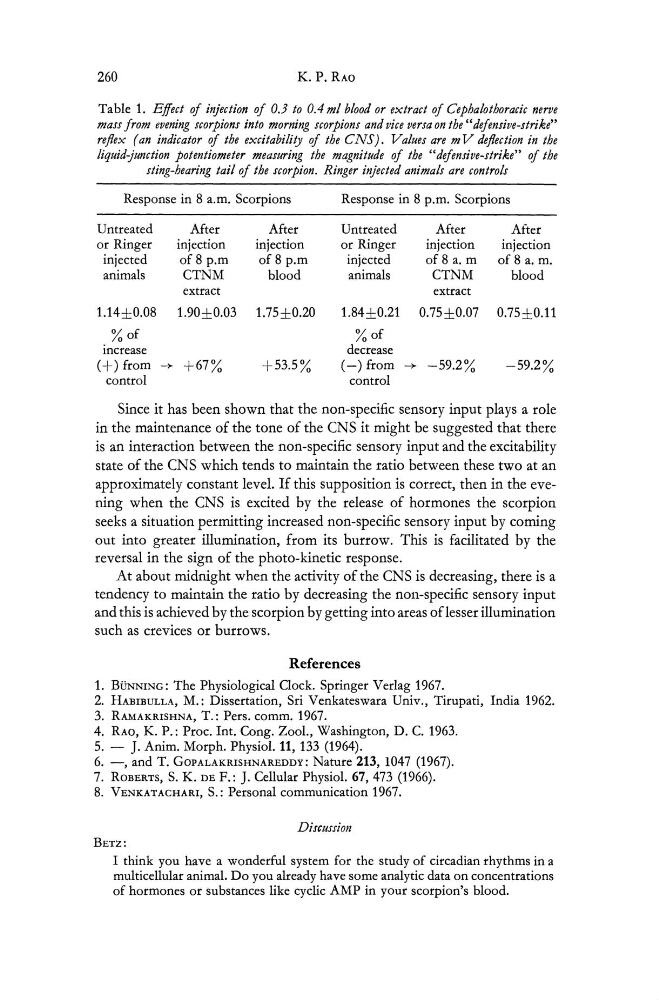
Table 1. Effect of injection of 0.3 to 0.4 ml blood or extract of Cephalothoracic nerve
mass from IJvening scorpions into morning scorpions and vice versa on the "defensive-strike"
reflex (an indicator of the excitability of the CNS). Values are mV deflection in the
liquid-junction potentiometer measuring the magnitude of the "defensive-strike" of the
sting-hearing tail of the scorpion. Ringer injected animals are controls
Response in 8 a.m. Scorpions
Response in 8 p.m. Scorpions
Untreated
After
After
Untreated
After
After
or Ringer
injection
injection
or Ringer
injection
injection
injected
of 8 p.m
of8 p.m
injected
of 8 a. m
of 8 a. m.
animals
CTNM
blood
animals
CTNM
blood
extract
extract
1.14±0.08
1.90±O.O3 1.75±O.20
1.84±O.21 O.75±O.O7 O.75±O.11
% of
% of
increase
decrease
(+) from --+ +67%
+53.5%
(-) from --+ -59.2%
-59.2%
control
control
Since it has been shown that the non-specific sensory input plays a role
in the maintenance of the tone of the eNS it might be suggested that there
is an interaction between the non-specific sensory input and the excitability
state of the eNS which tends to maintain the ratio between these two at an
approximately constant level. If this supposition is correct, then in the evening when the eNS is excited by the release of hormones the scorpion
seeks a situation permitting increased non-specific sensory input by coming
out into greater illumination, from its burrow. This is facilitated by the
reversal in the sign of the photo-kinetic response.
At about midnight when the activity of the eNS is decreasing, there is a
tendency to maintain the ratio by decreasing the non-specific sensory input
and this is achieved by the scorpion by getting into areas of lesser illumination
such as crevices or burrows.
References
1. BUNNING: The Physiological Clock. Springer Verlag 1967.
2. HABIBULLA, M.: Dissertation, Sri Venkateswara Univ., Tirupati, India 1962.
3. RAMAKRISHNA, T.: Pers. comm. 1967.
4. RAo, K. P.: Proc. Int. Congo Zool., Washington, D. C. 1963.
5. - J. Anim. Morph. Physiol. 11, 133 (1964).
6. -, and T. GOPALAKRISHNAREDDY: Nature 213, 1047 (1967).
7. ROBERTS, S. K. DE F.: J. Cellular Physiol. 67, 473 (1966).
8. VENKATACHARI, S.: Personal communication 1967.
Discussion
BETZ:
I think you have a wonderful system for the study of circadian rhythms in a
multicellular animal. Do you already have some analytic data on concentrations
of hormones or substances like cyclic AMP in your scorpion's blood.
K. P. RAo
Table 1. Effect of injection of 0.3 to 0.4 ml blood or extract of Cephalothoracic nerve
mass from IJvening scorpions into morning scorpions and vice versa on the "defensive-strike"
reflex (an indicator of the excitability of the CNS). Values are mV deflection in the
liquid-junction potentiometer measuring the magnitude of the "defensive-strike" of the
sting-hearing tail of the scorpion. Ringer injected animals are controls
Response in 8 a.m. Scorpions
Response in 8 p.m. Scorpions
Untreated
After
After
Untreated
After
After
or Ringer
injection
injection
or Ringer
injection
injection
injected
of 8 p.m
of8 p.m
injected
of 8 a. m
of 8 a. m.
animals
CTNM
blood
animals
CTNM
blood
extract
extract
1.14±0.08
1.90±O.O3 1.75±O.20
1.84±O.21 O.75±O.O7 O.75±O.11
% of
% of
increase
decrease
(+) from --+ +67%
+53.5%
(-) from --+ -59.2%
-59.2%
control
control
Since it has been shown that the non-specific sensory input plays a role
in the maintenance of the tone of the eNS it might be suggested that there
is an interaction between the non-specific sensory input and the excitability
state of the eNS which tends to maintain the ratio between these two at an
approximately constant level. If this supposition is correct, then in the evening when the eNS is excited by the release of hormones the scorpion
seeks a situation permitting increased non-specific sensory input by coming
out into greater illumination, from its burrow. This is facilitated by the
reversal in the sign of the photo-kinetic response.
At about midnight when the activity of the eNS is decreasing, there is a
tendency to maintain the ratio by decreasing the non-specific sensory input
and this is achieved by the scorpion by getting into areas of lesser illumination
such as crevices or burrows.
References
1. BUNNING: The Physiological Clock. Springer Verlag 1967.
2. HABIBULLA, M.: Dissertation, Sri Venkateswara Univ., Tirupati, India 1962.
3. RAMAKRISHNA, T.: Pers. comm. 1967.
4. RAo, K. P.: Proc. Int. Congo Zool., Washington, D. C. 1963.
5. - J. Anim. Morph. Physiol. 11, 133 (1964).
6. -, and T. GOPALAKRISHNAREDDY: Nature 213, 1047 (1967).
7. ROBERTS, S. K. DE F.: J. Cellular Physiol. 67, 473 (1966).
8. VENKATACHARI, S.: Personal communication 1967.
Discussion
BETZ:
I think you have a wonderful system for the study of circadian rhythms in a
multicellular animal. Do you already have some analytic data on concentrations
of hormones or substances like cyclic AMP in your scorpion's blood.