

224
P. ARESE, A. BOSIA, and L. ROSSINI
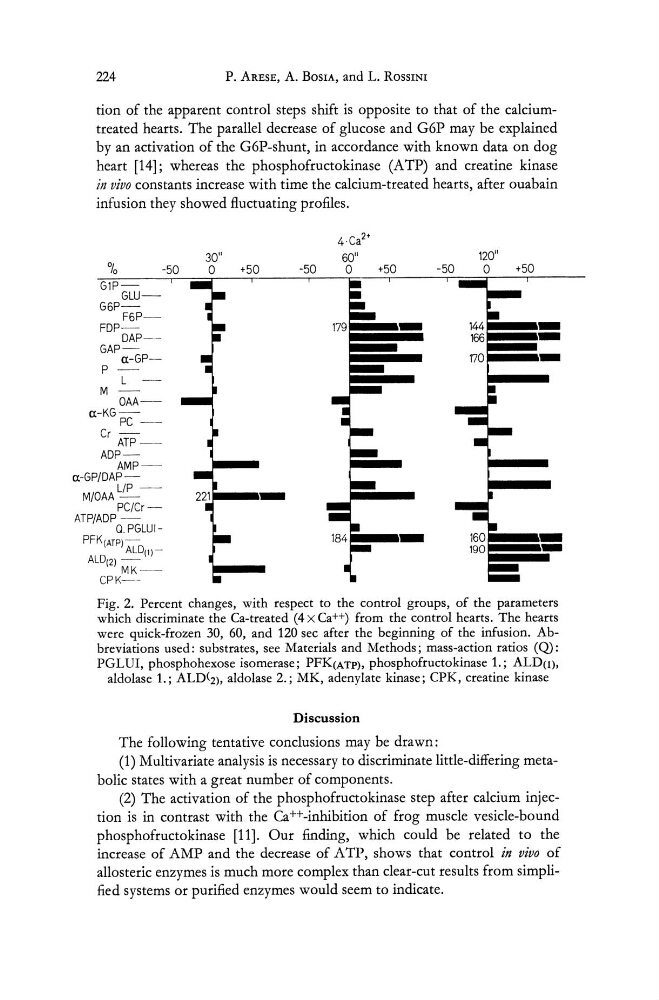
tion of the apparent control steps shift is opposite to that of the calciumtreated hearts. The parallel decrease of glucose and G6P may be explained
by an activation of the G6P-shunt, in accordance with known data on dog
heart [14]; whereas the phosphofructokinase (ATP) and creatine kinase
in vivo constants increase with time the calcium-treated hearts, after ouabain
infusion they showed fluctuating profiles.
(I-GPP
M
L
PCCr -
PC/CrATP/ADP -
ALD(1JALD(2) -
CPK+50
-50
Fig. 2. Percent changes, with respect to the control groups, of the parameters
which discriminate the Ca-treated (4 X Ca++) from the control hearts. The hearts
were quick-frozen 30, 60, and 120 sec after the beginning of the infusion. Abbreviations used: substrates, see Materials and Methods; mass-action ratios (Q):
PGLUI, phosphohexose isomerase; PFK(ATP), phosphofructokinase 1.; ALD(I),
aldolase 1.; ALD(2), aldolase 2.; MK, adenylate kinase; CPK, creatine kinase
Discussion
The following tentative conclusions may be drawn:
(1) Multivariate analysis is necessary to discriminate little-differing metabolic states with a great number of components.
(2) The activation of the phosphofructokinase step after calcium injection is in contrast with the Ca++-inhibition of frog muscle vesicle-bound
phosphofructokinase [11]. Our finding, which could be related to the
increase of AMP and the decrease of ATP, shows that control in vivo of
allosteric enzymes is much more complex than clear-cut results from simplified systems or purified enzymes would seem to indicate.
P. ARESE, A. BOSIA, and L. ROSSINI
tion of the apparent control steps shift is opposite to that of the calciumtreated hearts. The parallel decrease of glucose and G6P may be explained
by an activation of the G6P-shunt, in accordance with known data on dog
heart [14]; whereas the phosphofructokinase (ATP) and creatine kinase
in vivo constants increase with time the calcium-treated hearts, after ouabain
infusion they showed fluctuating profiles.
(I-GPP
M
L
PCCr -
PC/CrATP/ADP -
ALD(1JALD(2) -
CPK+50
-50
Fig. 2. Percent changes, with respect to the control groups, of the parameters
which discriminate the Ca-treated (4 X Ca++) from the control hearts. The hearts
were quick-frozen 30, 60, and 120 sec after the beginning of the infusion. Abbreviations used: substrates, see Materials and Methods; mass-action ratios (Q):
PGLUI, phosphohexose isomerase; PFK(ATP), phosphofructokinase 1.; ALD(I),
aldolase 1.; ALD(2), aldolase 2.; MK, adenylate kinase; CPK, creatine kinase
Discussion
The following tentative conclusions may be drawn:
(1) Multivariate analysis is necessary to discriminate little-differing metabolic states with a great number of components.
(2) The activation of the phosphofructokinase step after calcium injection is in contrast with the Ca++-inhibition of frog muscle vesicle-bound
phosphofructokinase [11]. Our finding, which could be related to the
increase of AMP and the decrease of ATP, shows that control in vivo of
allosteric enzymes is much more complex than clear-cut results from simplified systems or purified enzymes would seem to indicate.