

210
A. BETZ
used as reference, because it can be directly measured without difficulty.
In this way all metabolites can be compared among themselves [17a]. The
results are the phase relations shown in fig. 5. We see there is no important
control point between NADH and pyruvate, because both substances
oscillate completely in phase. The 180 0 phase difference between F-6-P and
FDP is indicative for the PFK reaction, being the most important control
step responsible for glycolytic oscillations. Provided this is correct, we can
f'\
\
~024 o
018
reduction
I I
oxidation ~ I
09
08
07
06
' I I I I iVIIIIIIII'11
I II
I
I I
o ,
I I I 11'1" ': I
~
I
11..0111111 II
I I I Ol't II I I 1/'\1 I I
, I I V" i\111 ' 0 1
: i :j'::: o~~Ji: ~-T G-6-P
I 0 I I I I I II I I I I I I
l :"~ I I I : I: I I I I I I I
\
1 I 11'1111 11111 I
I
: : fO~ I I : V~i :
: I V
O
0,1: I 0 0-0 F-6-P
I
I I
!/,~/
I I 0
I
' /
0 - 0
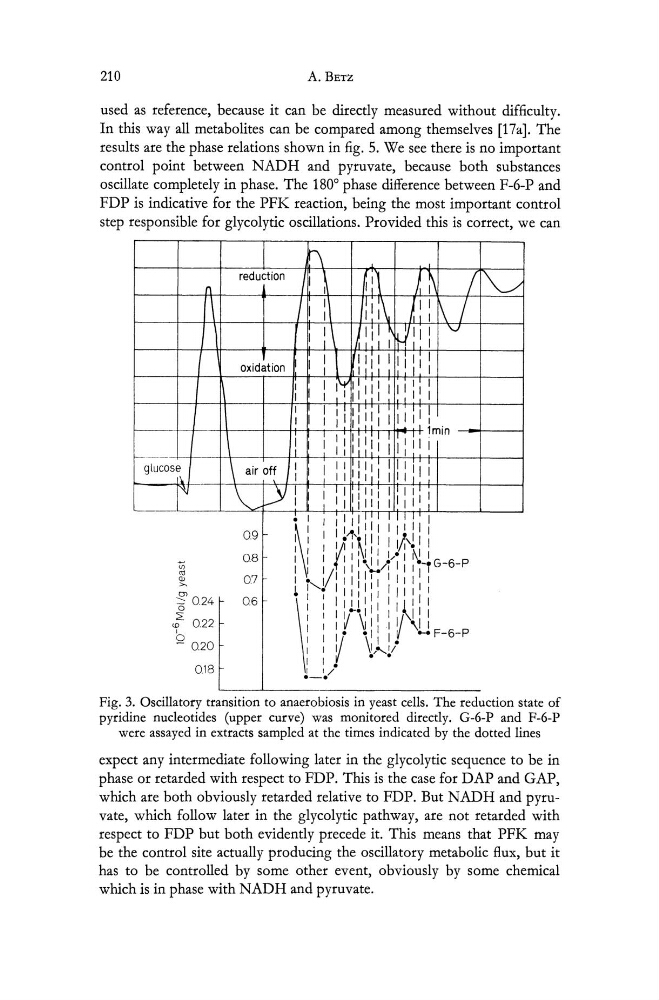
Fig. 3. Oscillatory transition to anaerobiosis in yeast cells. The reduction state of
pyridine nucleotides (upper curve) was monitored directly. G-6-P and F-6-P
were assayed in extracts sampled at the times indicated by the dotted lines
expect any intermediate following later in the glycolytic sequence to be in
phase or retarded with respect to FDP. This is the case for DAP and GAP,
which are both obviously retarded relative to FDP. But NADH and pyruvate, which follow later in the glycolytic pathway, are not retarded with
respect to FDP but both evidently precede it. This means that PFK may
be the control site actually producing the oscillatory metabolic flux, but it
has to be controlled by some other event, obviously by some chemical
which is in phase with NADH and pyruvate.
A. BETZ
used as reference, because it can be directly measured without difficulty.
In this way all metabolites can be compared among themselves [17a]. The
results are the phase relations shown in fig. 5. We see there is no important
control point between NADH and pyruvate, because both substances
oscillate completely in phase. The 180 0 phase difference between F-6-P and
FDP is indicative for the PFK reaction, being the most important control
step responsible for glycolytic oscillations. Provided this is correct, we can
f'\
\
~024 o
018
reduction
I I
oxidation ~ I
09
08
07
06
' I I I I iVIIIIIIII'11
I II
I
I I
o ,
I I I 11'1" ': I
~
I
11..0111111 II
I I I Ol't II I I 1/'\1 I I
, I I V" i\111 ' 0 1
: i :j'::: o~~Ji: ~-T G-6-P
I 0 I I I I I II I I I I I I
l :"~ I I I : I: I I I I I I I
\
1 I 11'1111 11111 I
I
: : fO~ I I : V~i :
: I V
O
0,1: I 0 0-0 F-6-P
I
I I
!/,~/
I I 0
I
' /
0 - 0
Fig. 3. Oscillatory transition to anaerobiosis in yeast cells. The reduction state of
pyridine nucleotides (upper curve) was monitored directly. G-6-P and F-6-P
were assayed in extracts sampled at the times indicated by the dotted lines
expect any intermediate following later in the glycolytic sequence to be in
phase or retarded with respect to FDP. This is the case for DAP and GAP,
which are both obviously retarded relative to FDP. But NADH and pyruvate, which follow later in the glycolytic pathway, are not retarded with
respect to FDP but both evidently precede it. This means that PFK may
be the control site actually producing the oscillatory metabolic flux, but it
has to be controlled by some other event, obviously by some chemical
which is in phase with NADH and pyruvate.