

Oscillatory Control of Glycolysis as Model for Timing Processes
207
used in the time-compensated sun orientation of birds and bees. Fig. 1
gives a rather incomplete survey on the time scale of some biological
processes, most of which are oscillatory.
All timing systems which correspond to an external cosmic event are
characterized by the fact that they are extremely independent of differences
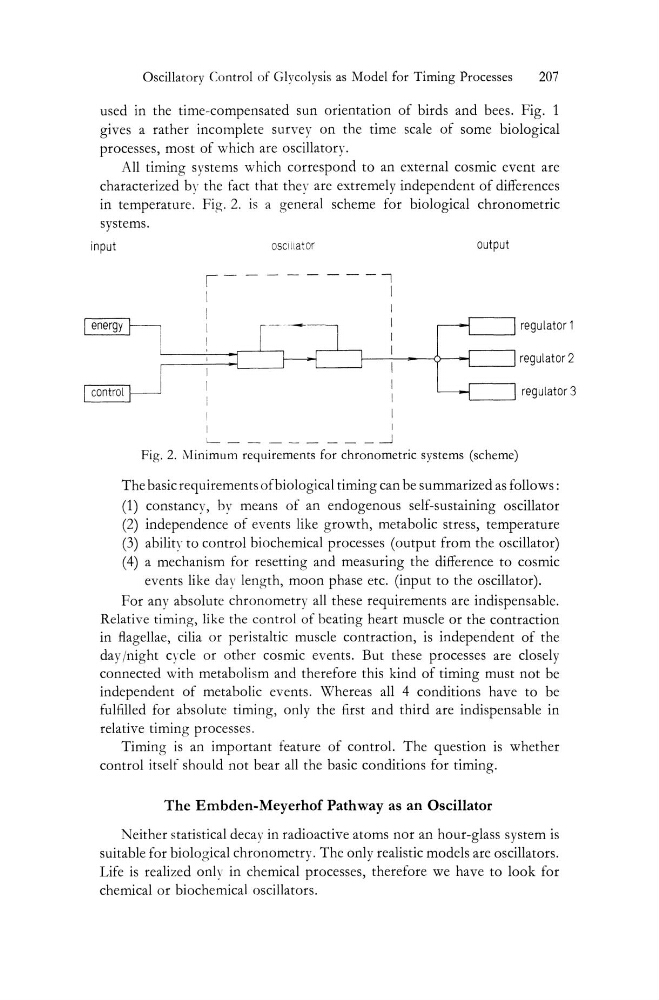
in temperature. Fig. 2. is a general scheme for biological chronometric
systems.
input
II
I
I
I
OSCillator
output
' - - - - - - '
regulator 1
C~:J--+~--1--[==J regulator 2
I
-~
'------'
regulator 3
Fig. 2. '\Iinimum requirements for chronometric systems (scheme)
The basic requirements of biological timing can be summarized as follows:
(1) constancy, by means of an endogenous self-sustaining oscillator
(2) independence of events like growth, metabolic stress, temperature
(3) abilit\ to control hiochemical processes (output from the oscillator)
(4) a mechanism for resetting and measuring the difference to cosmic
events like day length, moon phase etc. (input to the oscillator).
For any absolute chronometry all these requirements are indispensable.
Relative timing, like the control of heating heart muscle or the contraction
in fiagellae, cilia or peristaltic muscle contraction, is independent of the
dayjnight cycle or other cosmic events. But these processes are closely
connected with metabolism and therefore this kind of timing must not be
independent of metabolic events. Whereas all 4 conditions have to be
fulfilled for ahsolute timing, only the first and third are indispensable in
relative timing processes.
Timing is an important feature of control. The question is whether
control itself should not bear all the basic conditions for timing.
The Embden-Meyerhof Pathway as an Oscillator
Neither statistical decay in radioactive atoms nor an hour-glass system is
suitable for hiological chronometry. The only realistic models are oscillators.
Life is realized onlv in chemical processes, therefore we have to look for
chemical or biochemical oscillators.
207
used in the time-compensated sun orientation of birds and bees. Fig. 1
gives a rather incomplete survey on the time scale of some biological
processes, most of which are oscillatory.
All timing systems which correspond to an external cosmic event are
characterized by the fact that they are extremely independent of differences
in temperature. Fig. 2. is a general scheme for biological chronometric
systems.
input
II
I
I
I
OSCillator
output
' - - - - - - '
regulator 1
C~:J--+~--1--[==J regulator 2
I
-~
'------'
regulator 3
Fig. 2. '\Iinimum requirements for chronometric systems (scheme)
The basic requirements of biological timing can be summarized as follows:
(1) constancy, by means of an endogenous self-sustaining oscillator
(2) independence of events like growth, metabolic stress, temperature
(3) abilit\ to control hiochemical processes (output from the oscillator)
(4) a mechanism for resetting and measuring the difference to cosmic
events like day length, moon phase etc. (input to the oscillator).
For any absolute chronometry all these requirements are indispensable.
Relative timing, like the control of heating heart muscle or the contraction
in fiagellae, cilia or peristaltic muscle contraction, is independent of the
dayjnight cycle or other cosmic events. But these processes are closely
connected with metabolism and therefore this kind of timing must not be
independent of metabolic events. Whereas all 4 conditions have to be
fulfilled for ahsolute timing, only the first and third are indispensable in
relative timing processes.
Timing is an important feature of control. The question is whether
control itself should not bear all the basic conditions for timing.
The Embden-Meyerhof Pathway as an Oscillator
Neither statistical decay in radioactive atoms nor an hour-glass system is
suitable for hiological chronometry. The only realistic models are oscillators.
Life is realized onlv in chemical processes, therefore we have to look for
chemical or biochemical oscillators.