

206
A. BETZ
cept bacteria, fungi and some blue-green algae, have some endogenous
chronometric systems. Circadian rythms are as effective in Euglena as in
man. People isolated in a cave with completely constant conditions show
rhythmically changing phases of activity and of quiescence. The period
length of these phases differs slightly from one individual to another,
within the range 22-26 hrs [1]. These slight differences are indicative of
the endogenous nature of those rhythms.
Anticipating control of life activities is best done by an endogenous
chronometric system whose period length is similar but not identical to
that of the cosmic rhythm. Some mechanisms are needed to compare the
organismic timing system with the cosmic cycle and to reset the endogenous
Biological time scale
10-3
cytochrome oxidase
sec
half saturation
10- 2
nerve spikes
10-1
(X-waves
10 0
heart frequency
10 1
10 2
glycolylic oscillator (yeast cells)
glycolytic oscillator (yeast extract)
10 3
time compensated sun Orientation
10 4
105
CIrcadian rhythms
10 6
tidal rhythms
10 7
photoperiodism
108
109 - - man,half lifetime
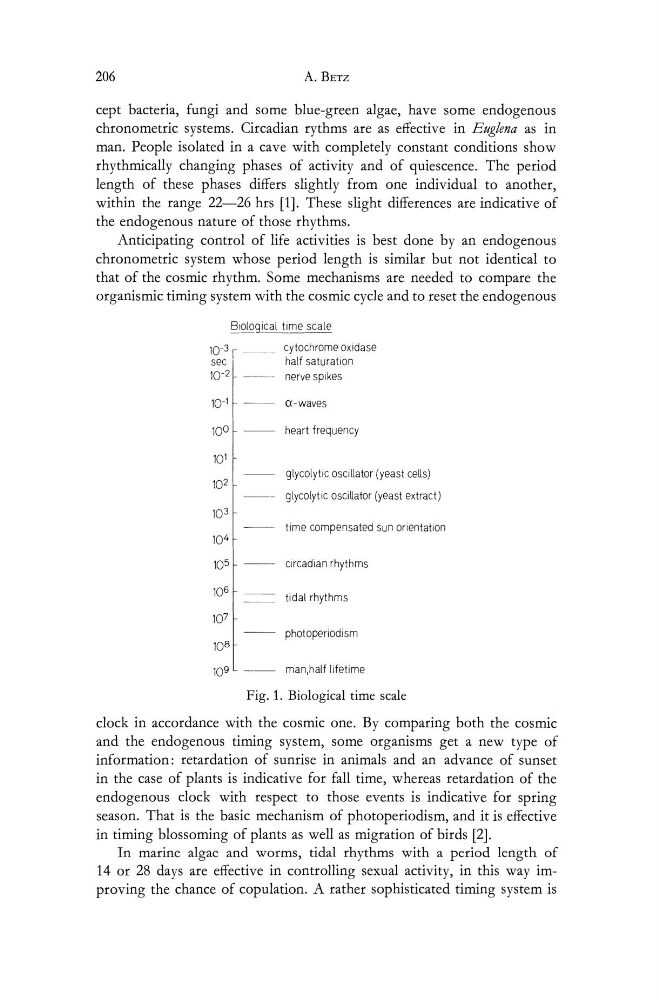
Fig. 1. Biological time scale
clock in accordance with the cosmic one. By comparing both the cosmic
and the endogenous timing system, some organisms get a new type of
information: retardation of sunrise in animals and an advance of sunset
in the case of plants is indicative for fall time, whereas retardation of the
endogenous clock with respect to those events is indicative for spring
season. That is the basic mechanism of photoperiodism, and it is effective
in timing blossoming of plants as well as migration of birds [2].
In marine algae and worms, tidal rhythms with a period length of
14 or 28 days are effective in controlling sexual activity, in this way improving the chance of copulation. A rather sophisticated timing system is
A. BETZ
cept bacteria, fungi and some blue-green algae, have some endogenous
chronometric systems. Circadian rythms are as effective in Euglena as in
man. People isolated in a cave with completely constant conditions show
rhythmically changing phases of activity and of quiescence. The period
length of these phases differs slightly from one individual to another,
within the range 22-26 hrs [1]. These slight differences are indicative of
the endogenous nature of those rhythms.
Anticipating control of life activities is best done by an endogenous
chronometric system whose period length is similar but not identical to
that of the cosmic rhythm. Some mechanisms are needed to compare the
organismic timing system with the cosmic cycle and to reset the endogenous
Biological time scale
10-3
cytochrome oxidase
sec
half saturation
10- 2
nerve spikes
10-1
(X-waves
10 0
heart frequency
10 1
10 2
glycolylic oscillator (yeast cells)
glycolytic oscillator (yeast extract)
10 3
time compensated sun Orientation
10 4
105
CIrcadian rhythms
10 6
tidal rhythms
10 7
photoperiodism
108
109 - - man,half lifetime
Fig. 1. Biological time scale
clock in accordance with the cosmic one. By comparing both the cosmic
and the endogenous timing system, some organisms get a new type of
information: retardation of sunrise in animals and an advance of sunset
in the case of plants is indicative for fall time, whereas retardation of the
endogenous clock with respect to those events is indicative for spring
season. That is the basic mechanism of photoperiodism, and it is effective
in timing blossoming of plants as well as migration of birds [2].
In marine algae and worms, tidal rhythms with a period length of
14 or 28 days are effective in controlling sexual activity, in this way improving the chance of copulation. A rather sophisticated timing system is