

Changes in Metabolite Concentrations in Ischemic and Transplanted Kidneys 193
recommenced. Average A TP content at this time was already higher than
that found after 40 min. of ischemia, while lactate and inorganic phosphate
decreased measurably. The lactate/pyruvate ratio decreased significantly.
The metabolite changes indicate the relatively quick recovery of the transplants, even after a fairly long period of ischemia. Our biochemical findings
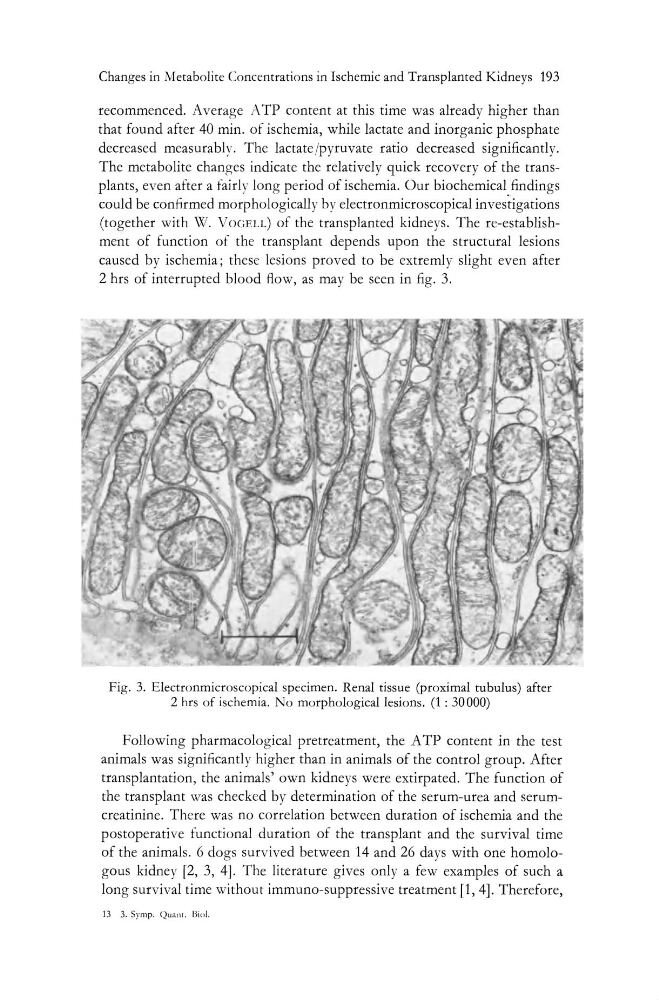
could be confirmed morphologically by electronmicroscopical investigations
(together with W. VOGEl.L) of the transplanted kidneys. The re-establishment of function of the transplant depends upon the structural lesions
caused by ischemia; these lesions proved to be extremly slight even after
2 hrs of interrupted blood flow, as may be seen in fig. 3.
Fig. 3. Electronmicroscopical specimen. Renal tissue (proximal tubulus) after
2 hrs of ischemia. No morphological lesions. (1 : 30000)
Following pharmacological pretreatment, the A TP content in the test
animals was significantly higher than in animals of the control group. After
transplantation, the animals' own kidneys were extirpated. The function of
the transplant was checked by determination of the serum-urea and serumcreatinine. There was no correlation between duration of ischemia and the
postoperative functional duration of the transplant and the survival time
of the animals. 6 dogs survived between 14 and 26 days with one homologous kidney [2, 3, 4]. The literature gives only a few examples of such a
long survival time without immuno-suppressive treatment [1, 4]. Therefore,
13 3. Symp. QuanL Blo!.
recommenced. Average A TP content at this time was already higher than
that found after 40 min. of ischemia, while lactate and inorganic phosphate
decreased measurably. The lactate/pyruvate ratio decreased significantly.
The metabolite changes indicate the relatively quick recovery of the transplants, even after a fairly long period of ischemia. Our biochemical findings
could be confirmed morphologically by electronmicroscopical investigations
(together with W. VOGEl.L) of the transplanted kidneys. The re-establishment of function of the transplant depends upon the structural lesions
caused by ischemia; these lesions proved to be extremly slight even after
2 hrs of interrupted blood flow, as may be seen in fig. 3.
Fig. 3. Electronmicroscopical specimen. Renal tissue (proximal tubulus) after
2 hrs of ischemia. No morphological lesions. (1 : 30000)
Following pharmacological pretreatment, the A TP content in the test
animals was significantly higher than in animals of the control group. After
transplantation, the animals' own kidneys were extirpated. The function of
the transplant was checked by determination of the serum-urea and serumcreatinine. There was no correlation between duration of ischemia and the
postoperative functional duration of the transplant and the survival time
of the animals. 6 dogs survived between 14 and 26 days with one homologous kidney [2, 3, 4]. The literature gives only a few examples of such a
long survival time without immuno-suppressive treatment [1, 4]. Therefore,
13 3. Symp. QuanL Blo!.