

Intracellular Recovery after Irradiation
167
complete recovery is shorter because of the reduced cycletime. The shape
of the recovery curve was similiar to that found in hamster cells, if log
phase cells were used. The initial peak did not appear if stationary cells
were stored overnight at 4°C before the experiment. Possible fluctuations
may have been obscured, however, because of the rather low dose-rate and
therefore long irradiation times used by these authors.
Recovery after UV requires a longer time than after X-rays if the same
survival levels are compared. This is in accord with our finding that division
delay is also enhanced after UV [33] and may be the reason for the lack of
success of earlier attempts although mammalian cells and yeast behave
10 t
001~~----C-_1
5
10
Interval [hours]
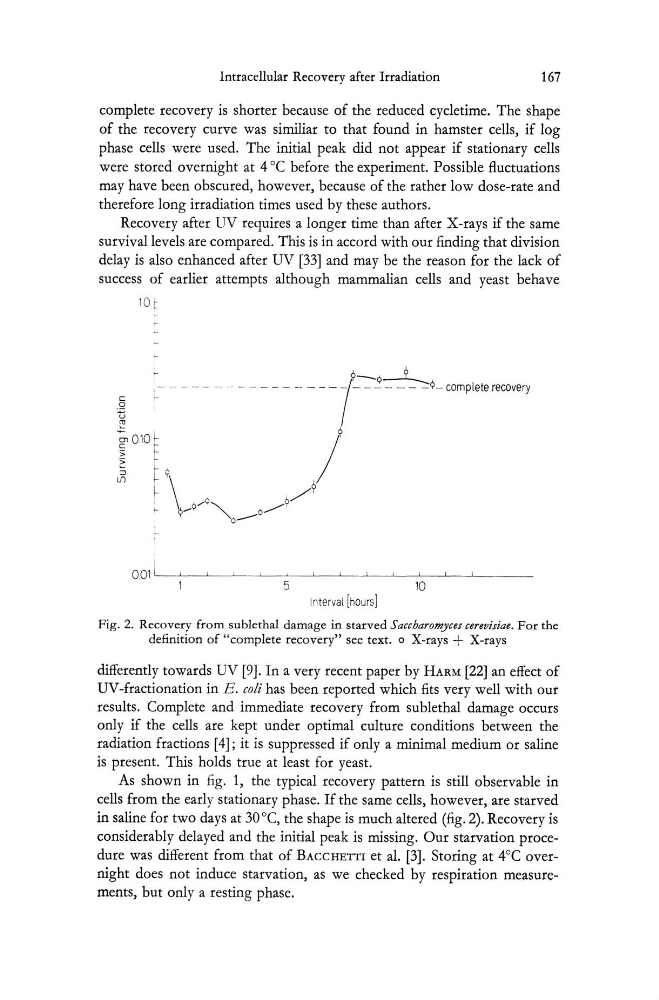
Fig. 2. Recovery from sublethal damage in starved Saccharomyces cerevisiae. For the
definition of "complete recovery" see text. 0 X-rays + X-rays
differently towards UV [9]. In a very recent paper by HARM [22] an effect of
UV-fractionation in E. coli has been reported which fits very well with our
results. Complete and immediate recovery from sublethal damage occurs
only if the cells are kept under optimal culture conditions between the
radiation fractions [4]; it is suppressed if only a minimal medium or saline
is present. This holds true at least for yeast.
As shown in fig. 1, the typical recovery pattern is still observable in
cells from the early stationary phase. If the same cells, however, are starved
in saline for two days at 30°C, the shape is much altered (fig. 2). Recovery is
considerably delayed and the initial peak is missing. Our starvation procedure was different from that of BACCHETTI et al. [3]. Storing at 4°C overnight does not induce starvation, as we checked by respiration measurements, but only a resting phase.
167
complete recovery is shorter because of the reduced cycletime. The shape
of the recovery curve was similiar to that found in hamster cells, if log
phase cells were used. The initial peak did not appear if stationary cells
were stored overnight at 4°C before the experiment. Possible fluctuations
may have been obscured, however, because of the rather low dose-rate and
therefore long irradiation times used by these authors.
Recovery after UV requires a longer time than after X-rays if the same
survival levels are compared. This is in accord with our finding that division
delay is also enhanced after UV [33] and may be the reason for the lack of
success of earlier attempts although mammalian cells and yeast behave
10 t
001~~----C-_1
5
10
Interval [hours]
Fig. 2. Recovery from sublethal damage in starved Saccharomyces cerevisiae. For the
definition of "complete recovery" see text. 0 X-rays + X-rays
differently towards UV [9]. In a very recent paper by HARM [22] an effect of
UV-fractionation in E. coli has been reported which fits very well with our
results. Complete and immediate recovery from sublethal damage occurs
only if the cells are kept under optimal culture conditions between the
radiation fractions [4]; it is suppressed if only a minimal medium or saline
is present. This holds true at least for yeast.
As shown in fig. 1, the typical recovery pattern is still observable in
cells from the early stationary phase. If the same cells, however, are starved
in saline for two days at 30°C, the shape is much altered (fig. 2). Recovery is
considerably delayed and the initial peak is missing. Our starvation procedure was different from that of BACCHETTI et al. [3]. Storing at 4°C overnight does not induce starvation, as we checked by respiration measurements, but only a resting phase.