

166
J. KIEFER
We have no clear-cut answer to the first question at the present time.
In summary, the investigations revealed: the first immediate rise in the
survival level is not influenced by a moderate reduction of temperature [14],
it is possibly delayed [8] and depressed only near 4 0 C [8]. It is not greatly
altered by inhibition of DNA- [35] or protein synthesis [16]. Actinomycin
D, which complexes to DNA, thus suppressing m-RNA synthesis [20],
completely inhibits recovery in hamster cells [16], although not in L-cells
[53]. All these findings refer to immediate recovery after the first dose. The
c
o
n
,g
tOO
g' 010
:>
.~
:::J
Ul
0.01 L -_ _ ' - - -_ _ ' - - -_ _ "----_ _ "----_ _
2
3
4
Interval [hours]
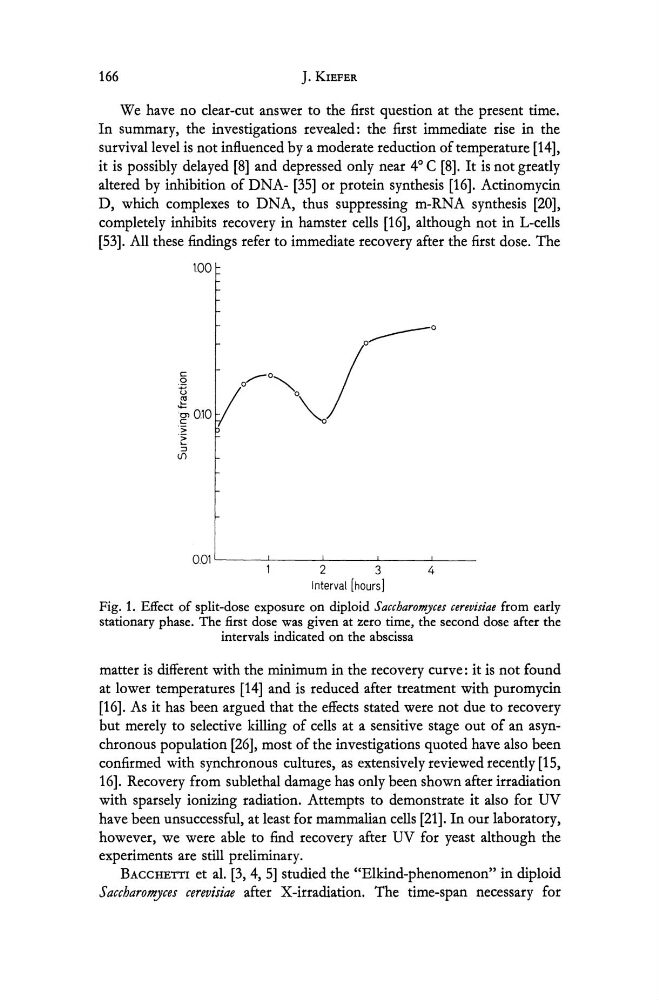
Fig. 1. Effect of split-dose exposure on diploid Saccharomyces cerevisiae from early
stationary phase. The first dose was given at zero time, the second dose after the
intervals indicated on the abscissa
matter is different with the minimum in the recovery curve: it is not found
at lower temperatures [14] and is reduced after treatment with puromycin
[16]. As it has been argued that the effects stated were not due to recovery
but merely to selective killing of cells at a sensitive stage out of an asynchronous population [26], most of the investigations quoted have also been
confirmed with synchronous cultures, as extensively reviewed recently [15,
16]. Recovery from sublethal damage has only been shown after irradiation
with sparsely ionizing radiation. Attempts to demonstrate it also for UV
have been unsuccessful, at least for mammalian cells [21]. In our laboratory,
however, we were able to find recovery after UV for yeast although the
experiments are still preliminary.
BACCHETTI et al. [3, 4, 5] studied the "Elkind-phenomenon" in diploid
Saccharomyces cerevisiae after X-irradiation. The time-span necessary for
J. KIEFER
We have no clear-cut answer to the first question at the present time.
In summary, the investigations revealed: the first immediate rise in the
survival level is not influenced by a moderate reduction of temperature [14],
it is possibly delayed [8] and depressed only near 4 0 C [8]. It is not greatly
altered by inhibition of DNA- [35] or protein synthesis [16]. Actinomycin
D, which complexes to DNA, thus suppressing m-RNA synthesis [20],
completely inhibits recovery in hamster cells [16], although not in L-cells
[53]. All these findings refer to immediate recovery after the first dose. The
c
o
n
,g
tOO
g' 010
:>
.~
:::J
Ul
0.01 L -_ _ ' - - -_ _ ' - - -_ _ "----_ _ "----_ _
2
3
4
Interval [hours]
Fig. 1. Effect of split-dose exposure on diploid Saccharomyces cerevisiae from early
stationary phase. The first dose was given at zero time, the second dose after the
intervals indicated on the abscissa
matter is different with the minimum in the recovery curve: it is not found
at lower temperatures [14] and is reduced after treatment with puromycin
[16]. As it has been argued that the effects stated were not due to recovery
but merely to selective killing of cells at a sensitive stage out of an asynchronous population [26], most of the investigations quoted have also been
confirmed with synchronous cultures, as extensively reviewed recently [15,
16]. Recovery from sublethal damage has only been shown after irradiation
with sparsely ionizing radiation. Attempts to demonstrate it also for UV
have been unsuccessful, at least for mammalian cells [21]. In our laboratory,
however, we were able to find recovery after UV for yeast although the
experiments are still preliminary.
BACCHETTI et al. [3, 4, 5] studied the "Elkind-phenomenon" in diploid
Saccharomyces cerevisiae after X-irradiation. The time-span necessary for