

124
F. KRUGER
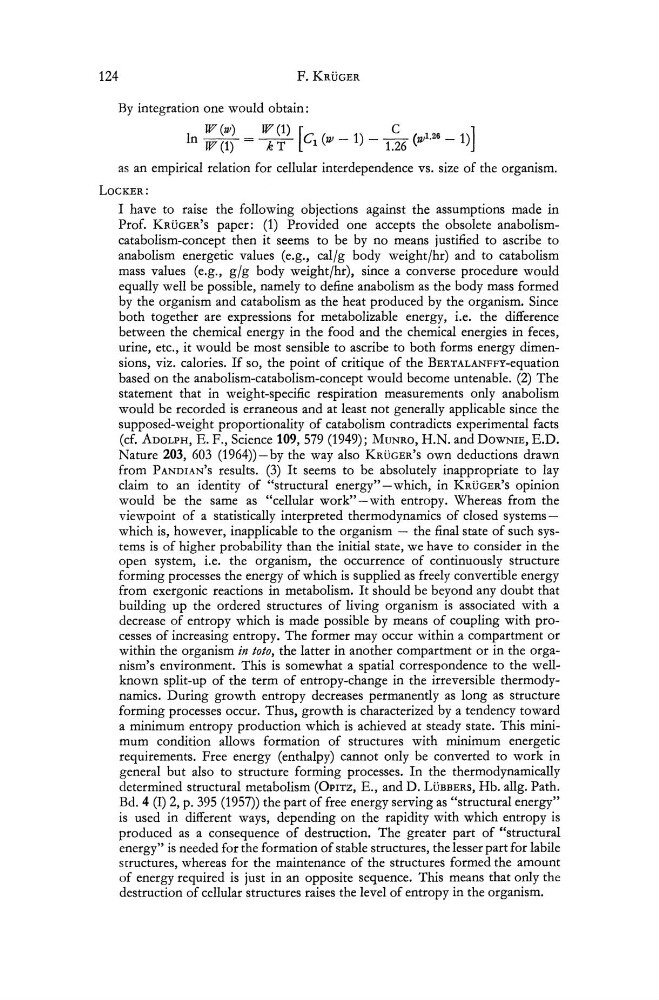
By integration one would obtain:
1 W (w)
W (1) [C (
1
C (126
1]
n W (1) = ----rT 1 W - ) - 1.26 w· - )
as an empirical relation for cellular interdependence vs. size of the organism.
LOCKER:
I have to raise the following objections against the assumptions made in
Prof. KRUGER'S paper: (1) Provided one accepts the obsolete anabolismcatabolism-concept then it seems to be by no means justified to ascribe to
anabolism energetic values (e.g., cal/g body weight/hr) and to catabolism
mass values (e.g., gig body weight/hr), since a converse procedure would
equally well be possible, namely to define anabolism as the body mass formed
by the organism and catabolism as the heat produced by the organism. Since
both together are expressions for metabolizable energy, i.e. the difference
between the chemical energy in the food and the chemical energies in feces,
urine, etc., it would be most sensible to ascribe to both forms energy dimensions, viz. calories. If so, the point of critique of the BERTALANFFY-equation
based on the anabolism-catabolism-concept would become untenable. (2) The
statement that in weight-specific respiration measurements only anabolism
would be recorded is erraneous and at least not generally applicable since the
supposed-weight proportionality of catabolism contradicts experimental facts
(cf. ADOLPH, E. F., Science 109, 579 (1949); MUNRO, B.N. and DOWNIE, E.D.
Nature 203, 603 (1964))-by the way also KRUGER'S own deductions drawn
from PANDIAN'S results. (3) It seems to be absolutely inappropriate to lay
claim to an identity of "structural energy" -which, in KRUGER'S opinion
would be the same as "cellular work" -with entropy. Whereas from the
viewpoint of a statistically interpreted thermodynamics of closed systemswhich is, however, inapplicable to the organism - the final state of such systems is of higher probability than the initial state, we have to consider in the
open system, i.e. the organism, the occurrence of continuously structure
forming processes the energy of which is supplied as freely convertible energy
from exergonic reactions in metabolism. It should be beyond any doubt that
building up the ordered structures of living organism is associated with a
decrease of entropy which is made possible by means of coupling with processes of increasing entropy. The former may occur within a compartment or
within the organism in toto, the latter in another compartment or in the organism's environment. This is somewhat a spatial correspondence to the wellknown split-up of the term of entropy-change in the irreversible thermodynamics. During growth entropy decreases permanently as long as structure
forming processes occur. Thus, growth is characterized by a tendency toward
a minimum entropy production which is achieved at steady state. This minimum condition allows formation of structures with minimum energetic
requirements. Free energy (enthalpy) cannot only be converted to work in
general but also to structure forming processes. In the thermodynamically
determined structural metabolism (OPITZ, E., and D. LUBBERS, Bb. allg. Path.
Bd.4 (I) 2, p. 395 (1957)) the part of free energy serving as "structural energy"
is used in different ways, depending on the rapidity with which entropy is
produced as a consequence of destruction. The greater part of "structural
energy" is needed for the formation of stable structures, the lesser part for labile
structures, whereas for the maintenance of the structures formed the amount
of energy required is just in an opposite sequence. This means that only the
destruction of cellular structures raises the level of entropy in the organism.
F. KRUGER
By integration one would obtain:
1 W (w)
W (1) [C (
1
C (126
1]
n W (1) = ----rT 1 W - ) - 1.26 w· - )
as an empirical relation for cellular interdependence vs. size of the organism.
LOCKER:
I have to raise the following objections against the assumptions made in
Prof. KRUGER'S paper: (1) Provided one accepts the obsolete anabolismcatabolism-concept then it seems to be by no means justified to ascribe to
anabolism energetic values (e.g., cal/g body weight/hr) and to catabolism
mass values (e.g., gig body weight/hr), since a converse procedure would
equally well be possible, namely to define anabolism as the body mass formed
by the organism and catabolism as the heat produced by the organism. Since
both together are expressions for metabolizable energy, i.e. the difference
between the chemical energy in the food and the chemical energies in feces,
urine, etc., it would be most sensible to ascribe to both forms energy dimensions, viz. calories. If so, the point of critique of the BERTALANFFY-equation
based on the anabolism-catabolism-concept would become untenable. (2) The
statement that in weight-specific respiration measurements only anabolism
would be recorded is erraneous and at least not generally applicable since the
supposed-weight proportionality of catabolism contradicts experimental facts
(cf. ADOLPH, E. F., Science 109, 579 (1949); MUNRO, B.N. and DOWNIE, E.D.
Nature 203, 603 (1964))-by the way also KRUGER'S own deductions drawn
from PANDIAN'S results. (3) It seems to be absolutely inappropriate to lay
claim to an identity of "structural energy" -which, in KRUGER'S opinion
would be the same as "cellular work" -with entropy. Whereas from the
viewpoint of a statistically interpreted thermodynamics of closed systemswhich is, however, inapplicable to the organism - the final state of such systems is of higher probability than the initial state, we have to consider in the
open system, i.e. the organism, the occurrence of continuously structure
forming processes the energy of which is supplied as freely convertible energy
from exergonic reactions in metabolism. It should be beyond any doubt that
building up the ordered structures of living organism is associated with a
decrease of entropy which is made possible by means of coupling with processes of increasing entropy. The former may occur within a compartment or
within the organism in toto, the latter in another compartment or in the organism's environment. This is somewhat a spatial correspondence to the wellknown split-up of the term of entropy-change in the irreversible thermodynamics. During growth entropy decreases permanently as long as structure
forming processes occur. Thus, growth is characterized by a tendency toward
a minimum entropy production which is achieved at steady state. This minimum condition allows formation of structures with minimum energetic
requirements. Free energy (enthalpy) cannot only be converted to work in
general but also to structure forming processes. In the thermodynamically
determined structural metabolism (OPITZ, E., and D. LUBBERS, Bb. allg. Path.
Bd.4 (I) 2, p. 395 (1957)) the part of free energy serving as "structural energy"
is used in different ways, depending on the rapidity with which entropy is
produced as a consequence of destruction. The greater part of "structural
energy" is needed for the formation of stable structures, the lesser part for labile
structures, whereas for the maintenance of the structures formed the amount
of energy required is just in an opposite sequence. This means that only the
destruction of cellular structures raises the level of entropy in the organism.