

Contributions to the Energetics of Animal Growth
123
MEYER-DORING:
It seems to me that the significance of the word "Strukturenergie" you introduce is somewhat different from that familiar in molecular biology.
KRUGER
Indeed the concept of "Strukturenergie" is used here not in the same way
as in biochemistry, what would probably be the reason to search for a better
suited and less ambiguous expression.
WALTER:
Could you give a precise definition of what you mean by "anabolism" and
"catabolism"? There is no way to distinguish many biochemical reactions
as reactions that "form" materials and reactions that "decompose" materials,
because often the decomposition of one material is necessary for the formation
of another material.
KRUGER:
It is certainly difficult to distinguish between anabolic and catabolic processes
at the molecular level, but in the overall balance of an organism we are nonetheless able to observe processes consisting of building up new material and
processes destroying at least a part of it.
BREMERMANN:
Since energy requirements for creation of structure have come up, I would
like to mention that I have just published a paper (Progr. Theor. BioI. 1, 59
(1967)) in which I argue: E. coli, in the process of growth, must compensate
the structural entropy that is created through giving off heat. The latter amounts
to 600 watts/kg under exponential growth conditions. A substantially higher
figure would most likely boil E. coli to death. The heat production, however,
limits the time in which E. coli can reproduce itself-16 -20 min. It turns
out that this time is about as short as is possible under the laws of physics.
SIMON:
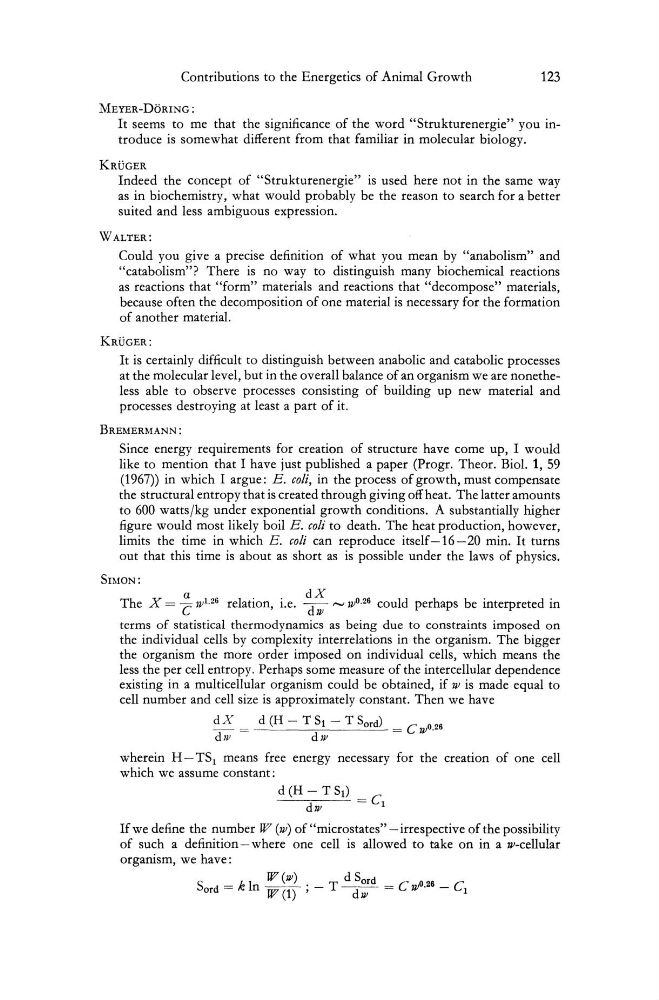
The X = ~ W 1 . 26 relation, i.e. ~~ """ WO. 26 could perhaps be interpreted in
terms of statistical thermodynamics as being due to constraints imposed on
the individual cells by complexity interrelations in the organism. The bigger
the organism the more order imposed on individual cells, which means the
less the per cell entropy. Perhaps some measure of the intercellular dependence
existing in a multicellular organism could be obtained, if w is made equal to
cell number and cell size is approximately constant. Then we have
~ X = d (H - T SI - T Sord) = C W O.26
diP
d,P
wherein H - TS1 means free energy necessary for the creation of one cell
which we assume constant:
,d (H - T SI) _ c
dw
- 1
If we define the number W (w) of "microstates" -irrespective of the possibility
of such a definition-where one cell is allowed to take on in a w-cellular
organism, we have:
_
W (w) .
d Sord _ ' 26
Sord - kIn W (1) , - T ~ - G wOo - C1
123
MEYER-DORING:
It seems to me that the significance of the word "Strukturenergie" you introduce is somewhat different from that familiar in molecular biology.
KRUGER
Indeed the concept of "Strukturenergie" is used here not in the same way
as in biochemistry, what would probably be the reason to search for a better
suited and less ambiguous expression.
WALTER:
Could you give a precise definition of what you mean by "anabolism" and
"catabolism"? There is no way to distinguish many biochemical reactions
as reactions that "form" materials and reactions that "decompose" materials,
because often the decomposition of one material is necessary for the formation
of another material.
KRUGER:
It is certainly difficult to distinguish between anabolic and catabolic processes
at the molecular level, but in the overall balance of an organism we are nonetheless able to observe processes consisting of building up new material and
processes destroying at least a part of it.
BREMERMANN:
Since energy requirements for creation of structure have come up, I would
like to mention that I have just published a paper (Progr. Theor. BioI. 1, 59
(1967)) in which I argue: E. coli, in the process of growth, must compensate
the structural entropy that is created through giving off heat. The latter amounts
to 600 watts/kg under exponential growth conditions. A substantially higher
figure would most likely boil E. coli to death. The heat production, however,
limits the time in which E. coli can reproduce itself-16 -20 min. It turns
out that this time is about as short as is possible under the laws of physics.
SIMON:
The X = ~ W 1 . 26 relation, i.e. ~~ """ WO. 26 could perhaps be interpreted in
terms of statistical thermodynamics as being due to constraints imposed on
the individual cells by complexity interrelations in the organism. The bigger
the organism the more order imposed on individual cells, which means the
less the per cell entropy. Perhaps some measure of the intercellular dependence
existing in a multicellular organism could be obtained, if w is made equal to
cell number and cell size is approximately constant. Then we have
~ X = d (H - T SI - T Sord) = C W O.26
diP
d,P
wherein H - TS1 means free energy necessary for the creation of one cell
which we assume constant:
,d (H - T SI) _ c
dw
- 1
If we define the number W (w) of "microstates" -irrespective of the possibility
of such a definition-where one cell is allowed to take on in a w-cellular
organism, we have:
_
W (w) .
d Sord _ ' 26
Sord - kIn W (1) , - T ~ - G wOo - C1