

108
R. E. SMITH, BARBARA A. HORWITZ, and Y. IMAI
cold, T a' T Y' Tf, and T b usually fell initially, while the rate of total oxygen
consumption (MR) rose (Figure 1). Within 10 min, however, Tf and Ty had
begun to increase, followed thereafter (18 min after cold exposure) by a
rise of T a and sometimes T b'
After the chamber temperature reached 4°C (within 10-15 min.),
T y - Ta was relatively constant for each rat, averaging 1 dc. During the
same time interval, T f averaged 2.9°C warmer than the inner skin surface
and 5.9 °C warmer than the outer skin surface.
From the observed temperature differences [Ty-Ta; Tf-Touterskin;
Tf(final)-Tf(initial)], the heat output of the interscapular pad was calculated
40
30
20
10
8
~ 6
~
4
OJ
"'
(;:;
Q
E
-'" 40
3i
~ 30
m
20
10
OL-L-L-L-L-~ __ ~ __ ~
o 20 40 6080 120 160 200
Arousal time (min)
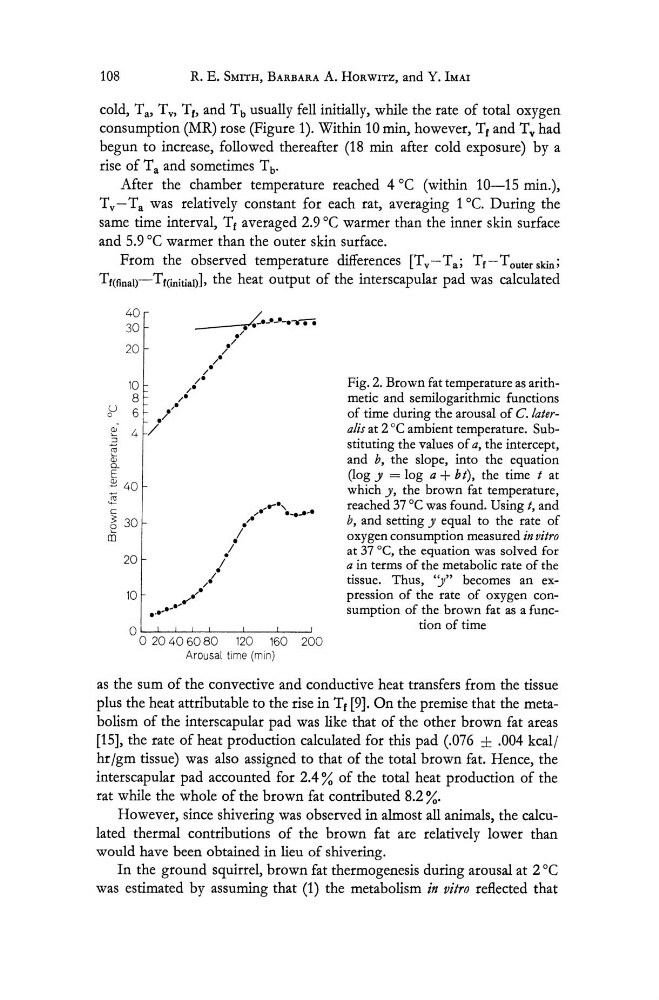
Fig. 2. Brown fat temperature as arithmetic and semilogarithmic functions
of time during the arousal of C. laleralis at 2 °C ambient temperature. Substituting the values of a, the intercept,
and b, the slope, into the equation
(log y = log a + bl), the time I at
which y, the brown fat temperature,
reached 37°C was found. Using I, and
b, and setting y equal to the rate of
oxygen consumption measured in vitro
at 37°C, the equation was solved for
a in terms of the metabolic rate of the
tissue. Thus, ')i" becomes an expression of the rate of oxygen consumption of the brown fat as a function of time
as the sum of the convective and conductive heat transfers from the tissue
plus the heat attributable to the rise in T f [9]. On the premise that the metabolism of the interscapular pad was like that of the other brown fat areas
[15], the rate of heat production calculated for this pad (.076 ± .004 kcal/
hr/gm tissue) was also assigned to that of the total brown fat. Hence, the
interscapular pad accounted for 2.4 % of the total heat production of the
rat while the whole of the brown fat contributed 8.2 %.
However, since shivering was observed in almost all animals, the calculated thermal contributions of the brown fat are relatively lower than
would have been obtained in lieu of shivering.
In the ground squirrel, brown fat thermogenesis during arousal at 2 °C
was estimated by assuming that (1) the metabolism in vitro reflected that
R. E. SMITH, BARBARA A. HORWITZ, and Y. IMAI
cold, T a' T Y' Tf, and T b usually fell initially, while the rate of total oxygen
consumption (MR) rose (Figure 1). Within 10 min, however, Tf and Ty had
begun to increase, followed thereafter (18 min after cold exposure) by a
rise of T a and sometimes T b'
After the chamber temperature reached 4°C (within 10-15 min.),
T y - Ta was relatively constant for each rat, averaging 1 dc. During the
same time interval, T f averaged 2.9°C warmer than the inner skin surface
and 5.9 °C warmer than the outer skin surface.
From the observed temperature differences [Ty-Ta; Tf-Touterskin;
Tf(final)-Tf(initial)], the heat output of the interscapular pad was calculated
40
30
20
10
8
~ 6
~
4
OJ
"'
(;:;
Q
E
-'" 40
3i
~ 30
m
20
10
OL-L-L-L-L-~ __ ~ __ ~
o 20 40 6080 120 160 200
Arousal time (min)
Fig. 2. Brown fat temperature as arithmetic and semilogarithmic functions
of time during the arousal of C. laleralis at 2 °C ambient temperature. Substituting the values of a, the intercept,
and b, the slope, into the equation
(log y = log a + bl), the time I at
which y, the brown fat temperature,
reached 37°C was found. Using I, and
b, and setting y equal to the rate of
oxygen consumption measured in vitro
at 37°C, the equation was solved for
a in terms of the metabolic rate of the
tissue. Thus, ')i" becomes an expression of the rate of oxygen consumption of the brown fat as a function of time
as the sum of the convective and conductive heat transfers from the tissue
plus the heat attributable to the rise in T f [9]. On the premise that the metabolism of the interscapular pad was like that of the other brown fat areas
[15], the rate of heat production calculated for this pad (.076 ± .004 kcal/
hr/gm tissue) was also assigned to that of the total brown fat. Hence, the
interscapular pad accounted for 2.4 % of the total heat production of the
rat while the whole of the brown fat contributed 8.2 %.
However, since shivering was observed in almost all animals, the calculated thermal contributions of the brown fat are relatively lower than
would have been obtained in lieu of shivering.
In the ground squirrel, brown fat thermogenesis during arousal at 2 °C
was estimated by assuming that (1) the metabolism in vitro reflected that