

32
KAI-OLAF NETZER
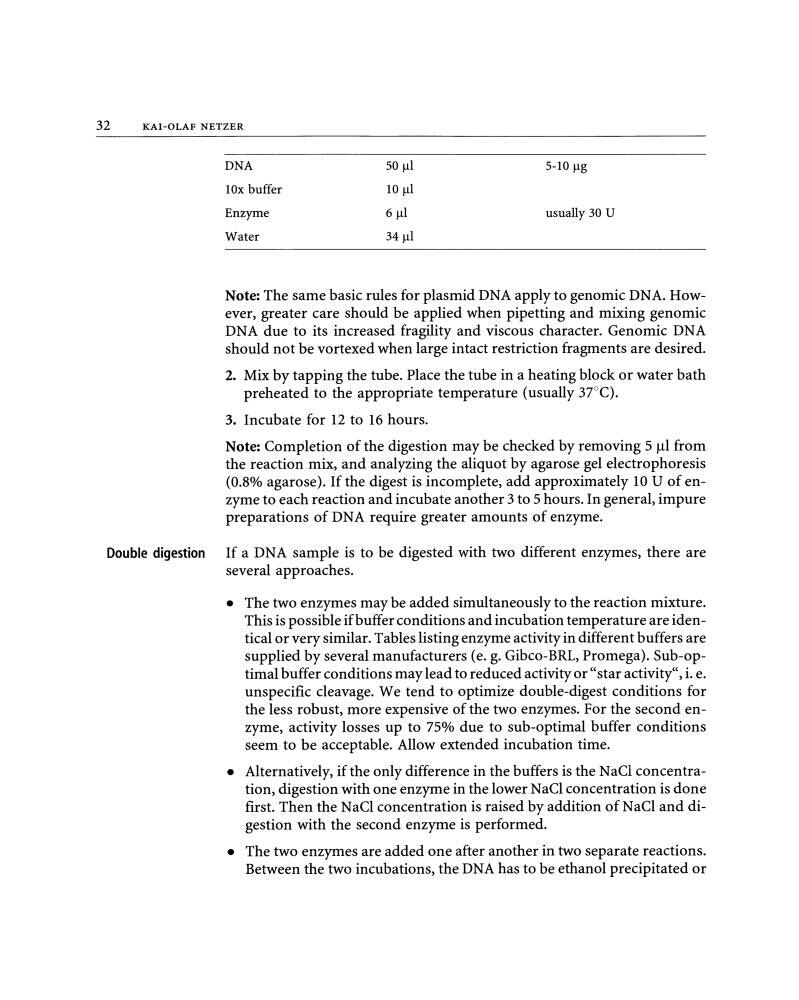
DNA
50 J.ll
5-10 J.lg
10x buffer
10 J.ll
Enzyme
6 J.ll
usually 30 U
Water
34 J.ll
Note: The same basic rules for plasmid DNA apply to genomic DNA. However, greater care should be applied when pipetting and mixing genomic
DNA due to its increased fragility and viscous character. Genomic DNA
should not be vortexed when large intact restriction fragments are desired.
2. Mix by tapping the tube. Place the tube in a heating block or water bath
preheated to the appropriate temperature (usually 37°C).
3. Incubate for 12 to 16 hours.
Note: Completion of the digestion may be checked by removing 5 ~1 from
the reaction mix, and analyzing the aliquot by agarose gel electrophoresis
(0.8% agarose). If the digest is incomplete, add approximately 10 U of enzyme to each reaction and incubate another 3 to 5 hours. In general, im pure
preparations of DNA require greater amounts of enzyme.
Double digestion If a DNA sample is tobe digested with two different enzymes, there are
several approaches.
• The two enzymes may be added simultaneously to the reaction mixture.
This is possible ifbuffer conditions and incubation temperature are identical or very similar. Tables listing enzyme activity in different buffers are
supplied by several manufacturers (e. g. Gibco-BRL, Promega). Sub-optimal buffer conditions may lead to reduced activity or "star activity", i. e.
unspecific cleavage. W e tend to optimize double-digest conditions for
the less robust, moreexpensive ofthe two enzymes. For the second enzyme, activity Iosses up to 75o/o due to sub-optimal buffer conditions
seem to be acceptable. Allow extended incubation time.
• Alternatively, if the only difference in the buffers is the NaCl concentration, digestion with one enzymein the lower NaCl concentration is done
first. Then the NaCl concentration is raised by addition ofNaCl and digestion with the second enzyme is performed.
• The two enzymes are added one after another in two separate reactions.
Between the two incubations, the DNA has to be ethanol precipitated or
KAI-OLAF NETZER
DNA
50 J.ll
5-10 J.lg
10x buffer
10 J.ll
Enzyme
6 J.ll
usually 30 U
Water
34 J.ll
Note: The same basic rules for plasmid DNA apply to genomic DNA. However, greater care should be applied when pipetting and mixing genomic
DNA due to its increased fragility and viscous character. Genomic DNA
should not be vortexed when large intact restriction fragments are desired.
2. Mix by tapping the tube. Place the tube in a heating block or water bath
preheated to the appropriate temperature (usually 37°C).
3. Incubate for 12 to 16 hours.
Note: Completion of the digestion may be checked by removing 5 ~1 from
the reaction mix, and analyzing the aliquot by agarose gel electrophoresis
(0.8% agarose). If the digest is incomplete, add approximately 10 U of enzyme to each reaction and incubate another 3 to 5 hours. In general, im pure
preparations of DNA require greater amounts of enzyme.
Double digestion If a DNA sample is tobe digested with two different enzymes, there are
several approaches.
• The two enzymes may be added simultaneously to the reaction mixture.
This is possible ifbuffer conditions and incubation temperature are identical or very similar. Tables listing enzyme activity in different buffers are
supplied by several manufacturers (e. g. Gibco-BRL, Promega). Sub-optimal buffer conditions may lead to reduced activity or "star activity", i. e.
unspecific cleavage. W e tend to optimize double-digest conditions for
the less robust, moreexpensive ofthe two enzymes. For the second enzyme, activity Iosses up to 75o/o due to sub-optimal buffer conditions
seem to be acceptable. Allow extended incubation time.
• Alternatively, if the only difference in the buffers is the NaCl concentration, digestion with one enzymein the lower NaCl concentration is done
first. Then the NaCl concentration is raised by addition ofNaCl and digestion with the second enzyme is performed.
• The two enzymes are added one after another in two separate reactions.
Between the two incubations, the DNA has to be ethanol precipitated or