

2 Enzymatic Modification of DNA and RNA
31
Procedure
This protocol is used for a standard 20 J..tl reaction, e. g. digestion of a plas- Plasmid DNA
mid miniprep. It can easily be scaled down to 10 J..tl or scaled up to 100 J..tl.
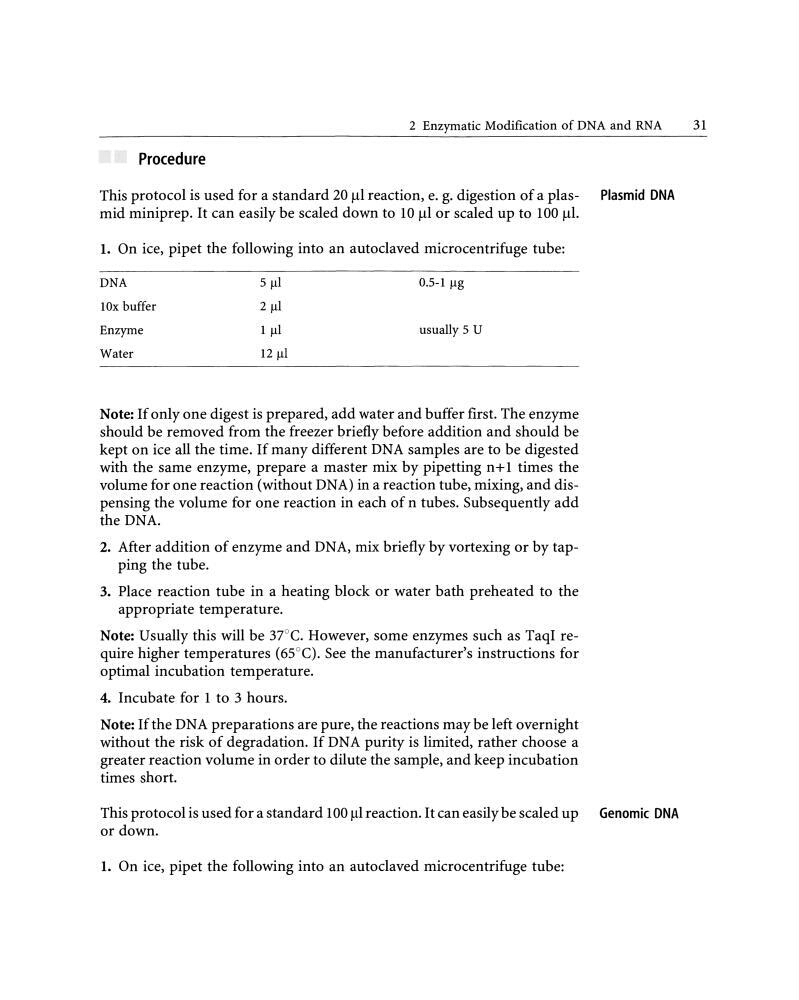
1. On ice, pipet the following into an autoclaved microcentrifuge tube:
DNA
lOx buffer
Enzyme
Water
0.5-1 llg
usually 5 U
Note: If only one digest is prepared, add water and buffer first. The enzyme
should be removed from the freezer briefly before addition and should be
kept on ice all the time. If many different DNA samples aretobe digested
with the same enzyme, prepare a master mix by pipetting n+ 1 times the
volume for one reaction (without DNA) in a reaction tube, mixing, and dispensing the volume for one reaction in each of n tubes. Subsequently add
the DNA.
2. After addition of enzyme and DNA, mix briefly by vortexing or by tapping the tube.
3. Place reaction tube in a heating block or water bath preheated to the
appropriate temperature.
Note: Usually this will be 37°C. However, some enzymessuch as Taqi require higher temperatures (65°C). See the manufacturer's instructions for
optimal incubation temperature.
4. Incubate for 1 to 3 hours.
Note: If the DNA preparations are pure, the reactions may be left overnight
without the risk of degradation. If DNA purity is limited, rather choose a
greater reaction volume in order to dilute the sample, and keep incubation
times short.
This protocol is used for a standard 100 J..tl reaction. It can easily be scaled up Genomic DNA
or down.
1. On ice, pipet the following into an autoclaved microcentrifuge tube:
31
Procedure
This protocol is used for a standard 20 J..tl reaction, e. g. digestion of a plas- Plasmid DNA
mid miniprep. It can easily be scaled down to 10 J..tl or scaled up to 100 J..tl.
1. On ice, pipet the following into an autoclaved microcentrifuge tube:
DNA
lOx buffer
Enzyme
Water
0.5-1 llg
usually 5 U
Note: If only one digest is prepared, add water and buffer first. The enzyme
should be removed from the freezer briefly before addition and should be
kept on ice all the time. If many different DNA samples aretobe digested
with the same enzyme, prepare a master mix by pipetting n+ 1 times the
volume for one reaction (without DNA) in a reaction tube, mixing, and dispensing the volume for one reaction in each of n tubes. Subsequently add
the DNA.
2. After addition of enzyme and DNA, mix briefly by vortexing or by tapping the tube.
3. Place reaction tube in a heating block or water bath preheated to the
appropriate temperature.
Note: Usually this will be 37°C. However, some enzymessuch as Taqi require higher temperatures (65°C). See the manufacturer's instructions for
optimal incubation temperature.
4. Incubate for 1 to 3 hours.
Note: If the DNA preparations are pure, the reactions may be left overnight
without the risk of degradation. If DNA purity is limited, rather choose a
greater reaction volume in order to dilute the sample, and keep incubation
times short.
This protocol is used for a standard 100 J..tl reaction. It can easily be scaled up Genomic DNA
or down.
1. On ice, pipet the following into an autoclaved microcentrifuge tube: