

23 Positional Cloning and Linkage Analysis
357
chromosome has (at locus D) the allele D and (at locus A) the allele A. The
matemal chromosome has (at locus D) the allele d and (at locus A) the allele
a. Due to a crossing over between the two loci of the homologaus chromosomes, there could be recombination suchthat D and a now lie on the same
chromosome and d and A lie on the same chromosome. If the two gene loci
are positioned far enough apart on the same chromosome, there may be
multiple crossing overs occurring between the two loci. If there were an
uneven number of crossovers we would observe recombination in the gametes or in their offspring, if there were an even number of crossovers we
would not observe a recombination. The occurrence of an uneven or even
number of crossovers is equally likely (SO%). Therefore, the likelihood of
observing a recombination between two distant loci is 50%, i. e. the recombination fraction 9 = 0.5. The recombination fraction is 9 defined as the
number of recombinations observed between two gene loci divided by
the number of meioses examined.
The closer two gene loci are to each other, the lower is the likelihood of a
crossover (recombination) between the two, i. e. the two loci are linked.
Therefore, genetic linkage is present if the observed recombination fraction
is < 0.5. If the two loci were directly next to each other we would never observe a recombination (9=0). Between the two extremes (9=0.5 and 9=0)
Iod
~s
score + 4
~ 3
+2
+1
0
-I
- 2
- 3
- 4
,
disease and marker A:
+ - Zmax = 4.3 at 9 = 0.05
recombination
Od
0.4
0 5 fraction 9
disease and marker B:
linkage at 10cM
or closer excluded
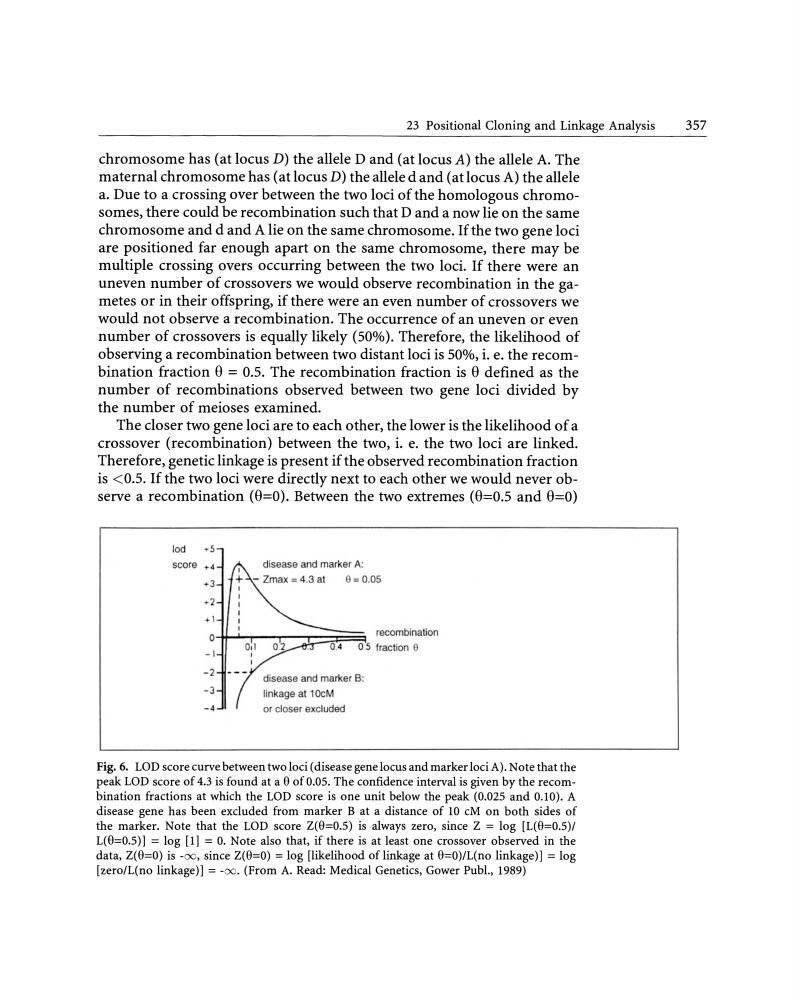
Fig. 6. LOD score curve between two loci (disease gene locus and marker lociA). Note that the
peak LOD score of 4.3 is found at a e of 0.05. The confidence interval is given by the recombination fractions at which the LOD score is one unit below the peak (0.025 and 0.10). A
disease gene has been excluded from marker B at a distance of 10 cM on both sides of
the marker. Note that the LOD score Z(6=0.5) is always zero, since Z = log [L(6=0.5)/
L(6=0.5)] = log [1] = 0. Note also that, if there is at least one crossover observed in the
data, Z(6=0) is -oo, since Z(6=0) = log [likelihood of linkage at 6=0)/L(no linkage)] = log
[zero/L(no linkage)] = -oo. (From A. Read: Medical Genetics, Gower Pub!., 1989)
357
chromosome has (at locus D) the allele D and (at locus A) the allele A. The
matemal chromosome has (at locus D) the allele d and (at locus A) the allele
a. Due to a crossing over between the two loci of the homologaus chromosomes, there could be recombination suchthat D and a now lie on the same
chromosome and d and A lie on the same chromosome. If the two gene loci
are positioned far enough apart on the same chromosome, there may be
multiple crossing overs occurring between the two loci. If there were an
uneven number of crossovers we would observe recombination in the gametes or in their offspring, if there were an even number of crossovers we
would not observe a recombination. The occurrence of an uneven or even
number of crossovers is equally likely (SO%). Therefore, the likelihood of
observing a recombination between two distant loci is 50%, i. e. the recombination fraction 9 = 0.5. The recombination fraction is 9 defined as the
number of recombinations observed between two gene loci divided by
the number of meioses examined.
The closer two gene loci are to each other, the lower is the likelihood of a
crossover (recombination) between the two, i. e. the two loci are linked.
Therefore, genetic linkage is present if the observed recombination fraction
is < 0.5. If the two loci were directly next to each other we would never observe a recombination (9=0). Between the two extremes (9=0.5 and 9=0)
Iod
~s
score + 4
~ 3
+2
+1
0
-I
- 2
- 3
- 4
,
disease and marker A:
+ - Zmax = 4.3 at 9 = 0.05
recombination
Od
0.4
0 5 fraction 9
disease and marker B:
linkage at 10cM
or closer excluded
Fig. 6. LOD score curve between two loci (disease gene locus and marker lociA). Note that the
peak LOD score of 4.3 is found at a e of 0.05. The confidence interval is given by the recombination fractions at which the LOD score is one unit below the peak (0.025 and 0.10). A
disease gene has been excluded from marker B at a distance of 10 cM on both sides of
the marker. Note that the LOD score Z(6=0.5) is always zero, since Z = log [L(6=0.5)/
L(6=0.5)] = log [1] = 0. Note also that, if there is at least one crossover observed in the
data, Z(6=0) is -oo, since Z(6=0) = log [likelihood of linkage at 6=0)/L(no linkage)] = log
[zero/L(no linkage)] = -oo. (From A. Read: Medical Genetics, Gower Pub!., 1989)