

356
FRIEDHELM HILDEBRANDT AND HEYMUT OMRAN
In this example it happens that the two affected children inherit the 100 bp
allele from the father and the 96 bp allele from the mother. In contrast, the
two healthy children, inherit the alternative alleles from father and mother.
Thus, for this marker there seems to be a correlation between the disease
status (affected or healthy) and the type of allele inherited. The explanation
for this phenomenon is that by chance a marker has been chosen which
happens to be so close to the formerly unknown disease locus (shown
as an "X" on chromosome 1) that the chance is very low for a crossingover to occur between the marker locus and the disease locus. In other
words, linkage has been demonstrated between the marker and the disease,
or the disease locus has been mapped to the vicinity of this DNA marker.
A statistical criterion that can be tested for such findings is the LOD score
Z (see below). Ifit is higher than 3, linkage has been proven to exist between
the marker and the disease locus. If the LOD score is below -2, the disease
locus has been excluded from a region araund this marker.
Recombination as a parameter for genetic distance
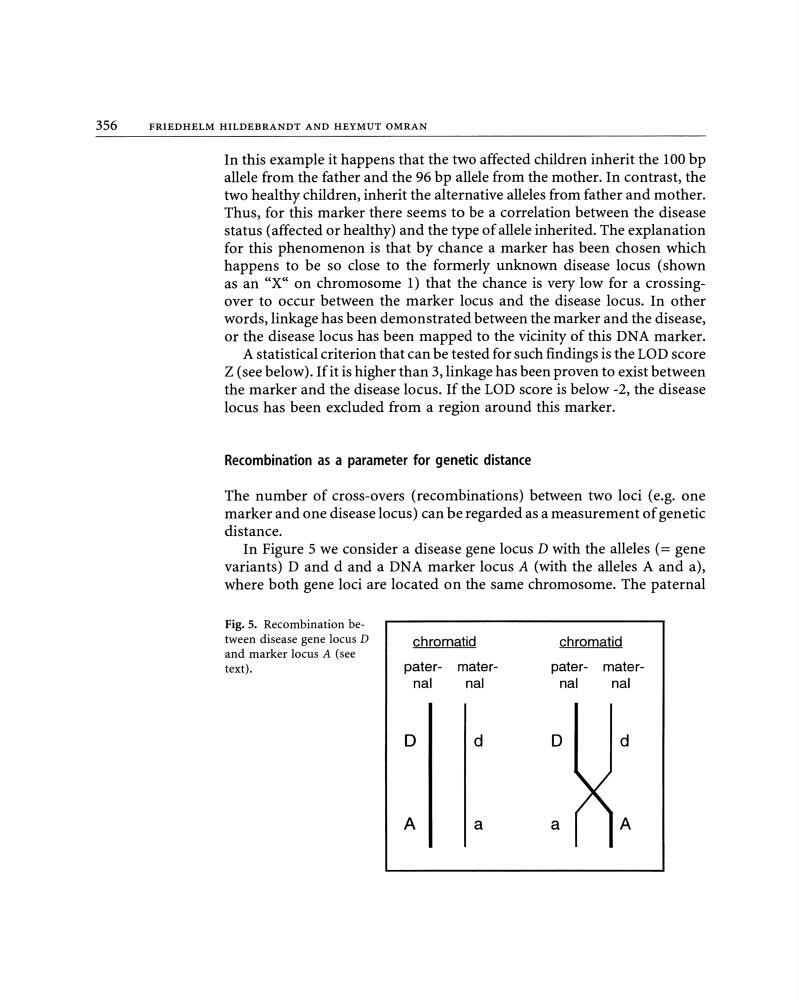
The number of cross-overs (recombinations) between two loci (e.g. one
marker and one disease locus) can be regarded as a measurement of genetic
distance.
In Figure 5 we consider a disease gene locus D with the alleles ( = gene
variants) D and d and a DNA marker locus A (with the alleles A and a),
where both gene loci are located on the same chromosome. The patemal
Fig. 5. Recombination between disease gene locus D
and marker locus A (see
text).
chromatid
paternal
D
A
maternal
d
a
chromatid
paternal
D
a
maternal
d
A
FRIEDHELM HILDEBRANDT AND HEYMUT OMRAN
In this example it happens that the two affected children inherit the 100 bp
allele from the father and the 96 bp allele from the mother. In contrast, the
two healthy children, inherit the alternative alleles from father and mother.
Thus, for this marker there seems to be a correlation between the disease
status (affected or healthy) and the type of allele inherited. The explanation
for this phenomenon is that by chance a marker has been chosen which
happens to be so close to the formerly unknown disease locus (shown
as an "X" on chromosome 1) that the chance is very low for a crossingover to occur between the marker locus and the disease locus. In other
words, linkage has been demonstrated between the marker and the disease,
or the disease locus has been mapped to the vicinity of this DNA marker.
A statistical criterion that can be tested for such findings is the LOD score
Z (see below). Ifit is higher than 3, linkage has been proven to exist between
the marker and the disease locus. If the LOD score is below -2, the disease
locus has been excluded from a region araund this marker.
Recombination as a parameter for genetic distance
The number of cross-overs (recombinations) between two loci (e.g. one
marker and one disease locus) can be regarded as a measurement of genetic
distance.
In Figure 5 we consider a disease gene locus D with the alleles ( = gene
variants) D and d and a DNA marker locus A (with the alleles A and a),
where both gene loci are located on the same chromosome. The patemal
Fig. 5. Recombination between disease gene locus D
and marker locus A (see
text).
chromatid
paternal
D
A
maternal
d
a
chromatid
paternal
D
a
maternal
d
A