

354
FRIEDHELM HILDEBRANDT AND HEYMUT OMRAN
chromosomes. Therefore, alleles (gene variants) of two different genes that
are located on two different chromosomes are assorted randomly. Such
genes are called "unlinked".
Instead of observing crossing overs as chiasmata cytogenetically in a microscope, in linkage analysis recombination between the alleles of two loci is
observed between parents and offspring by the so-called "family method".
Each offspring represents one meiosis. If two genes reside on the same chromosome, their alleles would always segregate together, i.e. the genes would
be completely linked. This is not the case, however, due to the fact that there
may be crossing over or recombination between one of the two chromatids
of one homologous chromosome and one of the two chromatids of the other
homologous chromosome.
Techniques of linkage Analysis
In linkage analysis, we compare the segregation (i.e. passing on to the offspring) of the alleles of a polymorphic DNA marker with the segregation of
disease states (affected versus healthy), which represent the different alleles
at a disease gene locus.
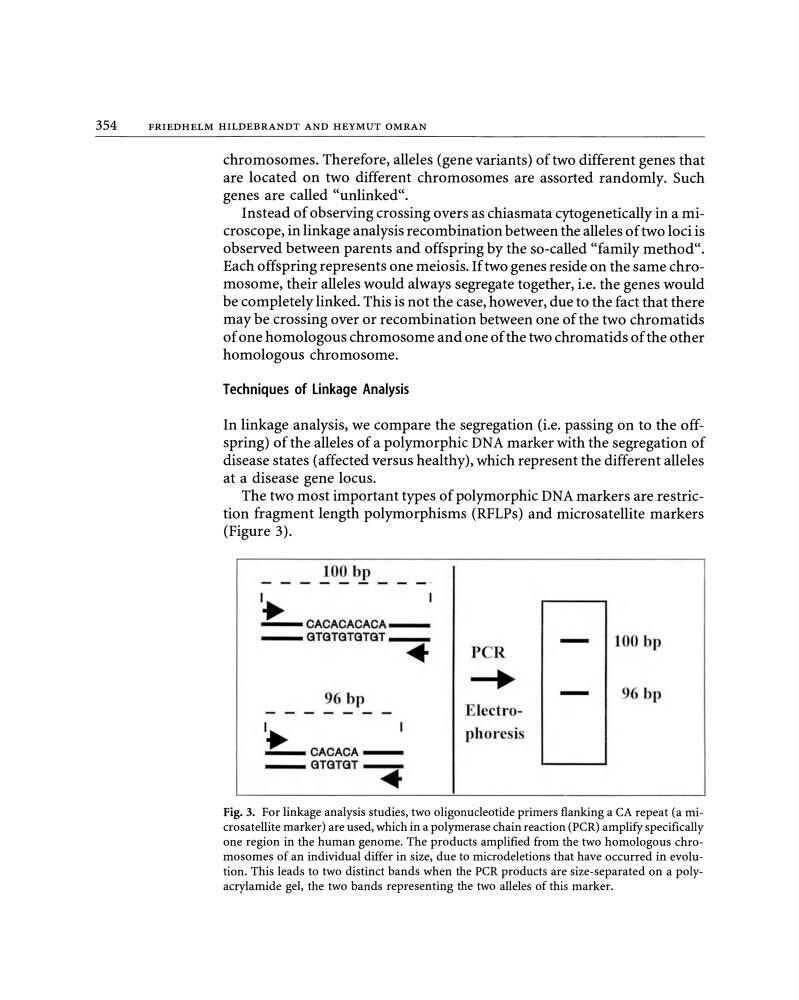
The two most important types of polymorphic DNA markers are restriction fragment length polymorphisms (RFLPs) and microsatellite markers
(Figure 3).
_!OQ_ b_p _
I
I
•
-
GTGTGTGTGT•
96 bp
I . I
-CACACA- G T GTGT
•
PCR
. .
Electrophoresis
- 100 bp
- 96 bp
Fig. 3. For linkage analysis studies, two oligonucleotide primers flanking a CA repeat (a microsatellite marker) are used, which in a polymerase chain reaction (PCR) amplify specifically
one region in the human genome. The products amplified from the two homologous chromosomes of an individual differ in size, due to microdeletions that have occurred in evolution. This leads to two distinct bands when the PCR products are size-separated on a polyacrylamide gel, the two bands representing the two alleles of this marker.
FRIEDHELM HILDEBRANDT AND HEYMUT OMRAN
chromosomes. Therefore, alleles (gene variants) of two different genes that
are located on two different chromosomes are assorted randomly. Such
genes are called "unlinked".
Instead of observing crossing overs as chiasmata cytogenetically in a microscope, in linkage analysis recombination between the alleles of two loci is
observed between parents and offspring by the so-called "family method".
Each offspring represents one meiosis. If two genes reside on the same chromosome, their alleles would always segregate together, i.e. the genes would
be completely linked. This is not the case, however, due to the fact that there
may be crossing over or recombination between one of the two chromatids
of one homologous chromosome and one of the two chromatids of the other
homologous chromosome.
Techniques of linkage Analysis
In linkage analysis, we compare the segregation (i.e. passing on to the offspring) of the alleles of a polymorphic DNA marker with the segregation of
disease states (affected versus healthy), which represent the different alleles
at a disease gene locus.
The two most important types of polymorphic DNA markers are restriction fragment length polymorphisms (RFLPs) and microsatellite markers
(Figure 3).
_!OQ_ b_p _
I
I
•
-
GTGTGTGTGT•
96 bp
I . I
-CACACA- G T GTGT
•
PCR
. .
Electrophoresis
- 100 bp
- 96 bp
Fig. 3. For linkage analysis studies, two oligonucleotide primers flanking a CA repeat (a microsatellite marker) are used, which in a polymerase chain reaction (PCR) amplify specifically
one region in the human genome. The products amplified from the two homologous chromosomes of an individual differ in size, due to microdeletions that have occurred in evolution. This leads to two distinct bands when the PCR products are size-separated on a polyacrylamide gel, the two bands representing the two alleles of this marker.