

21 Transgenie Animals
327
Southern Blot Analysis: Although Southern blotting is the most labor-intensive of the three methods, it is propably the most reliable way to prove the
integration of a transgene, especially if differentiation between a transgene
and a closely related endogenous gene is necessary.
Dot or Slot Blotting: Denatured undigested DNA is transfered to a solid
membrane and hybridization is performed. Although this method is propably the most convenient, it is only appropriate when the investigated gene
exists in a single copy in the animal' s genome. Therefore, dot or slot blotting
is best suitable when exogenous genes such as reporter genes are used as a
transgene or for assessment of the copy number.
Polymerase Chain Reaction: PCR also is a convenient and rapid method
to prove the presence of an inserted gene; DNA preparations that are oftoo
poor quality tobe used in Southern analysiswill still produce results in PCR.
However, as in dot and slot blotting, problems can occur if endogenous
sequences are present which are highly similar to the transgene. In PCR,
therefore, success depends on the ability of the primers to bind specifically
to the sequence of the transgene.
Applications
Use of other animal species in transgenic research
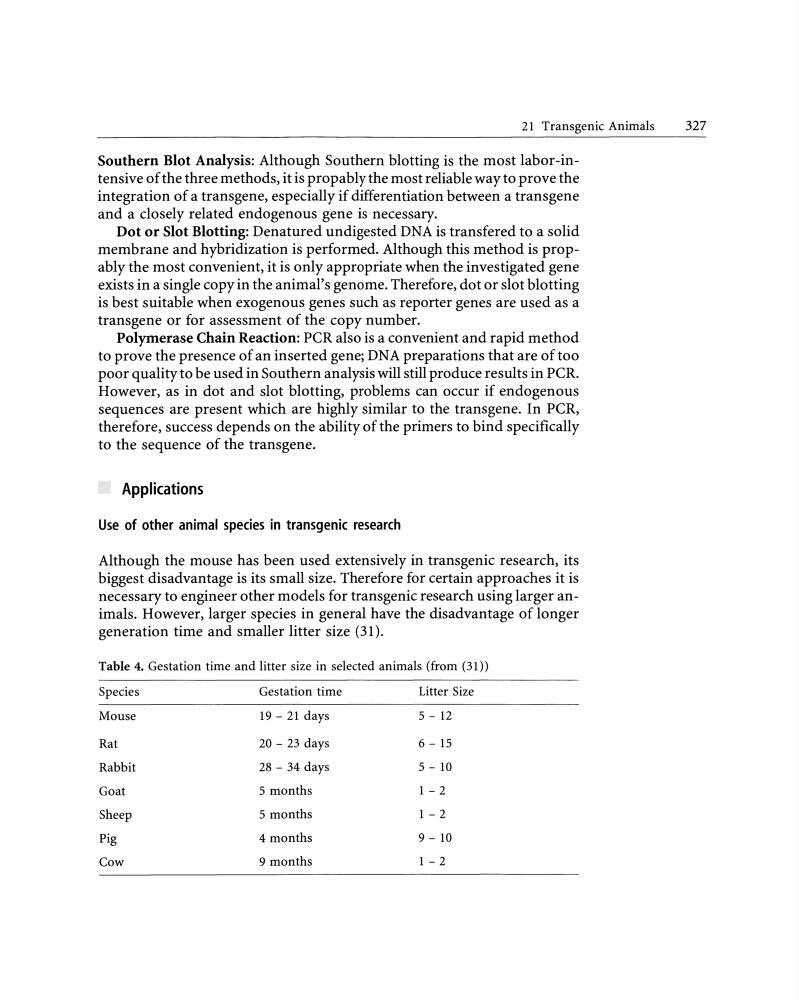
Although the mouse has been used extensively in transgenic research, its
biggest disadvantage is its small size. Therefore for certain approaches it is
necessary to engineer other models for transgenic research using larger animals. However, larger species in general have the disadvantage of Ionger
generation time and smaller litter size (31).
Table 4. Gestation time and litter size in selected animals (from (31))
Species
Gestation time
Litter Size
Mouse
19- 21 days
5- 12
Rat
20- 23 days
6- 15
Rahbit
28- 34 days
5 - 10
Goat
5 months
1-2
Sheep
5 months
1 - 2
Pig
4 months
9- 10
Cow
9 months
1-2
327
Southern Blot Analysis: Although Southern blotting is the most labor-intensive of the three methods, it is propably the most reliable way to prove the
integration of a transgene, especially if differentiation between a transgene
and a closely related endogenous gene is necessary.
Dot or Slot Blotting: Denatured undigested DNA is transfered to a solid
membrane and hybridization is performed. Although this method is propably the most convenient, it is only appropriate when the investigated gene
exists in a single copy in the animal' s genome. Therefore, dot or slot blotting
is best suitable when exogenous genes such as reporter genes are used as a
transgene or for assessment of the copy number.
Polymerase Chain Reaction: PCR also is a convenient and rapid method
to prove the presence of an inserted gene; DNA preparations that are oftoo
poor quality tobe used in Southern analysiswill still produce results in PCR.
However, as in dot and slot blotting, problems can occur if endogenous
sequences are present which are highly similar to the transgene. In PCR,
therefore, success depends on the ability of the primers to bind specifically
to the sequence of the transgene.
Applications
Use of other animal species in transgenic research
Although the mouse has been used extensively in transgenic research, its
biggest disadvantage is its small size. Therefore for certain approaches it is
necessary to engineer other models for transgenic research using larger animals. However, larger species in general have the disadvantage of Ionger
generation time and smaller litter size (31).
Table 4. Gestation time and litter size in selected animals (from (31))
Species
Gestation time
Litter Size
Mouse
19- 21 days
5- 12
Rat
20- 23 days
6- 15
Rahbit
28- 34 days
5 - 10
Goat
5 months
1-2
Sheep
5 months
1 - 2
Pig
4 months
9- 10
Cow
9 months
1-2