

326
ECKART SCHOTT, MARTIN PAUL AND DETLEV GANTEN
vessels of the ovarian capsule is a frequent problern in rats, whereas this
problern normally does not occur in mice. In rats, a few drops of epinephrine therefore are applied to the bursa ovaria, before the bursa is opened. A
glass transfer capillary is then inserted into the infundibulum and flxed in
position using a microforceps. To obtain a sufflcient number of progeny,
30-40 one-cell embryos or 15-30 two-cell embryos are typically transfered
bilaterally.
DNA analysis
If transgene integration occurs prior to the flrst cell cleavage, all cells of the
organism will contain the transgene and any tissue can be used for DNA
analysis. U sing small tail biopsies has proven the most convenient protocol,
biopsy is easy to perform and does not cause extensive harm to the animal. 1
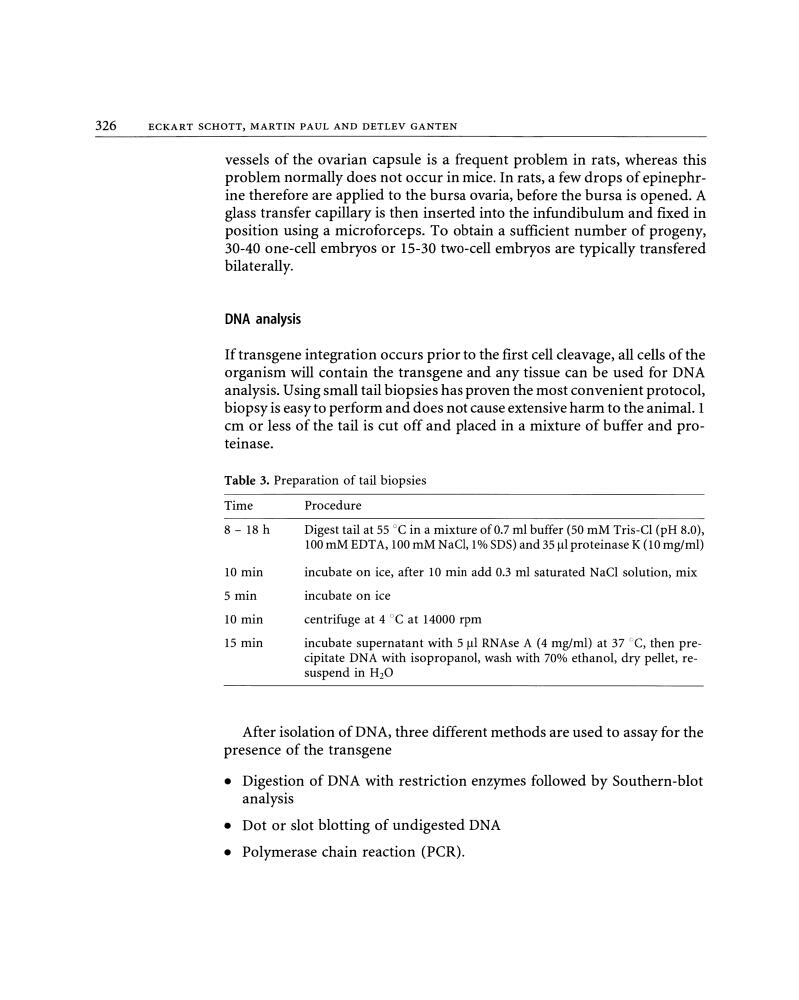
cm or less of the tail is cut off and placed in a mixture of buffer and proteinase.
Table 3. Preparation of tail biopsies
Time
8- 18 h
10 min
5 min
10 min
15 min
Procedure
Digest tail at 55 oc in a mixture of0.7 ml buffer (50 mM Tris-Cl (pH 8.0),
100 mM EDTA, 100 mM Na Cl, 1 o/o SDS) and 35 Jll proteinase K (10 mg/ml)
incubate on ice, after 10 min add 0.3 ml saturated NaCl solution, mix
incubate on ice
centrifuge at 4 oc at 14000 rpm
incubate supernatant with 5 Jll RNAse A (4 mg/ml) at 37 oc, then precipitate DNA with isopropanol, wash with 70o/o ethanol, dry pellet, resuspend in H20
Afterisolation ofDNA, three different methods are used to assay for the
presence of the transgene
• Digestion of DNA with restriction enzymes followed by Southern-blot
analysis
• Dot or slot blotting of undigested DNA
• Polymerase chain reaction (PCR).
ECKART SCHOTT, MARTIN PAUL AND DETLEV GANTEN
vessels of the ovarian capsule is a frequent problern in rats, whereas this
problern normally does not occur in mice. In rats, a few drops of epinephrine therefore are applied to the bursa ovaria, before the bursa is opened. A
glass transfer capillary is then inserted into the infundibulum and flxed in
position using a microforceps. To obtain a sufflcient number of progeny,
30-40 one-cell embryos or 15-30 two-cell embryos are typically transfered
bilaterally.
DNA analysis
If transgene integration occurs prior to the flrst cell cleavage, all cells of the
organism will contain the transgene and any tissue can be used for DNA
analysis. U sing small tail biopsies has proven the most convenient protocol,
biopsy is easy to perform and does not cause extensive harm to the animal. 1
cm or less of the tail is cut off and placed in a mixture of buffer and proteinase.
Table 3. Preparation of tail biopsies
Time
8- 18 h
10 min
5 min
10 min
15 min
Procedure
Digest tail at 55 oc in a mixture of0.7 ml buffer (50 mM Tris-Cl (pH 8.0),
100 mM EDTA, 100 mM Na Cl, 1 o/o SDS) and 35 Jll proteinase K (10 mg/ml)
incubate on ice, after 10 min add 0.3 ml saturated NaCl solution, mix
incubate on ice
centrifuge at 4 oc at 14000 rpm
incubate supernatant with 5 Jll RNAse A (4 mg/ml) at 37 oc, then precipitate DNA with isopropanol, wash with 70o/o ethanol, dry pellet, resuspend in H20
Afterisolation ofDNA, three different methods are used to assay for the
presence of the transgene
• Digestion of DNA with restriction enzymes followed by Southern-blot
analysis
• Dot or slot blotting of undigested DNA
• Polymerase chain reaction (PCR).