

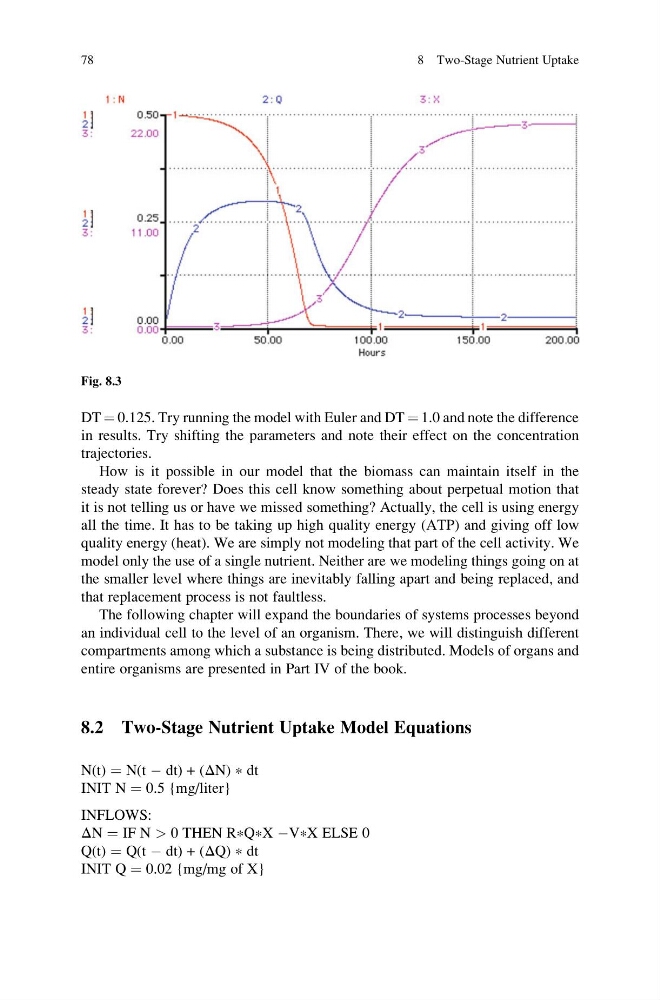
DT ¼ 0.125. Try running the model with Euler and DT ¼ 1.0 and note the difference
in results. Try shifting the parameters and note their effect on the concentration
trajectories.
How is it possible in our model that the biomass can maintain itself in the
steady state forever? Does this cell know something about perpetual motion that
it is not telling us or have we missed something? Actually, the cell is using energy
all the time. It has to be taking up high quality energy (ATP) and giving off low
quality energy (heat). We are simply not modeling that part of the cell activity. We
model only the use of a single nutrient. Neither are we modeling things going on at
the smaller level where things are inevitably falling apart and being replaced, and
that replacement process is not faultless.
The following chapter will expand the boundaries of systems processes beyond
an individual cell to the level of an organism. There, we will distinguish different
compartments among which a substance is being distributed. Models of organs and
entire organisms are presented in Part IV of the book.
8.2 Two-Stage Nutrient Uptake Model Equations
N(t) ¼ N(t À dt) + (ΔN) * dt
INIT N ¼ 0.5 {mg/liter}
INFLOWS:
ΔN ¼ IF N > 0 THEN R * Q * X ÀV * X ELSE 0
Q(t) ¼ Q(t À dt) + (ΔQ) * dt
INIT Q ¼ 0.02 {mg/mg of X}
Fig. 8.3
78
8 Two-Stage Nutrient Uptake
in results. Try shifting the parameters and note their effect on the concentration
trajectories.
How is it possible in our model that the biomass can maintain itself in the
steady state forever? Does this cell know something about perpetual motion that
it is not telling us or have we missed something? Actually, the cell is using energy
all the time. It has to be taking up high quality energy (ATP) and giving off low
quality energy (heat). We are simply not modeling that part of the cell activity. We
model only the use of a single nutrient. Neither are we modeling things going on at
the smaller level where things are inevitably falling apart and being replaced, and
that replacement process is not faultless.
The following chapter will expand the boundaries of systems processes beyond
an individual cell to the level of an organism. There, we will distinguish different
compartments among which a substance is being distributed. Models of organs and
entire organisms are presented in Part IV of the book.
8.2 Two-Stage Nutrient Uptake Model Equations
N(t) ¼ N(t À dt) + (ΔN) * dt
INIT N ¼ 0.5 {mg/liter}
INFLOWS:
ΔN ¼ IF N > 0 THEN R * Q * X ÀV * X ELSE 0
Q(t) ¼ Q(t À dt) + (ΔQ) * dt
INIT Q ¼ 0.02 {mg/mg of X}
Fig. 8.3
78
8 Two-Stage Nutrient Uptake