

the way in which MU is used in the ΔX and ΔQ equations. It is an interesting use of
a common variable. The ΔQ equation makes more sense if you multiply through by
X. Curiously, R * X and R * Q * X are not included in the ΔQ equation. The R factor is
apparently designed to represent the communication of the cell biomass to the main
nutrient source only. This fact, as with the definition of Q, is the likely result of
experimental measurement problems of the time.
In this model N and Q are concentrations. But they are different kinds of
concentrations. N is measured in mgN/liter, a volumetric concentration and Q is
measured in mgN/mgX, a mass-based concentration. It must be too hard to measure
the volume of a cell. The units are tricky. The units of the uptake rate for N, V are
mgN/mgX/hour, while the rate of formation and mortality of the biomass X are
1/hour. The units of MU are 1/time. Work out the units of ΔN, ΔQ, and ΔX to
make sure that they are consistent.
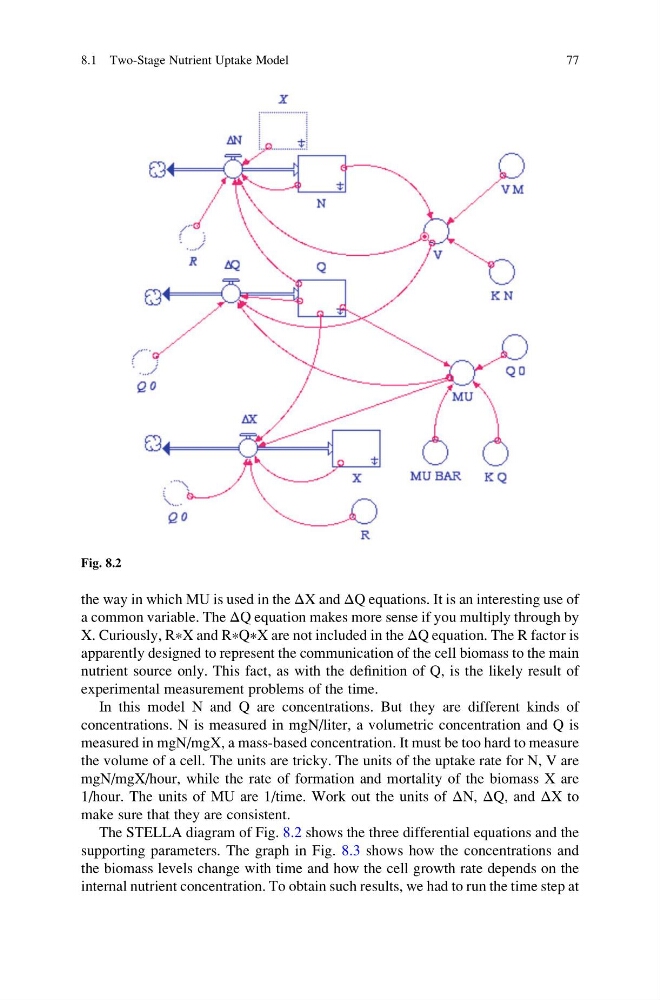
The STELLA diagram of Fig. 8.2 shows the three differential equations and the
supporting parameters. The graph in Fig. 8.3 shows how the concentrations and
the biomass levels change with time and how the cell growth rate depends on the
internal nutrient concentration. To obtain such results, we had to run the time step at
Fig. 8.2
8.1 Two-Stage Nutrient Uptake Model
77
a common variable. The ΔQ equation makes more sense if you multiply through by
X. Curiously, R * X and R * Q * X are not included in the ΔQ equation. The R factor is
apparently designed to represent the communication of the cell biomass to the main
nutrient source only. This fact, as with the definition of Q, is the likely result of
experimental measurement problems of the time.
In this model N and Q are concentrations. But they are different kinds of
concentrations. N is measured in mgN/liter, a volumetric concentration and Q is
measured in mgN/mgX, a mass-based concentration. It must be too hard to measure
the volume of a cell. The units are tricky. The units of the uptake rate for N, V are
mgN/mgX/hour, while the rate of formation and mortality of the biomass X are
1/hour. The units of MU are 1/time. Work out the units of ΔN, ΔQ, and ΔX to
make sure that they are consistent.
The STELLA diagram of Fig. 8.2 shows the three differential equations and the
supporting parameters. The graph in Fig. 8.3 shows how the concentrations and
the biomass levels change with time and how the cell growth rate depends on the
internal nutrient concentration. To obtain such results, we had to run the time step at
Fig. 8.2
8.1 Two-Stage Nutrient Uptake Model
77